


This article was first published on The Dispatch. It can be accessed on their website here.
Even during a period of unprecedented political events witnessed by the British public, the idea of a regional mayor using a single local election to effectively unseat the prime minister seems shocking. But that’s exactly what happened in the U.K. last week.
On June 22, Keir Starmer announced, after serving less than two years as prime minister, that he would vacate No. 10 Downing Street.
Now Andy Burnham, who until last week was the mayor of Greater Manchester, is suddenly on course to become the country’s next leader.
Starmer’s resignation came after months of intense pressure from fellow Labour Party members of Parliament over his handling of various issues: the appointment of Peter Mandelson to the position of ambassador to the U.S. despite Mandelson’s prior relationship with Jeffrey Epstein; embarrassing U-turns on key welfare and pension reforms; the Labour Party’s languishing favorability among the British public; and the recent resignations of Defence Secretary John Healey and Armed Forces Minister Al Carns—both of whom stepped down to protest Starmer’s agreement to a defense spending plan that offered substantially less funding over the next four years than had been requested.
But as Burnham—the so-called “King of the North” (a nickname that any politician would envy)—takes the reins in Westminster, he will do so during a period of unusual volatility for the office of prime minister. Since Conservative David Cameron’s resignation in 2016 following the U.K.’s vote to leave the European Union, five prime ministers have occupied Downing Street—and each for no more than a few years. Cameron’s successor, Theresa May, served for only three years before being deposed for failing to deliver on Brexit promises. Boris Johnson’s scandal- and sleaze-marred premiership then lasted only slightly longer before giving way to that of Liz Truss, who herself survived for only 50 days before backlash to her “mini Budget”—a 45 billion pound (equivalent to $60 billion) package of largely unfunded tax cuts, alongside a subsidy for each household’s energy costs following a spike in prices during the Ukraine War—sent her packing. Rishi Sunak lasted less than two years before leading the Conservative Party into a general election that produced its worst result in modern history. And when Starmer announced his imminent resignation last week, his brief spell as leader of a Labour government had similarly lasted less than two years.
Most in the U.K. recognize that frequently changing prime ministers between general elections—which must occur within five years of the preceding general election—is not a strong and stable way to run a country. Yet almost no one agrees on how to fix the problem. Some argue that the U.K. is simply ungovernable and that Britain’s parliamentary system is no longer fit for purpose. Some propose that a political party in control of Parliament should commit to calling an election when it seeks to change its leadership, or even that this requirement should be written into law. Others argue that the country’s first-past-the-post electoral system—which elevates candidates to office even if they win only a plurality, but not a majority, of the vote—should be scrapped to achieve a more enduring democratic mandate for prime ministers.
But many of these arguments are focused on addressing the symptoms of the U.K.’s political and economic problems, not the underlying disease itself.
What is that disease? As a result of decades of state overreach and ever-growing state spending commitments, the U.K. is on the brink of fiscal collapse. The cost of the country’s public services and welfare spending has swelled without the necessary economic growth or expanded tax base to support it. Britain is facing a paralyzed planning system, historic tax highs, declining productivity, and a persistent fiscal gap. Meanwhile, the country’s bureaucracy is ballooning, both in central government and the quasi-autonomous nongovernmental organizations—known in the U.K. as “quangos”—that operate at arm’s length from direct political control, but are funded by taxpayers and carry out legislative governmental duties. And despite record funding for public services like the National Health Service (NHS), the quality of many of those services appears to be in terminal decline.
The issue facing the U.K. is not that it is changing prime ministers too often, or that every one of our prime ministers over the past decade has somehow not been up to the job. The problem is that every one of those prime ministers has refused to confront Britain’s harsh economic reality. And until the country’s leaders are willing to take drastic measures to address that reality, they will continue to try—and fail—in leading the country into greater prosperity.
During Starmer’s time in power, both the U.K.’s public-sector spending and its tax burden reached record highs. Yet public services still don’t seem to work. For example, waiting lists for the NHS are enormous—around 2.5 million patients in England are waiting more than 18 weeks for elective treatments recommended by their doctors. Excessive regulatory burdens are also strangling the British economy. State infrastructure projects take decades to build and, even when they run significantly over budget, often end up being scaled back. And in London, even during a widespread housing availability and affordability crisis, homebuilding has fallen by 84 percent in only a decade, largely due to a failure to reform the planning system, which has acted as a chokehold on new housing developments. The U.K.’s planning system is based on the 1948 Town and Country Planning Act, which was intended to build whole new towns following the bombing destruction of World War II, not to allow urban cities to grow and expand to meet their population needs.
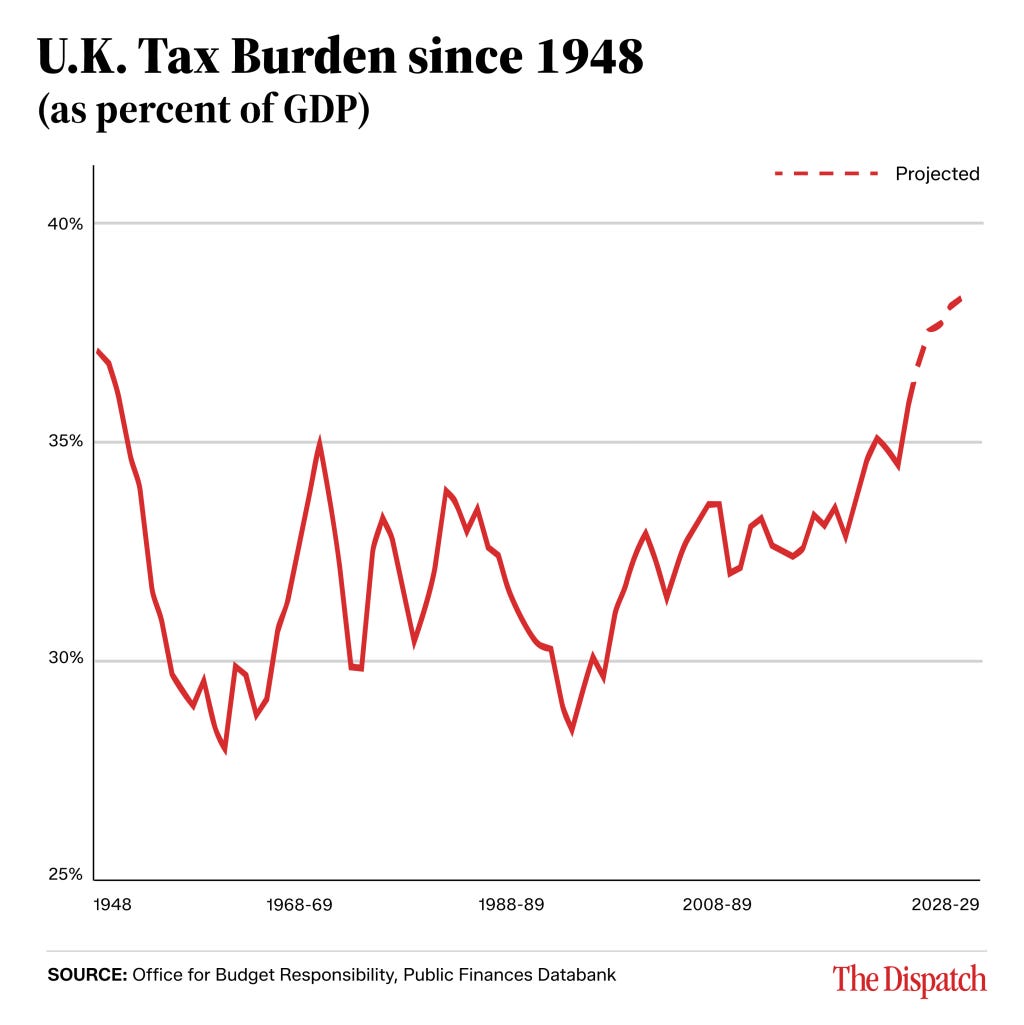
Britain’s National Insurance Fund—the fund used to pay the country’s state welfare—also appears to be in trouble. In a 2020 review of the fund, the Government Actuary’s Department projected that the U.K. would effectively default on its welfare spending commitments, including those related to pensions, in less than 20 years. But the reckoning could come even sooner: The review took place before U.K. welfare spending ballooned even further under Starmer. And overspending isn’t just a Labour Party issue: Tax burdens and public-sector spending also rose under the leadership of Conservative prime ministers. The U.K.’s total tax-to-GDP ratio in 2023, for example—under Sunak’s Conservative government—was 35 percent. By comparison, the United States’ total tax-to-GDP ratio at the same time was only 25 percent.
In fact, public spending as a share of Britain’s GDP hasn’t fallen below 34 percent since before World War II, and only once—under Margaret Thatcher—was there a serious attempt to constrain the state. Even Cameron’s 2010–2015 “austerity” plan only managed to bring down public-sector spending as a share of GDP to the size it was three years before the plan started. By 2025, government spending accounted for more than 44.5 percent of GDP. This is a level that previous generations would have considered necessary only in wartime. Other than a temporary rebound following the lifting of COVID-19 lockdown restrictions, the U.K. economy has not grown by 3 percent or more since 2017. Last year, GDP only grew by 1.3 percent despite government spending increasing by 5 percent during the same period. Since 2021, the U.K.’s annual productivity growth has averaged less than 1 percent.
These financial woes are not unknown to the British public. In a January 2026 survey by the Institute of Economic Affairs, 67 percent of respondents said that Britain was heading in the wrong direction and 87 percent said that the U.K. should focus more on economic growth. But even then, respondents dramatically overestimated the U.K.’s economic position relative to other countries. When asked to compare the U.K.’s per capita GDP with the 50 U.S. states, for example, respondents guessed that the U.K. was wealthier than all but six of them. In reality, however, the U.K.’s per capita GDP is lower than that of every single American state, including states like Alabama, Mississippi, and Arkansas.
Politicians may be making promises that the state cannot deliver, but they often do so because the British public demands it of them. As someone who has worked in the British Parliament and run election campaigns, I can tell you these demands are ever-present. Both politicians and the public are as bad as each other. Politicians need to tell the British public the real truth about our financial situation and the drastic change necessary. And the British public must come to the realization that its constant demands for greater state action and state spending on almost every issue are bringing Britain to ruin.
Starmer ran on a cautious manifesto that promised change but spelled out little of how that change would be implemented. He seemed to genuinely believe that the country was heading in the wrong direction simply because of Conservative Party mismanagement. All that was needed, in his and the Labour Party’s eyes, was for the adults to be back in charge. But Starmer, like his predecessors in Downing Street, failed to understand Britain’s harsh fiscal reality.
The major issue holding Britain down is not Brexit—as many on the left claim. Nor is it immigration—as many on the right do. As economists like Julian Jessop have suggested, economic indicators do not suggest that Brexit has had a measurably negative effect on the U.K.’s economic situation. And while immigration has played a minor role in increasing the costs of the British welfare system and public services, it is not the protagonist. Instead, Britain needs to confront that its decades of unfunded spending commitments have created obligations that cannot be met by any sustainable taxation system or debt burden. This requires fundamental restructuring of the welfare state and government commitments, not tinkering at the margins as successive prime ministers have done. The country’s pension system requires immediate reform that stops inflation-busting increases; the NHS must transition to an insurance-based model like that used in the Netherlands or Switzerland; the welfare system must be significantly reformed with far stricter requirements for welfare recipients; and the vast apparatus of regulations, regulatory bodies, and bureaucrats—those that prevent us from building anything anywhere in Britain—must be drastically cut.
Time and again, the country’s leaders have promised the world to the British people—from Johnson’s “Levelling Up” agenda and Sunak’s five promises to Starmer’s commitment to put growth at the heart of his government. But even with the promises of hardworking politicians, the U.K.’s growth remains sluggish and living standards continue to fall. The British government now spends about as much on interest payments on its debt as it does on the country’s entire education system. Yet successive prime ministers have done little to rein that spending in.
The choice facing the U.K. is either voluntary reform now or involuntary collapse later. We must either implement drastic spending cuts or accept the inevitable collapse of the British economy and the welfare state. That economic reality is why Britain churns through prime ministers—they all enter office making promises that our fiscal situation will not allow them to keep. But dumping one prime minister who is unwilling to address these challenges for another who is equally unwilling to face them will do nothing. It is the equivalent of scrubbing the decks on the Titanic as the ship is already sinking—it might make the ship look better momentarily, but we’re all still going down.
The U.S. should take what is occurring in Britain as a warning of what happens when fiscal reality is ignored. Successive U.K. prime ministers have tried to square an impossible circle: the promise of Scandinavian-style public services to a demanding electorate in the face of weak productivity growth and an overcommitted state. We have seen members of Parliament turn on their leaders in the hope that a new face may somehow be able to wish away the same problems that led to the previous leader’s departure. The root of our prime ministerial carousel is not individual failures; it is a total economic model that cannot and will never deliver what it promises.
America is not yet where Britain is, but it is heading down the same path. Debt is rising and there are growing entitlement pressures. U.S. publicly held debt has exceeded 100 percent of GDP for the first time in 80 years. Yet Congress is dominated by a bipartisan refusal to confront the significant gap between what the politicians promise and what the real economy can sustain. Federal government interest payments have already reached the same level as defense and education spending combined. The same problems that have driven British political instability are quietly taking root in Washington. Britain’s experience has made clear that you can ignore economic realities for a time, but you will never be able to escape them. The U.S. should heed our warning from across the Atlantic. You do not want to join Britain on the edge of economic breakdown.
In less than three weeks’ time, the U.K. will see its seventh prime minister in 10 years. Andy Burnham will be a better communicator than his predecessor, but will do little to address the root problems causing Britain’s decline. Over the next few weeks, Burnham is due to make a series of speeches setting out his policy platform. Those policies may include raising capital gains tax, devolving greater powers to city mayors, and implementing a universal social care system. None of these policies—and little in Burnham’s recent speeches or actions as the mayor of Greater Manchester—suggest that he will implement the broad cuts, reforms, and spending discipline needed to right the fiscal ship. Britain is on the brink of fiscal collapse, and until its prime ministers, Parliament, civil service, and voters reckon with that reality, the carousel of British leaders will continue to spin.
Harry Richer is the director of Fighting for a Free Future, under Chairman the Rt Hon Steve Baker. He has worked as a senior aide in the British Parliament and has also co-written multiple publications on Austrian School economics, including the 2024 Springer book The Age of Debt Bubbles.
This article was first published on The Dispatch. It can be accessed on their website here.