


As the Labour Party Conference gathers in Liverpool, plans for a publicly funded National Care Service raise a wider issue about the role of the state in managing life’s risks. Jilan Shah considers a profound and too-often ignored question: whether an expansive welfare state is even compatible with a free and prosperous democracy.
If you ask someone on the street what actually matters to them, you won’t hear about GDP targets or government metrics. You’ll hear about prosperity, real achievement, feeling safe, saying what they think without fear, and the simple dignity of building a life on their own terms.
Yet slowly, under the banner of keeping us safe, government intervention, spending, regulation and bureaucracy has been quietly reshaping the way we live with increasing central planning and restrictions on personal freedoms.
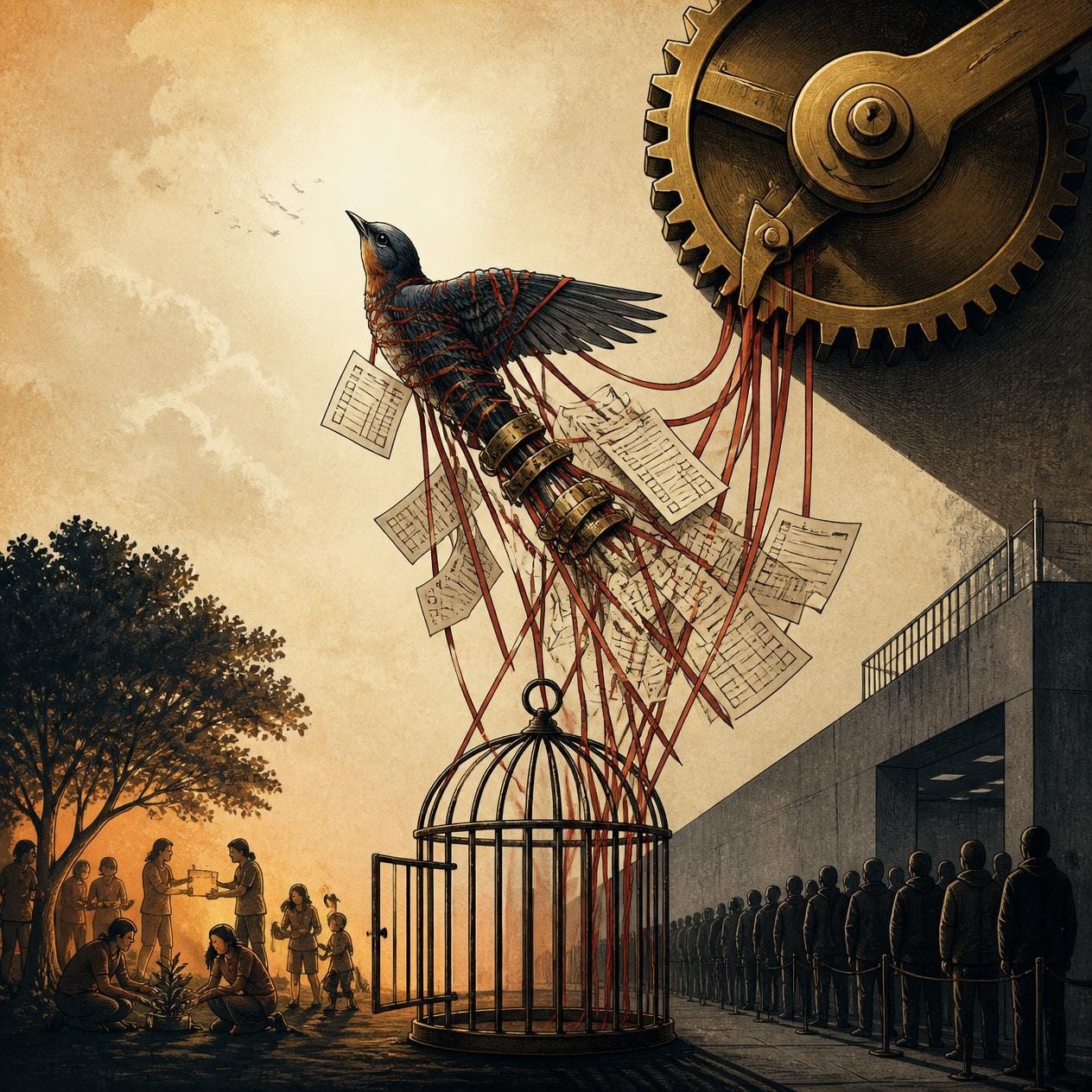
Walk into any political debate today, and it feels like watching two people argue over who gets to drive a car that’s running out of fuel. Both promise a smoother ride, but neither is willing to open the hood to see if the engine is actually running nor accept that freedom is the best and most sustainable fuel.
How we are defining a free society
We are using a classical liberal definition of freedom in the negative sense. An individual is free to make their own choices and is responsible for the consequences. The law exists only to protect those freedoms and restrain other individuals and governments from coercing, stealing from or arbitrarily controlling them. Please see post below on The Principles for a Free Society.
The Principles for a Free Society

“Among the laws that rule human societies there is one which seems to be more precise and clear than all others. If men are to remain civilised or to become so, the art of associating together must g…
Why is freedom and a free society important
Individuals are unique and thus create very diverse societies which they form through mutual cooperation. An individual can be a member of multiple societies by virtue of their different interests and lifestyles. It is inevitable then that individuals and societies will have very different views about what a “good life” is.
So, liberty in the negative sense allows individuals to coexist in different groups all pursuing happiness in their own way without the need of an official vision of virtue, religion, culture or values enforced on them. A free society treats adults as individuals capable of making their own choices in their individual pursuit of their own “good life” and are held responsible for the consequences of those choices.
The state’s legitimate role in a free society is to protect individual liberty and prevent coercion.
How does welfare fit into the story
We are all blessed with different talents and abilities however there are individuals who are less fortunate to suffer in the longer term from a physical / mental / other disability or in the shorter term a temporary setback such as an illness or loss of employment.
Kindness, fairness and compassion are among the hallmarks of a civilised society which is able to provide support to those in genuine need. Most people are naturally moved by stories of fairness and kindness and reasonably believe that the strong should help the weak and the fortunate should support the less fortunate.
The moral value of any assistance or helping hand to our fellow human beings lies in the voluntary character of the action. Generosity, compassion, personal sacrifice for the benefit of others are virtuous actions only when they are freely chosen. If they are coerced or compelled they cease to be virtuous and it becomes merely extraction.
Furthermore, we have for a long time conflated state with society and hence confused or blended the role of the state. The state has a monopoly on force and coercion while society is voluntary. We are going down a dark road by believing that the state can be a substitute for society and hence should constantly intervene in people’s lives to correct perceived inequities and deliver social justice. Welfare delivered as enforceable entitlements changes society from a free society based on voluntary cooperation to one defined by political allocation which goes beyond the legitimate role of the state.
This isn’t just about personal welfare, it is across the entire political economy. Long before the state offers a hand to a struggling family, it hands out subsidies, tax loopholes, and regulatory benefits to big corporations, financial institutions, and well-connected groups. When government possesses the authority to redistribute trillions, politics inevitably becomes a contest of who can lobby the hardest and inevitably the system serves the powerful and politically well-connected who will always win that game over the general public.
Challenges with the Robin Hood story we’re told and keep reinforcing
When a government starts to intervene and engage in redistribution and social engineering to reshape society, some predictable dynamics tend to kick in:
Voters learn they can use the ballot box to secure benefits for themselves.
Politicians learn they can use spending promises and regulation to buy voter support and loyalty.
Over time, a powerful narrative develops to justify redistribution.
The costs are diffused across a much broader population – so the full trade-offs are rarely confronted honestly.
The government is expected to continue to engage in redistribution at an even larger scale
It’s extremely easy and lucrative to support benefits, be they in the form of rights, grants, subsidies, regulations or individual welfare payments, so long as the public doesn’t ask or want to understand some basic questions: Where does the money come from? Who is paying? What incentives does this create? What does it do to the culture over time?
A society can survive a fair bit of political turmoil in the short term, however in the long term it appears to be virtually impossible to survive a system of redistribution which steadily divides the population and society into warring groups competing to determine who gets the benefits and who bears the burden.
How redistribution forms a one-way ratchet which continually erodes individual liberty
The desire to create entitlement for a safety net comes from a genuine desire for human decency. In theory, a strictly limited safety net acts like an insurance policy - a temporary fallback for those hit by sudden misfortune, designed to restore dignity and independence without distorting the broader market.
The fatal flaw, however, is not in the intent of the safety net, but in the inherent mechanics and incentives under a democratic system. A limited safety net requires political restraint, but modern democratic politics contains no mechanism for restraint. The moment a safety net is institutionalized as a state-managed entitlement, it ceases to be a fixed safety net and becomes an open-ended political prize. What begins as a compassionate floor quickly becomes an expanding ceiling as politicians compete to broaden eligibility, increase payouts, and redefine basic human comfort as an enforceable right.
Take the Winter Fuel Payment for example. It was introduced in 1997 as a targeted help for pensioners struggling with heating costs. Within a few years it became universal, regardless of need. The most recent attempt to means-test it became politically toxic and was branded as taking money from pensioners to freeze. What began as compassion has become an untouchable entitlement.
The strongest objection:
Wouldn’t the vulnerable fall through the cracks without state entitlements and support?
History suggests otherwise as explained in David Green’s 1985 book Working Class Patients and the Medical Establishment and summarised here Cobden Centre - Working Class Patients and the Medical Establishment.
Before the welfare state, we had a network of friendly societies, mutual aid organisations, cooperatives etc - all voluntary institutions. They were accountable, local and didn’t create a permanent political incentive to expand.
The problem is not that helping the vulnerable is wrong; it is that a state-managed safety net structurally cannot remain small.
So, once a redistributive state is established, it tends towards forming a self-reinforcing coalition. People who depend on government programmes – directly or indirectly – will naturally support any system and politician who is most likely to preserve those programmes. It’s not malice; it’s just human nature.
Few people vote to burn the bridge they’re standing on especially once so many have become used to the government programmes and institutions e.g. The NHS, the State Pension, Free Schools, etc. We have become so accustomed to these institutions that we can’t imagine an alternative without them and hence the sub-optimal outcomes persist e.g. the idea of not having a centrally planned and funded NHS or state schools brings up visions of no healthcare or education provision for the public.
Over time, this produces a one-way political ratchet:
It’s politically rewarding to keep growing government with more market interventions and social programmes.
It’s politically suicidal to shrink the state and scale back these social programmes if not remove them completely.
Even when politicians and political parties campaign on measures to reform the system, the incentives within the system have been seen to prevent and even punish meaningful reform and rollback. Rhetoric changes; the basic direction often doesn’t as evidenced by recent history.
As more groups become beneficiaries (e.g. pensioners, public sector workers, businesses receiving subsidies, individuals not in employment) the system becomes constrained by one overriding requirement: keep the coalition of net beneficiaries satisfied. Meanwhile, the productive side of society carries an ever-growing load – taxes, regulation, compliance, inflationary financing – often while being told that questioning any of it is immoral. The question is not whether there should be help, but whether help should take the form of politically competitive entitlements aimed at outcomes.
Frédéric Bastiat once wrote that “The government is the great fiction by which everyone endeavors to live at the expense of everyone else.”
Why better leaders won’t fix a system where political incentives corrupt good intentions
The prevailing political debate revolves around the core issue being who holds power: the right leaders or the wrong leaders, the right party or the wrong party, the right policies or the wrong policies.
What if our current parliamentary democracy contains incentives that consistently produce outcomes we claim to dislike: living standards that slip over time, basic public services that don’t work as they should, and a political culture that hardens into a bitter “us vs. them” fight?
Why do voters keep supporting policies (whether by nudges or outright bribes) that are fiscally unsustainable and culturally unstable in the long run?
Have we got a system that rewards extraction over value creation, encourages dependence rather than resilience, and makes meaningful reform not just difficult but structurally unlikely?
A free society doesn’t appear to be compatible with state welfare and social engineering
If the argument so far is right, then an uncomfortable conclusion is not that compassion is wrong but that state entitlements delivered through a system with mass democratic policies where benefits can be voted up while costs are dispersed and a government empowered to engage in broad social engineering and redistribution is inherently unstable.
Why? Because the electorate is always incentivised to vote itself benefits financed by others, and politicians are always incentivised to compete to offer even more benefits to gain favour. That combination invites permanent escalation. Over time, this produces a ratchet: expansion is rewarded, restraint is punished, and reform becomes politically near-impossible.
The result is a state that grows in power and a society in which liberty steadily narrows. The more power the state has, the more dangerous it becomes – regardless of who holds office.
So if we agree that the democratic system has flaws and that we want to address the broken incentives without giving up on the benefits of democracy itself then we need to face up to the reality that the current system eventually leads to self-destruction.
Public Choice Theory provides perspective and insights
Public choice theory, developed by James Buchanan and Gordon Tullock, offers a useful framework for understanding the dynamics between voters and politicians. Public choice assumes politicians, bureaucrats and voters are motivated by the same incentives and constraints as other individuals. In this view, the state is not a neutral actor implementing policies for the public good, but an institution whose members respond to incentives - seeking power, career stability and electoral success.
From this perspective any government in power faces enormous pressure from entrenched interests - civil servants, public sector unions, big business, special interest lobby groups, the media and international institutions.
The result is a form of policy convergence. The past 30 years confirm that we have been governed within a narrow range, with politicians and government only tinkering at the edges rather than undertaking fundamental reform.
The topic has been covered in more detail in the following posts:
Why politicians so often fail us all

Introducing public choice theory - politics without the romance
Book club: public choice and journalists

Last night, Book Club discussed the immensely insightful field of public choice theory, which applies insights and methods from economics to explain political and official decision making, together w…
Fighting for a free society is an imperative but will not be easy
Even if you accept the diagnosis, moving towards a free society is not an easy journey.
A large state won’t shrink quietly. Coalitions, built on benefit recipients, will fight tooth and nail to preserve them. And as pressures rise, politics becomes more bitter, more coercive, and people within become more willing to cross lines to maintain control.
No political party seems to want to shrink the state and move towards a free society. Those that are talking about cuts to welfare are merely proposing slowing the growth of welfare spending.
And given politicians try to deliver what the public want, perhaps the hardest challenge lies with us culturally where the public always looks to the government for solutions to all problems with a ‘something must be done’ attitude to any challenge. It’s far easier for people to believe that the problem is the wrong leaders than to convince themselves that the incentives of the system itself are broken.
The structural conflict of interest in voting on the expansion of government spending will need to be addressed. It’s simply not possible to stop the expansion of government as long as this conflict of interest persists which is evidenced by the growth of the state under both Labour and the Conservatives.
Bread and circuses are politically easy to provide. Taking them away is not.
Attribution
This post is based on ideas and phrasing from Julius Ruechel (https://www.juliusruechel.com/) and Steve Baker, Harry Richer and Liam Shearer from Voices for a Free Future.
