


Many free-market thinkers see trade unions as the enemies of the market economy. That scepticism is understandable, since unions have often been closely aligned with the Labour Party and, at their worst, have used industrial action to impose costs on businesses and the wider public. Closed-shop arrangements, pressure on members to strike, and pressure on non-members to join increase that scepticism.
However, if we agree that the frontiers of the state must be rolled back in the interests of liberty, then civil society must be empowered to fill the gaps left by the state. Voluntary, democratic unions give workers a real ability to bargain directly with their employers. By creating a channel for negotiation, unions can encourage a more constructive relationship between employers and employees without transferring decisions over pay and conditions to the state.
Voluntary association, not central control
Hayek in The Constitution of Liberty and many other writings warned that unions with coercive privileges risk becoming labour-market monopolies that override individual choice and weaken competition by restricting the supply of labour to raise wages. He argued that unions with these privileges could pressure workers into joining them and intimidate them into following union directives.
A voluntary union is not the same as advocacy for state-set wages or nationalisation. Instead, a voluntary association gives workers a means of negotiating with their employer over wages and conditions under which they sell their labour. By empowering civil society, voluntary collective bargaining balances power between workers and employers without transferring the outcome to the state.
Adam Smith in The Wealth of Nations identified a different danger; he claimed that in his day, the law prohibited workers from combining to raise wages, whilst employers tacitly agreed not to raise wages. This meant that bargaining power was heavily shifted to employers. In disputes, Smith argued that employers could hold out in negotiations with individual workers as they could survive on their accumulated stock, whilst many workers could not subsist for a week without a wage.
Smith and Hayek each identify a real danger. Hayek illustrates how unchecked union power can weaken market competition and individual liberty. By contrast, Smith argues that unchecked employer power can weaken workers’ bargaining position. The balance must be found: workers must be free to join a union, refuse to join one, and choose whether to participate in industrial action. That is why the case must also be made for limits on union power– a principle that shaped Thatcher’s union reforms.
Thatcher’s reforms: freedom needs limits
Unions can help workers but, as Hayek argued, they must not override workers’ individual liberty. Thatcher’s reforms targeted the coercive privileges of unions that Hayek warned could turn them into labour-market monopolies; she curbed closed-shop arrangements, restricted secondary action, and required secret ballots before official industrial action. These changes protected a worker’s right not to join a union, prevented unrelated firms and workers from being drawn into disputes, and ensured that industrial action required a clear mandate from the members affected. This strengthened individual liberty by making unions accountable to their members and democratic in their strike decisions.
Most workers genuinely want to work, earn money and support their families. Industrial action can be legitimate, but it should be a last resort authorised through a properly conducted ballot of the members being asked to take part. A ballot gives a union a mandate to strike, but it does not mean that every individual will choose to take part. This is where Thatcher’s reforms were successful and genuinely beneficial to workers: they shifted authority from union leadership to ordinary members. But they also increased the legitimacy and credibility of strikes because the new conditions communicated a clear message to employers that the action had genuine member support.
Thatcher’s principles should still apply today. However, the Employment Rights Act 2025 has diluted them. The standard ballot mandate now lasts for 12 months, replacing a 6-month period that could previously be extended to 9 months by agreement. This arguably shifts power from workers back to union leaders because it allows them to rely on a mandate whose current support has not been retested.
In any free society, unions must be tolerated and recognised as an integral part of civil society. Still, it is equally important that those unions remain accountable to their members and truly representative of their wishes.
A free market needs competition for workers
A free-market economic model assumes that competition works in both directions. Employers aim to attract and hire the best candidates, while workers compete for better jobs. In a dynamic economy, individuals are free to leave their jobs if they feel they are underpaid or face poor conditions.
However, this is not always what happens in practice. In many areas, workers have only a few realistic employers to choose from. Those with children, mortgages or limited access to transport may be especially constrained because they cannot afford to lose the wage on which they depend. If alternative employment is available, conditions and pay may be worse, and relocation may be necessary.
The CMA found an association between employer concentration and lower pay: comparable workers in the most concentrated tenth of UK labour markets earned, on average, around 10% less than those in the least concentrated tenth. The CMA’s research also suggests that collective bargaining can counter downward pressure on pay within concentrated private-sector labour markets.
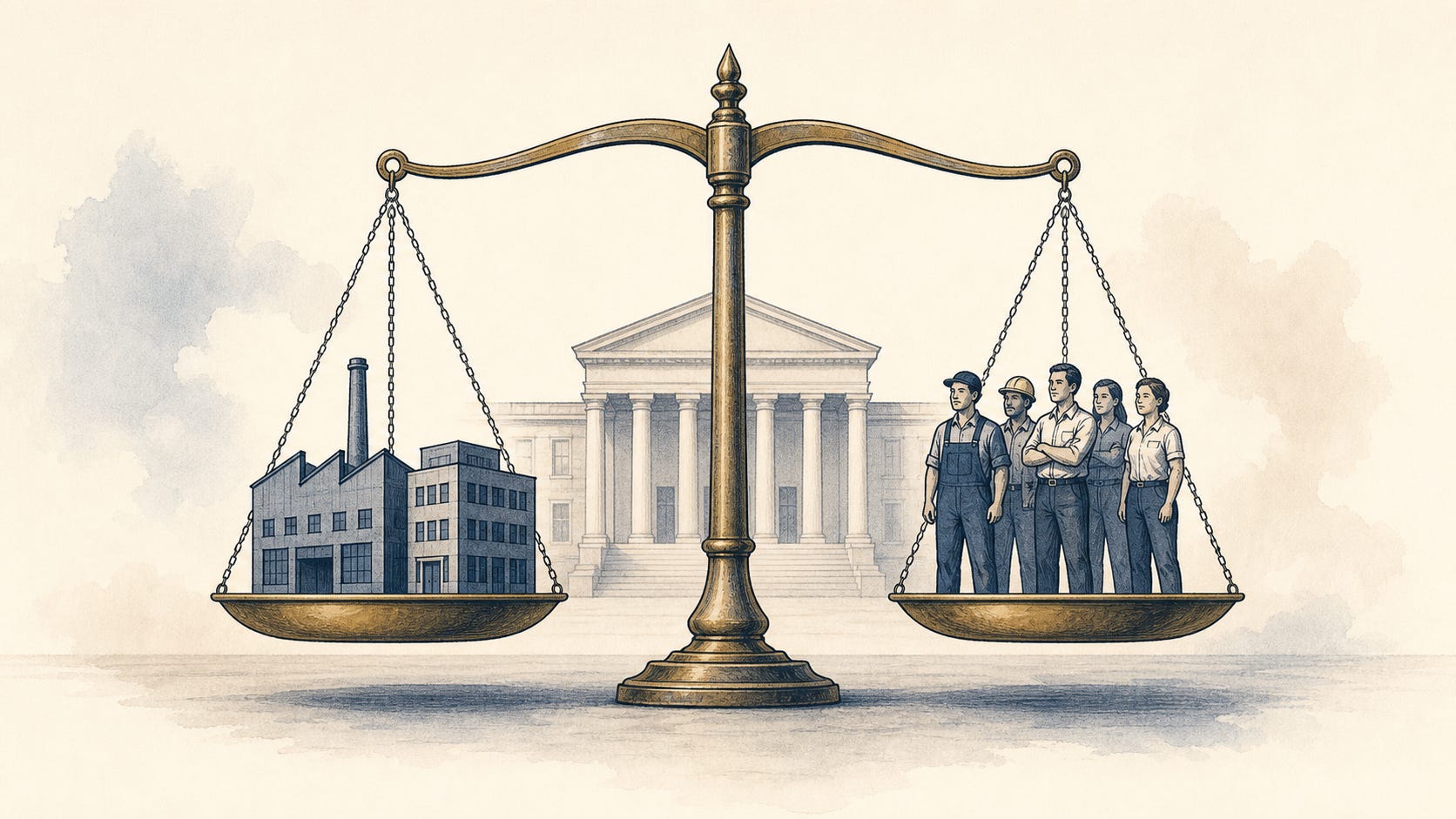
Unions do not create additional employers, but in these circumstances, they can pool workers’ bargaining power to support a selection of individuals who would otherwise be bargaining alone. This is important because freedom of contract means little when bargaining power is concentrated on only one side.
The state as referee, not a player
The state must act as a defender of rights and a referee in disputes. This means protecting workers from employer retaliation, unlawful dismissal and breaches of contract, while also protecting employers from union intimidation and unlawful industrial action. This ensures that collective bargaining remains a means of balancing the power of workers and employers rather than an instrument of coercion.
Once the state moves beyond enforcing the rules to determining pay or funding, it ceases to be wholly neutral and acquires a stake in the outcome. The planned Adult Social Care Fair Pay Agreement process in England shows how quickly this can happen. An arm’s-length body will conduct the negotiations between worker and employer, but the Secretary of State will set the remit and maximum funding available, while any agreement will be reviewed before ratification in Parliament. These responsibilities give the government a material interest in the result and distort accountability; employers remain formally responsible for pay, but the state sets the funding limit and retains the power to ratify the settlement.
Within a genuine free market, the state should protect the process of negotiation rather than determine its outcome.
Conclusion
Free-market advocates are justified in their scepticism of unions; unchecked unions can overpower employers in negotiations and exert significant influence over sectors of the economy. However, they are a necessary counterweight within a genuinely free-market society; within such a society, both employers and workers need meaningful bargaining power to ensure that contracts are not dictated by either side.
Hence, the state should enforce the rules fairly, rather than determine wages or settlements. Unions can create a direct channel for negotiation between workers and employers. When the state determines pay and conditions itself, it displaces that negotiation and acquires a material interest in its outcome.
Liberty also requires limits on union power. Closed-shop tactics must remain prohibited, secret ballots must remain mandatory, and ballot mandates should be restored to a six-month default. Under these conditions, industrial action is more likely to represent workers’ contemporary wishes rather than serve as a strategic tool for union leaders.
When properly limited, unions are not an enemy of the free market; they are a cornerstone of civil society that makes the free market possible.
Harry Curtis is a student at the University of Warwick, reading politics and international relations. He has worked and run campaigns for the Conservative Party, including during the 2024 General Election.

Completely agree. Unions as with businesses and government can be a force for good as well as essentially a fascist organisation if they have too much power. I’ve encouraged my youngest daughter, who is a careworker, to belong to a union because they are treated appallingly and all too often endure owners that exploit them and poor quality management. Conversely closed shop unions and ones where the members they supposedly serve are punished for critical views need radical reform - as experienced by Lord Tebbit in his early career which influenced his subsequent politics.