


Eve Lugg is a Voice for Freedom with Fighting for a Free Future - our group of young advocates fighting for liberty, freedom, and free markets. Eve served as Special Adviser (SpAd) in the Cabinet Office and brings with her experience in policy and comms, as well as knowledge of how Whitehall really operates.
Party conference season is almost upon us. Britain is about to endure several weeks of politicians competing to tell us what else they intend to do to us and for us - with our money.
The government will announce new funds, new programmes, new initiatives and perhaps even some new “missions”. Problems will be identified and, almost invariably, the proposed solution will involve the government doing more.
We are much less likely to hear the one promise a country burdened by an ever-expanding state badly needs: what are you going to stop doing?
For too long, British politics has operated according to the peculiar assumption that government action is always the answer. If there is a problem, ministers must intervene. If an intervention fails, they must intervene again. If a regulator fails, it receives more powers. If a public service deteriorates, it receives more money.
Government failure rarely results in less government. Take affordable housing. The government has been the biggest driver of our housing crisis through our broken planning system. It is government failure that has made it extremely difficult to build homes. And it is government intervention that keeps putting more and more costs on the private developers who, once they have got past the NIMBYs, actually build the vast majority of our homes.
Conference speeches embody this instinct perfectly. Success is measured by the length of the shopping list. A new scheme for families. Another fund for businesses. More protection for consumers. Another strategy, task force, or regulator. Each announcement generates applause in the conference hall and another small expansion of the state outside it. Well, we’re running out of people, and we have most definitely run out of money.
There are promising signs that the Right are beginning to ask this question. Kemi Badenoch’s Conservatives and Reform have started challenging the assumption that government must always do more. Badenoch’s decision to abandon the Conservatives’ commitment to the 2050 Net Zero target, alongside promises to cut subsidies and regulation, suggests a willingness to revisit policies that previous Conservative governments treated as effectively irreversible. Reform, meanwhile, has promised significant cuts to the size and cost of the state, tighter welfare eligibility and the abolition or restructuring of parts of the quango and regulatory system.
Meanwhile, the current government consumes an ever-greater share of our money while assuming an ever-greater role in our lives.
So how about this. Rather than making another set of promises that we cannot as a country afford, tell us where you are willing to make spending cuts. Tell us which regulations you will repeal. Which quangos you will close. Which responsibilities currently hoarded in Whitehall will return to individuals, families, communities and businesses.
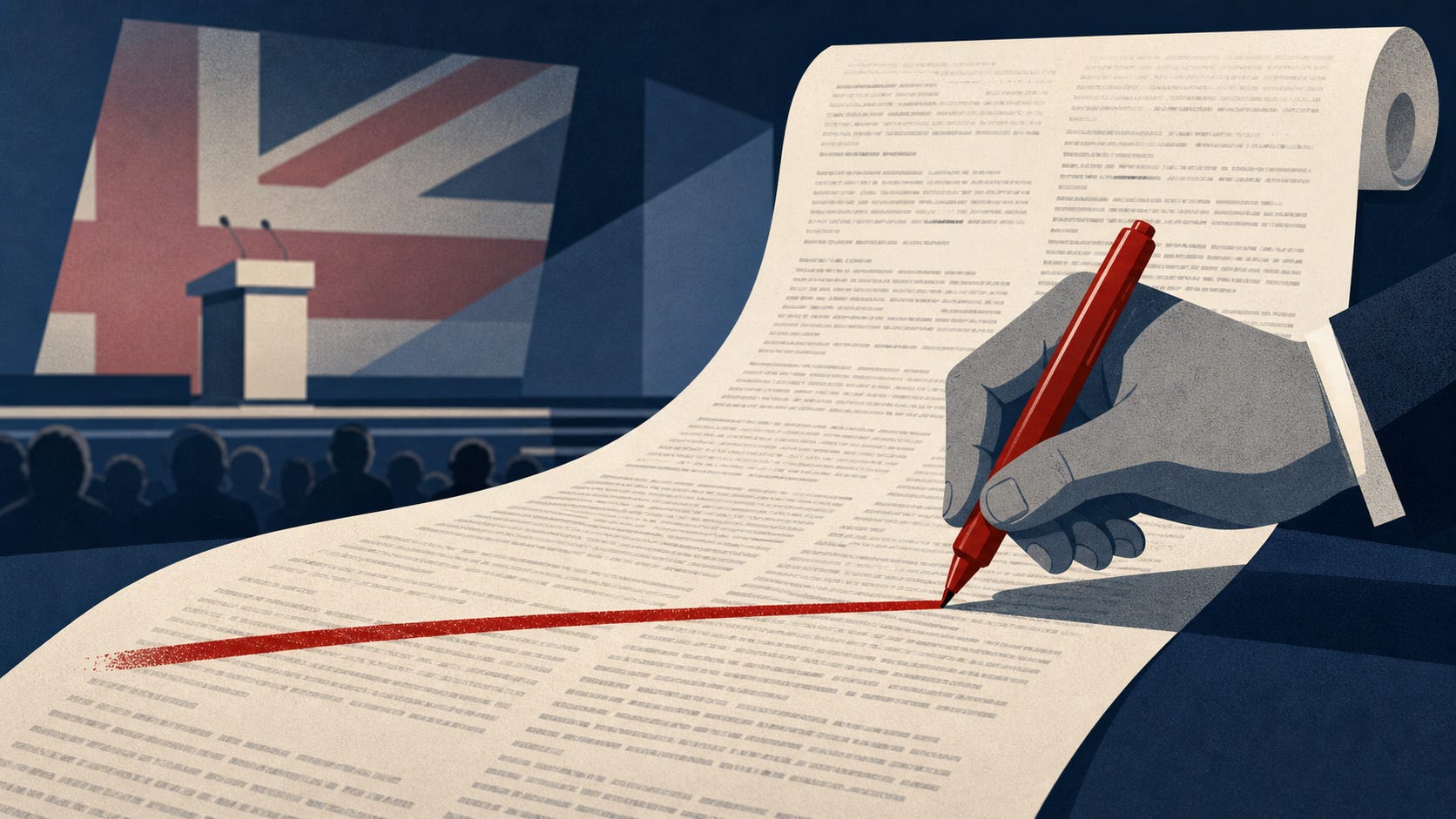
This requires a different understanding of political leadership. Ministers have become accustomed to demonstrating their seriousness by announcing action. There is a deeper principle here. A free society should begin with the presumption that individuals are capable of making decisions for themselves.
Government undoubtedly has essential functions: protecting borders, maintaining order and providing public goods which will be chronically underprovided by individuals without government intervention. But outside those functions, intervention should require justification. Instead, we increasingly demand that individuals justify why they should be left alone.
Every unnecessary regulation imposes costs. Every additional tax changes incentives. Every extra bureaucratic requirement consumes time that could otherwise be spent producing, hiring or innovating. Small businesses feel these burdens particularly acutely because they cannot employ armies of accountants, lawyers and compliance officers to absorb them.
And of course, for many of us, the argument is bigger than economics. It is about freedom.
A state that continually expands inevitably diminishes the space in which individuals can exercise responsibility. We cannot simultaneously lament declining self-reliance while constructing a government that increasingly makes decisions on people’s behalf.
The most radical speech this autumn would not contain fifty new pledges. It would contain ten things the government intends never to do again.
So, as politicians take to conference stages over the coming weeks, listen carefully to what they promise. By all means, ask what they intend to create. But there is a much more important question for anyone interested in a freer and more prosperous Britain.
What are you prepared to stop doing?
Eve Lugg is a Voice for Freedom with Fighting for a Free Future - our group of young advocates fighting for liberty, freedom, and free markets. Eve served as Special Adviser (SpAd) in the Cabinet Office and brings with her experience in policy and comms, as well as knowledge of how Whitehall really operates.

Absolutely right Eve. Excellent article and perfect closing question.
We know it is a lost cause as far as the current government is concerned. Your advice will fall on deaf ears and they will do the exact opposite.
However, for the future's sake, please keep on repeating your message and momentum will undoubtedly build.
Thank you, David
The politics paradox - many people are drawn to politics to be important, to have power and to 'do things'.
The electorate also promote and vote those who offer to 'do the most for us' but they never tell us that the cost will be paid by us in taxes and in freedom.
It would make a welcome change to have politicians promising to do as Javier Milei has done - cut back the bureaucratic state, cut back every non essential, free us from that tyranny.
Unfortunately it seems that nations have to be practically suffocated by government before they choose to vote for drastically less of it. That or a financial crisis forces it.
What was refreshing in Milei's case is that the people voted for it. They saw how bad Peronism was for them and they finally rejected it. It took a hell of a long time though!
Thank you for making the case to do less in exchange for people keeping more of what belongs to them in the first place.
It's an argument we never hear in the mainstream media! Thanks for making it here.