


Public sector net debt – the amount owed to the UK private sector and overseas, less liquid assets - was provisionally estimated at £2,984.9 billion at the end of July 2026, £95.9 billion more than a year earlier.
– ONS July 2026

The TaxPayers’ Alliance (TPA) estimates the UK national debt is now over £3 trillion. We will see in the next ONS release on the public finances due out on 22 September. The TPA estimates the debt is “rising by £4,270 per second or £369 million per day”.
The TPA briefing on the real national debt lays out the problems dealt with in Jon Moynihan’s essential book, Return to Growth: UK taxpayers are ultimately on the hook for state pension commitments, public-service pension schemes and other long-term liabilities. The TPA key findings are:
In 2026-27 the real national debt will be £11.7 trillion. This is more than the entire economic output of Africa, Central America, Oceania and Singapore combined.
The real national debt, in 2026-27, is equivalent to almost four times the size of the UK economy or 369 per cent of forecast nominal GDP.
The government’s preferred debt measure, public sector net financial liabilities (PSNFL), significantly understates the burden facing taxpayers. In 2026-27, the real national debt is more than four times larger than the official forecast.
On a per-household basis, the real national debt will equate to £402,946 in 2026-27. On a per-person basis, it will be £168,184.
Repaying £1 million every hour, it would still take someone 1,334 years to exhaust the real national debt, meaning the repayment would have needed to begin in the year 692, during the Anglo-Saxon period, for it all to be gone by 2026.
Debt interest payments are now much more than what is spent on defence. The idea that the UK state can meet the liabilities it has accrued without profound reform seems fanciful.
Where does this lead? Inflation and financial repression, unless we positively choose another path.
It would be extraordinary if the UK had to restructure the national debt. It is probably unthinkable to politicians and officials who have yet to understand the implications of the scale of our liabilities. But what happens when promises which cannot be kept are not honoured?
We borrow in our own currency, so the British state need not run out of money, if it is willing to change the policy of the Bank of England. This is, of course, the danger: the state can create more money, but not the real resource it would chase. So up go prices.
One way or another, when promises cannot be kept, there is a default. The question is what kind. A direct failure to meet the promises of the welfare state would be obvious: failing to pay benefits and pensions, cutting spending on the NHS, missing debt interest payments. These are the big items.
That doesn’t seem likely to be chosen.
Restructuring the national debt might not involve an explicit cut to the principal owed. Maturities would be extended, and coupons reduced: less interest would be paid over a longer period. Steps would have to be taken to protect individual savers and the stability of the financial system. Banks, insurers and pension funds would face serious risks.
Investors might have choices, but they would certainly have losses. A government doing it would never live it down.
If both outright default on spending and debt restructuring would be unacceptable to a government, what then? Covid may be our guide.
As I set out in my paper for Axiom, according to the Office for Budget Responsibility (OBR), the Bank of England issued new money to buy from the markets the volume of bonds issued by the government to fund pandemic measures. Purchases were indirect, but the OBR chart speaks for itself.
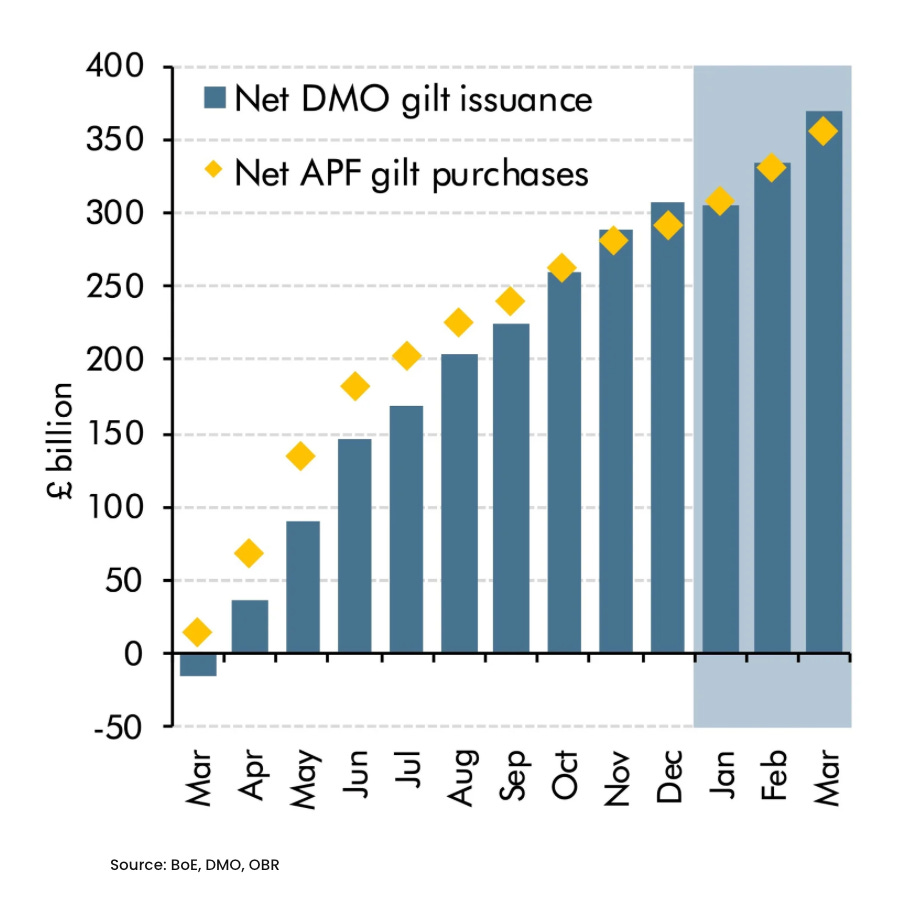
This is the great danger. Politicians who cannot bear to cut spending will also not want to restructure the national debt. There is now a track record of creating new money to fund spending which cannot be honestly paid for from taxation or by borrowing savings in the market. With inflation, the state may pay the promised sum, but that money will buy less.
Given all the political factors at work, such as voters impatient for spending and opposition politicians eager to convict a governing party of economic incompetence, the short-term, apparently easy way out will most likely be taken: using money creation indirectly to buy bonds, robbing us all.
As former Prime Minister Liz Truss spoke about on The Free Future Podcast, we cannot trust the Bank of England to make the right decisions for our economy in high-pressure, high-stakes times, nor can we trust it to resist political pressure and influence.
Index-linked bonds would be a problem. Investors would demand higher rates. A dreadful spiral would accelerate. Financial repression would begin: using policy to secure finance on terms savers would not offer. Controls on capital could return. Propaganda would abound.
Money is the basis of social cooperation. Without prices, profit and loss, it is impossible to coordinate the actions of billions of people. When money is manipulated by authority, the justice of those social processes is corrupted. Economic turmoil would be followed by still greater social and political disruption.
None of this means default is imminent. The UK is not likely soon to “go to the IMF”. The OBR’s warnings might be heeded. The debt reported by the ONS might be tackled. Spending might be substantially cut. Politicians and the public could insist that we confront the hard truth that we have been living for too long far beyond our means and that is now coming back to haunt us.
This project is amplifying voices for freedom in the hope that adjustment can take place sooner rather than later: as the OBR itself warned (emphasis mine),
Together, these scenarios underline the importance of early action to address fiscal sustainability, and of using periods where the economy is not experiencing major shocks to build resilience to future fiscal challenges. Improving the position of the primary deficit in the medium term, as in the baseline scenario, delays the point at which debt starts to accelerate especially if the economy is then hit by major shocks – which at some point is a near certainty. But, if debt were, nevertheless, to move onto one of these steep upward paths, it is almost certain that future governments would have to take further action to address it. This would be needed to avoid the risk of the type of negative interest rate feedback loop modelled here from developing, and because of the increasing likelihood of a sudden adverse market reaction. As shown in the final section of this chapter, choosing to delay the policy action needed to do this would require a more significant, and therefore more painful, fiscal tightening in the future.
The situation is grave and urgent. Our problems cannot be solved without consequences. Further debasing the currency seems the last but likely resort of desperate politicians unwilling or unable to cut spending. That could result in accelerating inflation and soaring interest rates, eventually forcing the spending cuts politicians had sought to avoid.
This country, together with the rest of the developed welfare states drowning in debt, needs greater political capacity. We need institutions which reward honesty sooner, greater scrutiny by journalists of commitments and a better-informed public willing to give a government a mandate to sort this mess out before solutions are forced upon us by reality.
Further reading
Honest money and social progress, my paper for Axiom exploring the state of the public finances
Paper Money Collapse: The Folly of Elastic Money and the Coming Monetary Breakdown, Detlev S. Schlichter
I think your persistence, and patience, is starting to pay off Steve. This issue is starting to seep into the public consciousness & as you say that is essential. People are actually feeling and noticing the consequences now.
- £3trillion suddenly seems like a lot of debt as opposed to only £2.9trillion.
- mortgage rates are on the way up, even though bank base rate remains static.
Hopefully, momentum will continue to build, as the debt continues to build. If Liz is right though, & I suspect that she is, we can't fix individual broken components without first fixing the way the whole political system works. There is therefore much more to do than persuade a government to cut down on spending.
We need as many clever people on the right as we can possibly muster.
Please keep on going!