


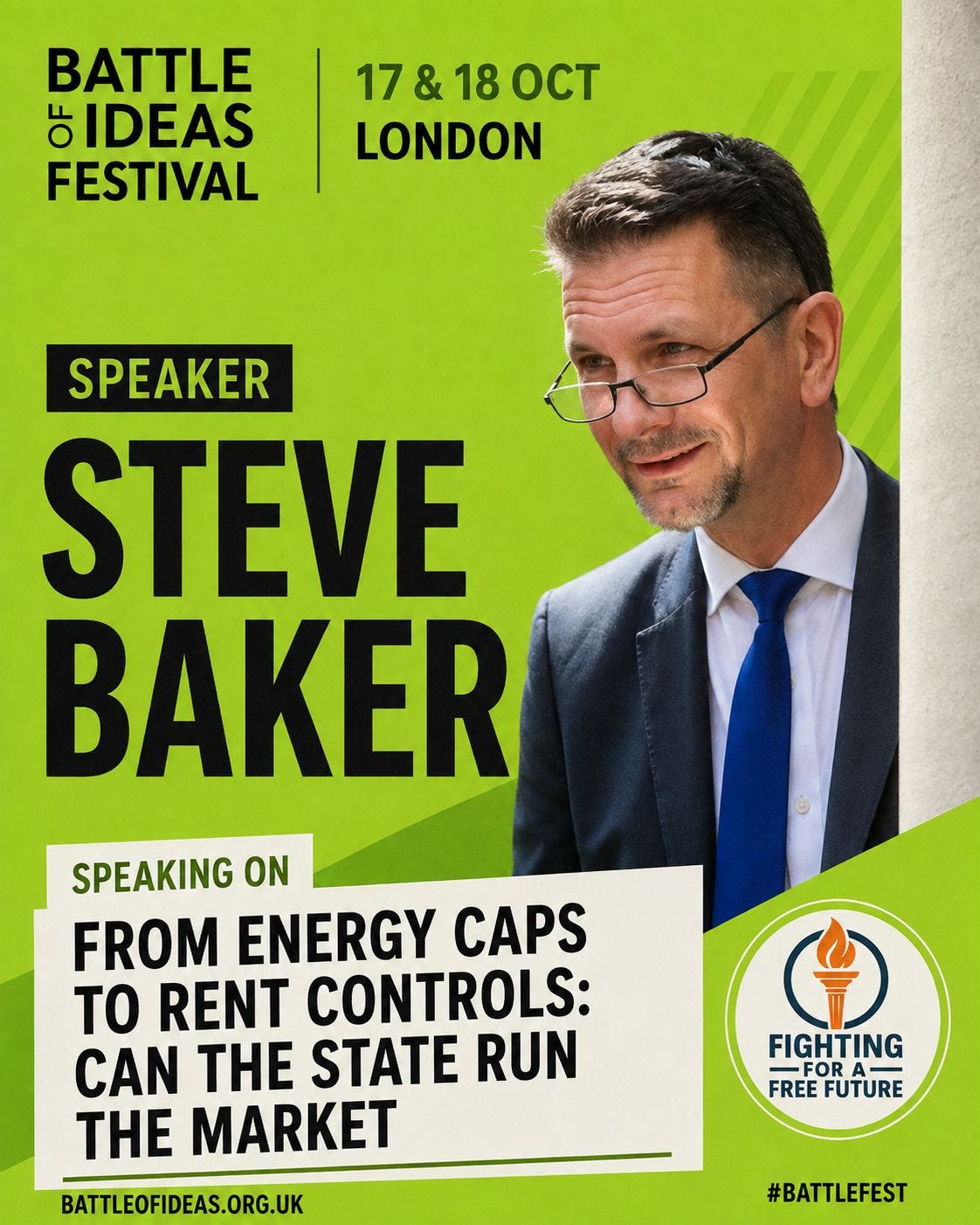
Fighting for a Free Future are partners of the Battle of Ideas festival on 17 and 18 October. You can catch chairman Steve Baker speaking on the keynote controversy, Should we tolerate the intolerant? and on the panel, From energy caps to rent controls: can the state run the market? And take advantage of being there to meet the FFF team, who have a stall in the festival Ideas Market. Full details of the festival and how to attend can be found here.
Everyone claims to believe in free speech – until someone says something they don’t like. Misgender somebody or criticise Islam, and progressives may call HR, the regulator or the police. Chant pro-Palestine slogans or display ‘Las Malvinas son Argentinas’ banners and the pearl-clutching right also call for vetoes. Demands to ban (or defend) Kneecap or Kanye West, boycott Eurovision or cancel Ali G seem ever more tied to pet hates or personal sympathies. Little wonder a recent survey by Liberty found Britain to be deep in a free-speech recession. As one commentator noted, speech is ‘under relentless attack – on both Left and Right’, meaning you’re now ‘far more likely to hear someone say “You can’t say that!” than “It’s a free country”’.
The Liberty poll reveals that an overwhelming majority of people believe that the government places too many limits on what we say. Another report published this week certainly seems to back this up. Big Brother Watch found that over 60,000 people have been arrested for communication offences over five years, with the arbitrary nature of laws and how they are enforced meaning that some police forces make 14 times more arrests than others.
But is an even bigger problem that we ourselves fail to uphold free speech for all? Yes, Andy Burnham is well-known to favour press regulators. But who needs new Leveson controls when the thin-skinned amongst us petition Ofcom to censure GB News or Channel 4, delight in Green Party calls for the media to be ‘sorted out’ or applaud Reform UK’s demand that regulators curtail investigative reporting on financial donations. But journalists, too, promote speech limits. Accusations that the tragic death of Jason Arday resulted from a ‘racist feeding frenzy’ led some to endorse reporting limits. Should journalists ever refrain from publishing truth? And with Novara Media journalists who had been critical of Arday confessing to wrongthink, is journalistic self-censorship now a problem?
As ever, where to draw red lines on free speech is a controversial issue. In the context of security concerns following Ann Widdecombe’s gruesome murder, it was insensitive for Zack Polanski to repost an image with a guillotine and the song lyric ‘We’re only making plans for Nigel’. When Reform UK’s Zia Yusuf called on police to investigate on the grounds of ‘incitement to murder’, Polanski’s response was that Yusuf’s hyperbolic claims meant he, too, received death threats. Is this simply tit-for-tat performative outrage and even weaponising speech for political gain – or do politically polarised times necessitate tighter restrictions?
Or take demands for legal action to limit what can be said – such as the furore around Amnesty, who accused gender-critical organisations of being ‘anti-rights’. JK Rowling is a stalwart defender of women’s rights. But does advocating and funding of legal actions on the grounds of defamation – cheered on by supporters anticipating litigation may force Amnesty to shut down – threaten the very free-speech principles that allowed public criticism of Amnesty in the first place? Is this matter better fought out in the political sphere as a clash of views and different interpretations of rights – or is litigation to prevent organisations losing their charitable status justified? And for those cheering President Trump for sticking it to the BBC, is his $10 billion defamation claim also a threat to speech, creating what the BBC alleges to be a ‘chilling effect’ on reporting?
Given our free-speech recession, the big question is how to respond. One traditional means of defending free expression rested on the ‘marketplace of ideas’ as a testing ground for falsehood and bad ideas, in the belief that the truth will out. But in recent years this defence has come under attack. Writing for Index on Censorship, the author Anshuman Mondal says free speech is a ‘charade’ used ‘to prise open the gates of acceptable public discourse and thereby poison the well’. It is a weapon that can be wielded against socially subordinated groups, he says.
Taking a different view, Robert Tombs, the free-speech academic, advocates making the state and the law active champions of freedom so that ‘what is not forbidden is protected’. Others, such as Battle of Ideas festival partner Prosperity Institute, argue in their report Reversing Britain’s Free Speech Recession that we must repeal inappropriate criminal laws, criminalising only speech intended or likely to cause violence in public-order speech, or speech intended to be menacing and targeted in communications. Meanwhile, protections for religion and belief in the Equality Act should, they say, be replaced with a tort of unlawful interference with free speech.
Clearly, there is much to discuss for our panel featuring the Prosperity Institute’s Paul Coleman, Akiko Hart, director of Liberty, Jacob Mchangama from Future of Free Speech and spiked editor, Tom Slater.
After years of blaming progressives for the free-speech deficit, we will reflect on whether a horseshoe-style convergence means that left and right are now equally blameworthy for the free-speech recession. How do we get out of the rut of this thin-skinned hostility towards anything challenging or objectionable? And where do red lines need to be drawn in terms of incitement, harassment, defamation and legislation?
Alastair Donald is the Associate Director at the Academy of Ideas and co-convenor of Battle of Ideas festival.
Don’t miss Battle of Ideas festival on 17 and 18 October, where YOU will be able to join in the debate, challenging views you disagree with while putting forward your own thoughts and opinions.
Fighting for a Free Future are festival partners, and you can catch chairman Steve Baker speaking on the keynote controversy Should we tolerate the intolerant? and on the panel, From energy caps to rent controls: can the state run the market? And take advantage of being there to meet the FFF team, who have a stall in the festival Ideas Market.
Full details of the festival and how to attend can be found here.
Take advantage of the Early Bird tickets offer before it finishes next week on Thursday 17 September.
