


Steve writes: Is there a place for bans on face coverings in a free society? I have always said no but Albie makes a persuasive case. Please let us know what you think in the comments.
Every year, Britain’s public spaces sprout more covered faces, and it is a grim trend to watch. The other day, I watched a mother in a full niqab walking with her young daughter. The girl’s hair blew in the wind, her smile wide and carefree. It was a poignant sight because I knew that one day, she will likely be told to hide that smile forever. Children copy their parents; what they see every day becomes their baseline. But covering your face in public is not normal. Not in Britain. It isn’t even normal in much of the Islamic world, where nations like Tunisia and Turkey have restricted full veils in public spaces.
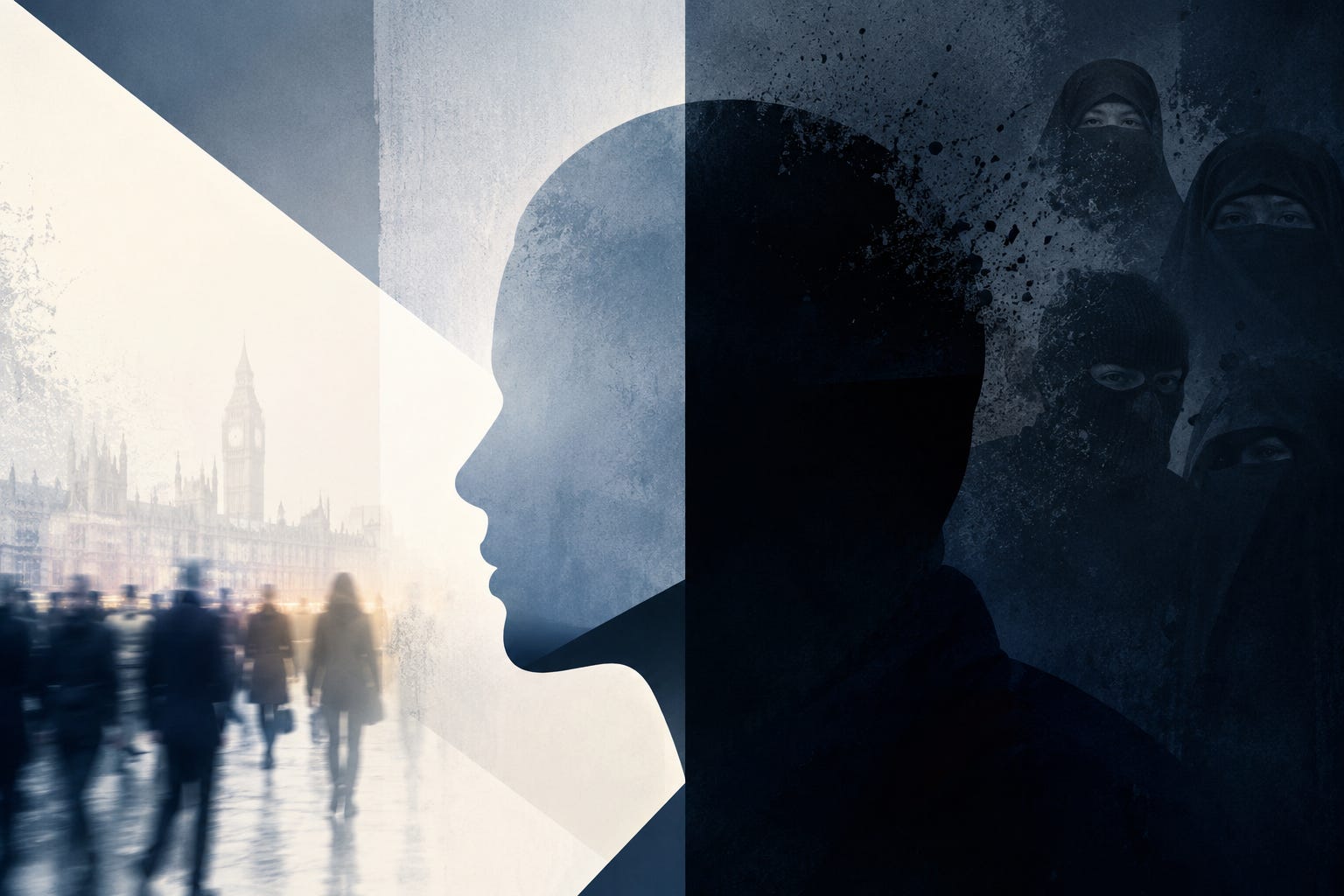
The social contract is simple: show your face if you want to be a full participant in British society. This rule must apply across the board, to youths prowling the high street in balaclavas just as much as to religious fundamentalists or political performance artists.
The most urgent argument for a ban is basic public safety. Criminals cover their faces because anonymity breeds impunity. Yassin Omar, one of the failed 7/7 bombers, famously attempted to evade capture disguised in a burqa. Today, the problem is more mundane but entirely pervasive. Fare-dodgers openly ride the Tube in balaclavas to trick facial-recognition CCTV. Shoplifters brazenly loot supermarkets while security guards stand by, their identities safely hidden behind Lycra masks. We already accept restrictions on face coverings in specific settings; petrol stations and banks routinely ban motorcycle helmets because concealment makes robbery easy. The underlying principle is clear: once you step into shared public space, you must show who you are.
This is no longer just a hypothetical issue for the high street; it is actively knocking on the doors of our democracy. Consider the bizarre political circus unfolding in Clacton, where Nigel Farage has engineered a sudden by-election. Because the mainstream political parties have chosen to boycott the contest, the highest-profile challenger left on the ballot is Count Binface, an intergalactic space warrior with an upturned dustbin strapped to his head. Social media is already alight with voters half-seriously plotting to do the funniest thing in British political history by electing a comedian in a dustbin to Parliament.
While the British public rightfully loves an eccentric protest candidate to mock the establishment, we must maintain absolute clarity about the serious nature of institutional power. If the voters of Clacton actually deliver this ultimate electoral punchline, the joke must stop at the gates of Westminster. No allowances or special exemptions can be made for satirical performance art in the House of Commons. If Count Binface defeats Nigel Farage, he must be forced to take off the bin.
Democracy requires absolute, unyielding transparency. We cannot have lawmakers debating legislation, voting on national security, or representing the interests of British citizens from behind a literal piece of sheet metal. The rulebook of Parliament exists for a reason, and it dictates that members cannot cover their faces because officials must be able to visually identify them to register a vote. If you want the immense privilege of sitting on the green benches, you must look your colleagues and your constituents in the eye. To allow a politician to hide behind a mask under the guise of theatre would completely undermine the principle of democratic accountability.
After all, human beings talk with their faces. In Britain, our unspoken vocabulary relies on a flash of expression: a widened eye, a smirk, a pursed lip, a warm smile. To hide all of that is to cut yourself off from the community. It naturally invites suspicion.
We already have fresh, painful evidence of the psychological harm caused by masked societies from the Covid-19 pandemic. During that time, our cities felt instantly colder and meaner because the smiles vanished. More troubling still, developmental researchers have since proven that children’s speech and emotional growth suffered significantly. One major study found that young children’s accuracy in recognising basic human emotions fell by almost a third when adults were masked. Research focusing on nursery-age children showed sharp declines in their ability to identify joy, sadness, and anger behind surgical masks, while acoustic studies confirmed that masks muffle the high-frequency sounds essential for speech clarity. If a few years of temporary masking did this to a generation of children, what does a lifetime behind a heavy veil do?
I feel this cultural friction myself. At a political vigil recently, someone turned up wearing an England flag face mask. It felt deeply bizarre and hostile, and I instinctively moved away. Ironically, when I see women in niqabs or burqas, I do not feel threatened; I simply feel sad. I feel sad because I know that if they had been born men, no one would expect them to live out their lives behind a wall of cloth.Of course, there are reasonable exceptions. Festivals, theatre, and cultural celebrations are entirely different. Halloween masks, the Venice Carnival, or a masked ball are moments of collective joy. Crucially, they prove the rule because they are temporary. Step outside the venue and back into everyday life, and you show your face.
It is a matter of profound regret that the unspoken rule of “when in Rome” is no longer enough. Once, it was simply understood that living in Britain meant adhering to British norms of openness and mutual trust. Today, those eroding norms must be codified into law. Covering your face has never been a British habit.
Other confident, liberal nations have already successfully drawn this line. France, Denmark, Austria, and Belgium have all passed public face-covering bans. The sky did not fall. Liberal democracy did not collapse. If anything, those societies look more secure and self-assured for having done so. Allowing masks in public life, whether for crime, fashion, faith, or political theatre, legitimises concealment. It opens the door to a pervasive culture of mistrust. If we cannot even look each other in the eye, we are no longer the Britain we think we are.
Albie Amankona is a broadcaster, financial analyst and political activist. He is the co-founder of Conservatives Against Racism and a member of the Conservatives LGBT+ National Executive. He regularly appears across broadcast media and can be followed on X through @albieamankona.
Interesting to read the case Albie puts forward and there are many things that I would agree with on the benefits of not covering your face and the disadvantages of covering your face.
However I'm with Steve in the answer to the question: Is there a place for bans on face coverings in a free society? And the answer is No. A resounding No.
A bank as a private enterprise may set it's terms of engagement and not allow face coverings including helmets. However banning something requires the use of force by the state and there lies the conflict with fundamental principles of liberty i.e. liberty from government coercion.
More so, if the state bans something, then the state must expend tax payer resources to enforce this against people's will. Criminals do prefer and get away by covering faces, but CCTV and facial recognition is not the answer given downstream implications. And last bit not least one more job for the state means more taxes and less freedom, no mater how well meaning it is I don't believe a ban is a good idea.
I was 51/49 in favour of Steve's argument. I think the point you made Steve was that if it does no harm, don't ban it.
However, as Albi describes, face coverings are increasingly being used to further criminality and often violent criminality. Detection and prosecution becomes almost impossible.
I'm with Albie now!