


When considering how best to secure a free future for the next generation, the work of a socialist philosopher rarely comes to mind. However, Antonio Gramsci is an exception. Writing during the era of Italian fascism, Gramsci viewed fascist state control with a considerable degree of fear. When imprisoned by the fascists, he was subjected to the kind of neglect depicted in Orwell’s 1984. He had a head-on and ultimately fatal experience with state tyranny. Gramsci is best known for developing the concept of “cultural hegemony.”
Cultural hegemony can be defined as the state shaping “correct” and “incorrect” views in society. It is what separates legitimate political disagreement from what is considered outlandish and problematic. In the context of Britain’s Net Zero 2050 target, this has manifested in sceptics being labelled “climate deniers.”
With climate alarmism reaching new heights under Extinction Rebellion from 2018, figures such as Greta Thunberg were lauded for standing up to “ineffective” politicians through protest. In reality, all they manifested was ignoring economic reality in favour of an idealist ideology. The reverence surrounding Thunberg captured both government and opposition alike; the widely circulated image of Ed Miliband applauding a visibly uncomfortable Thunberg symbolised that deference.
Though Chancellor, Phillip Hammond, wrote a letter warning against the enormous cost, the debate on signing Net Zero into law in 2019 was given all of 90 minutes before being passed.
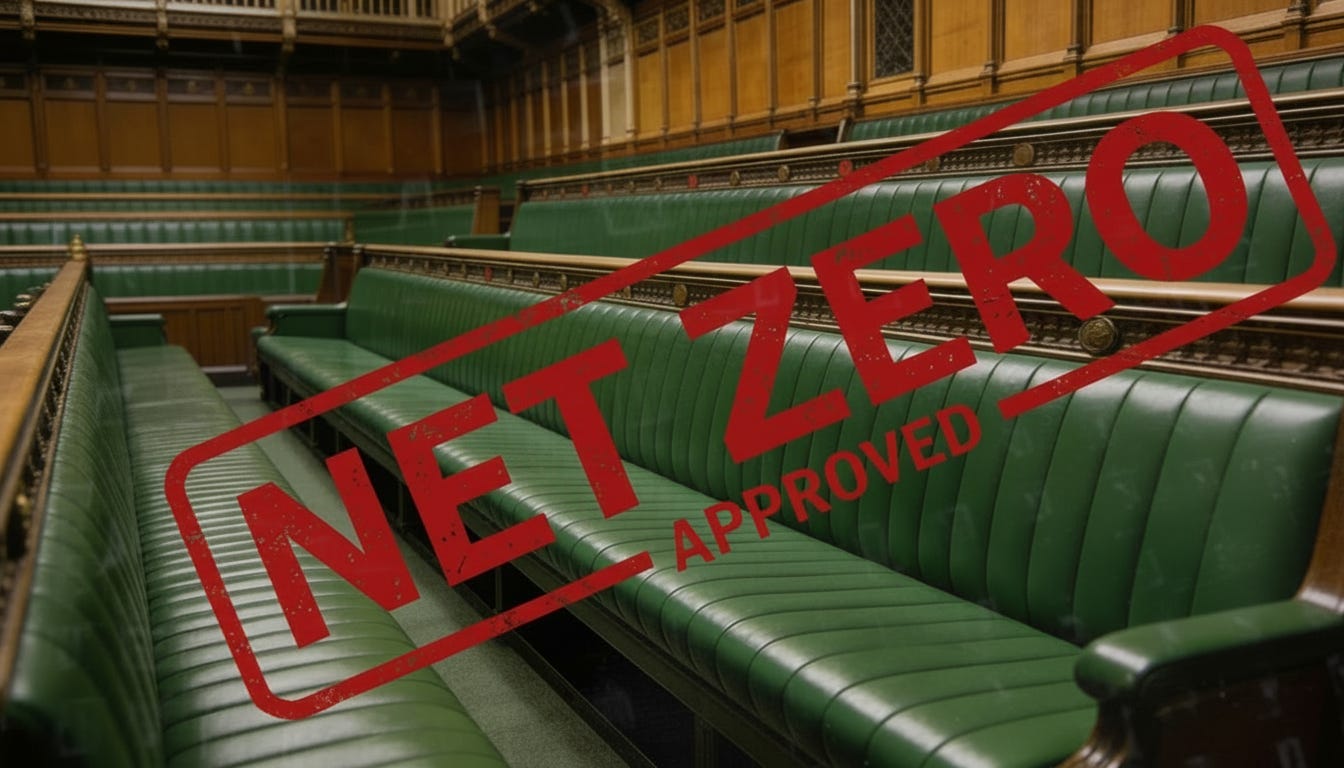
In doing this, Theresa May had kowtowed to Corbyn-loving Extinction Rebellion instead of looking after the country’s interests.
The politics of Net Zero have since captured the government and the civil service. For too long, officials have stressed that higher taxes, higher bills, and less freedom are necessary responses to the “climate emergency.” The spending response is equally alarmist, with Net Zero predicted to cost around £7.6tn in a recent paper, a sum more commonly associated with a long war or mass reindustrialisation. Yet the result is increased energy insecurity with higher bills and a greater state scrutiny of the way you, as an individual, live your life.
For an economy to spend such sums defending its sovereignty would be one thing. Spending them to reduce global emissions by less than Britain’s 1% contribution is quite another.
Climate alarmism nonetheless permeates much of the civil service. Local governments, already suffering from budget constraints, shell out thousands for “Climate Change Managers” or “Carbon Accountants.” In just one London borough, the GWPF identified spending of almost £400,000 a year on climate-related roles.
Within the civil service, climate policy now represents a form of institutional capture, framed as seriousness vs unseriousness about the climate crisis. Following the 2019 amendment to the Climate Change Act, which made Net Zero legally binding, civil servants are tasked not with questioning its economic rationale but with implementing it, regardless of cost. As with any policy placed beyond scrutiny, those with the most insight into the economic flaws of Net Zero are often those least able to challenge it.
As much as Net Zero policies are framed as virtuous, data suggesting individuals will be worse off as a result should raise alarm bells. There is no nobility in energy poverty.
When such ideology captures the public sector, costs rise for everyone. Consider NHS procurement policy: companies bidding for major supply contracts must first publish a “carbon reduction plan.” This increases compliance costs, which are ultimately passed on to the NHS, unless firms absorb them entirely. All this is possible because the NHS has no profit motive. Instead, management is free to pursue whatever political ideology they desire, at the taxpayer’s expense.
Further orthodoxy has slipped into local government, with over 300 councils declaring a “climate emergency”, opening the door to LTNs, ULEZ zones, and greater planning restrictions.
This cultural hegemony has not just infected the public sector. As universities and other institutions declare “climate emergencies” and establish Net Zero taskforces, it becomes increasingly difficult to challenge underlying assumptions. Academics who stray from mainstream views risk being branded as heretics or cranks, rather than being examined and challenged in open debate.
Figures such as Roger Pielke Jr, Peter Ridd, and Judith Curry are prime examples of academics who have faced professional backlash due to their sceptical views on climate consensus and policy. Without scrutiny, the scientific community risks treating climate science and strategy more as a religious belief than a scientific idea.
In both the government and the scientific community, Net Zero should not be treated as an ironclad doctrine. Climate policy ought to be evidence-based and grounded in sound economics, not optimistic modelling and massive energy taxes.
Going forward, Britain must have the courage to reject commitments that make little economic or strategic sense. Just recently, Centrica warned that following a Clean Power 2030 agenda, British businesses and household billpayers could face higher energy prices in 2030 than at the peak of the Ukraine war. Such an outcome would only worsen an already struggling business sector and the ongoing cost-of-living crisis.
Evidence suggests that relying predominantly on intermittent energy generation is not a credible strategy for grid security. As much of the public and political class wakes up to the cold reality of this type of cultural hegemony, there is still time to change course. The prevailing climate orthodoxy within the state must evolve with changing realities, rather than bankrupt the country one decision at a time.
Ted Newson is a Researcher at The Global Warming Policy Foundation

Climate change is impossible to stop we may be able to slow it down. Our actions should focus on how we deal with the effects, which will cost much less than trying to stop it.