


Housing has long been one of the most discussed topics in UK politics, and since the financial crisis in 2008, the situation has only worsened. The Institute of Economic Affairs recently republished a monograph on the causes and consequences of the crisis. The work was first published in 1988, but unfortunately for my generation - and as Kristian Niemietz notes in the Foreword - it feels as if it could have been published last week.
It has become so prominent and dire that one of Keir Starmer’s main manifesto promises in 2024 was to build 1.5 million new homes over the next 5 years.
Deservedly so. England has a housing affordability ratio of 7.63 in 2025, and London has a ratio of 10.5, which has trended upwards since 1997, peaking in 2021. For reference, 5 is considered the affordability threshold, with anything above that meaning less affordable housing. Housing services make up 22% of total consumption spending, higher than the 17% OECD average, behind only Finland.
The UK has manufactured its own housing crisis. Since the introduction of the Town and Country Planning Act 1947, the UK has moved to a discretionary planning system in which development rights have effectively been nationalised. It means that planning permission is uncertain, expensive and lengthy. Furthermore, it has given small NIMBY lobbies a more influential voice in whether a development is blocked or not. It is central to the crisis because when you restrict supply, demand increases, and prices inevitably rise.
The Ultimate Resource at Risk
Simultaneously, the UK faces a population crisis created by a plummeting fertility rate. The current fertility rate in the UK is 1.44, while the replacement rate is approximately 2.1. The population will begin to fall in 2029 if we exclude migration. Fertility rates in the UK have decreased by 25% since 2010, more than any G7 nation.
A declining population creates challenges for general productivity as well as issues for funding our welfare state. Some models conclude that population decline signifies the end of economic growth and, therefore, a rapidly declining standard of living. Julian Simon famously referred to human beings as the ‘ultimate resource’. In his titular book, he writes, “population growth has long-term benefits, though added people are a burden in the short run.” In the long run, however, “our species is better off in just about every measurable material way.”
The population crisis is happening for a number of reasons, and it would be difficult to pin it down to just one cause. However, I would argue that a major factor is the unaffordable and stagnant housing market. People are more likely to stay living with their parents and less likely to move out, marry, and have kids. If they do, they are usually notably older than previous generations: the median age for an opposite-sex first marriage in England and Wales is now around 35 for men and 33 for women, roughly five years higher than in the mid-1990s.
The housing crisis also makes it harder to move to more productive parts of the country, where there are higher-quality, better-paying jobs. Even if they can move to one of these areas, London being the obvious example, rent can easily eat up 50% or more of your income, which makes it a lot harder to move to a family home and raise children.
These seemingly obvious conclusions are borne out by the data. A recent study concluded that a major cause of declining fertility is rising housing costs. Other studies show that less affordable housing means that people start families when they are older and also have fewer children.
Humans are the ‘ultimate resource’: we innovate, solve problems, and, generation after generation, tend to leave the world better than we found it for our descendants. Unless we build a housing system that is explicitly pro-natalist, we will choose a future of decline, irrelevance, and avoidable poverty.
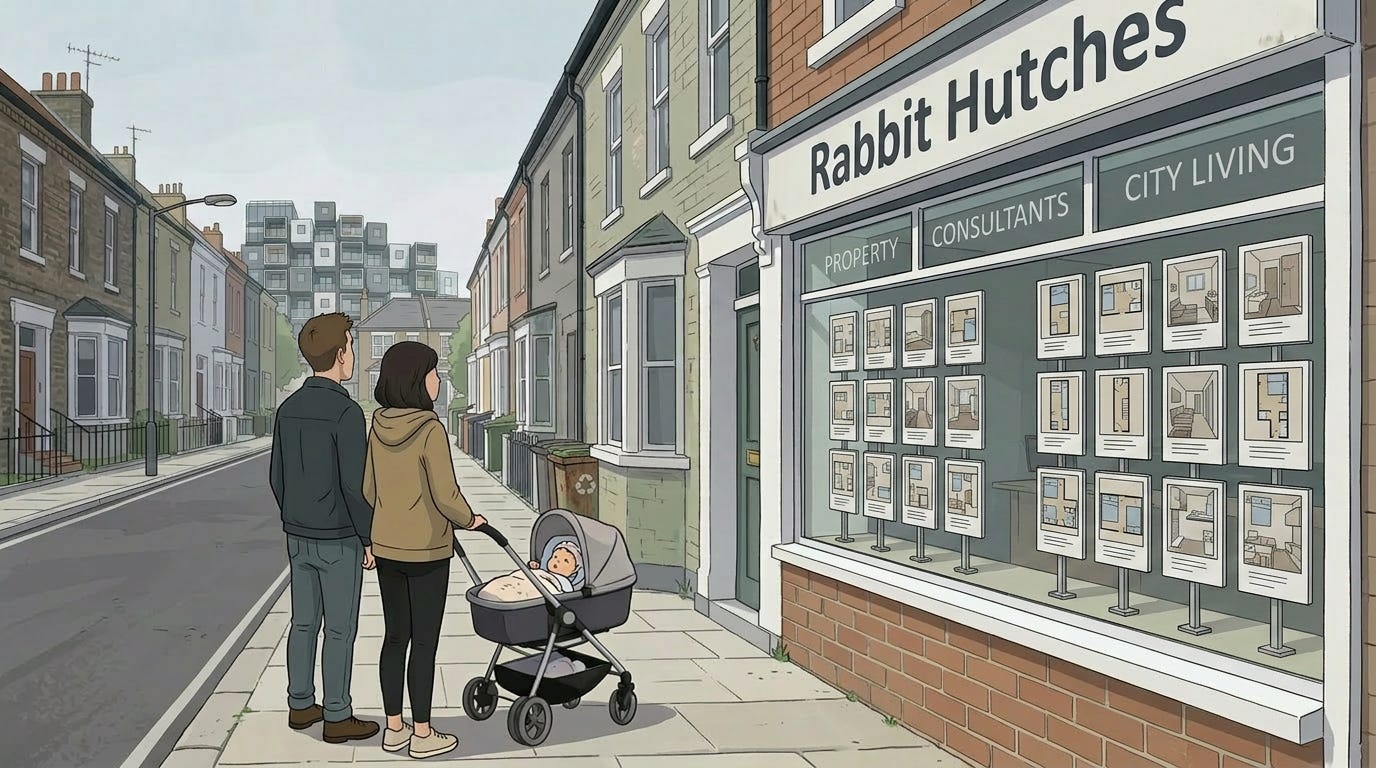
So, tackling the fertility problem starts with housing. In general, couples will only start a family when they have enough space and the security that only a home of their own can give them. Would-be parents are less likely to start a family when the more available housing is like “rabbit hutches on postage stamps” with poor architectural design and little to no garden space.
We should look to America here and reap the rewards. An American study suggests that the first thing we should be trying to do is build more family-sized housing units in the short term. It hints that it will likely lead to 4.7 million more children born over three decades. It is a cheap way of increasing the fertility rate and increasing economic efficiency. In other words, to achieve the same results with a subsidy would require up to a staggering $160,000 per birth. A recent IEA study comes to similar conclusions, demonstrating that cash incentives and baby bonus subsidies have little to no effect on fertility. There is no reason to pay the subsidy when you can just allow people to build family-sized units. The study goes on to show how intended fertility, what women and couples want, is greater than actual fertility. Increasing the supply of family units helps ease the heavy burden of housing costs on current families and soon-to-be parents. Both of these studies agree that housing liberalisation could be key in closing the ‘fertility gap’.
In the long term, we need to build more micro units to get young people on the housing ladder earlier. Scholars like Emily Hamilton have highlighted that in the US, the number of 1-person households far exceeds the number of studio apartments. This goes a long way to explaining why the rate of 25-to-45 year olds still living with their parents has doubled since 1960. The best way to rectify this is to deregulate land use so that a variety of houses can be built, particularly smaller and cheaper units. As young people’s incomes rise as they get older, they can slowly scale the housing ladder until they can afford a single-family house. This plan is far more realistic than expecting young people’s first house to be a single-family unit. Furthermore, if they are still living at home, they probably aren’t moving to places where there are more job opportunities and higher wages. So, the high cost of housing is causing young people to forgo better jobs and a family, two key components of a fulfilled life.
We should encourage and allow for more micro units and Accessory Dwelling Units (commonly known as ‘granny flats’) to be built. By doing so, we can decrease rents and housing costs across the board, making it much more affordable for people in their 20s to buy their first home or leave their parents’. If 20-somethings stay living with their parents, it is tantamount to choosing not to have children. By making small units affordable, we reduce the costs of fertility in the long term, because adult children can move out.
From NIMBYism to Proprietary Governance
In order to get more housing and a greater variety of it, land-use deregulation is the single most effective policy. It would allow the building of more houses that people actually want, replacing a system where planners build an inadequate number of houses which they don’t.
Liberating land-use laws will also lead to more of this desirable housing in places that people want to live, with more opportunities and higher wages. These places also tend to be more desirable for raising children because of easier access to schools and work. One way to achieve this, according to Mark Pennington’s Liberating the Land, is to denationalise development rights by giving local communities property rights. Communities with strong amenity interests (e.g. privacy, sunlight, and green space), which give them the right to prevent development, often provide the strongest objections to new projects. If these property rights were tradable, communities could sell them and negotiate development, reducing the potential for objection.
Our planning system may have been spawned with good intentions, but now it simply serves to make homes unaffordable. In late 2025, a new build property costs £377,675 versus existing properties with an average price of £266,805. On average, detached houses are the most expensive at around £440,000, followed by semi-detached. Both are more expensive than terraced housing, and detached homes are almost double the price of flats. All the while, rents in cities like Reading and Oxford outstrip those in many major European cities, and London is the only city to rival New York.
Fast-tracking approval for large apartment buildings with lots of small units, as well as approving more granny flats and micro units, are vital policy tools for increasing the supply of housing affordable for people on the first rungs of the housing ladder: helping both the ‘banished bottom’ and reduce the strain on the supply for the ‘missing middle’.
Another important proposal is for proprietary governance. It means that the state would give up its development rights, and private property rights would be held collectively by all property owners in a given community in the form of a private landowner association or company. Property owners would receive profits from new developments based on the proportion of shares they own in the association.
The current system is plagued by a complex hierarchy of nationalised development rights and plans by local authorities. Hayek would say that the system suffers from a “pretence of knowledge”. Planners lack the necessary local and dispersed knowledge to correctly determine the right number, size, and location of new housing. They also lack any feedback mechanism that could hint at whether the plan was any good.
Proprietary governance and private development rights could ease the implementation of many such development strategies. It could see more plot splitting that will increase both small and large units. Furthermore, it may relax parking and fire-exit rules, freeing up more space that families truly value. Both reforms will open the door to a spontaneous order in which tacit knowledge of what consumers want and are willing to sacrifice and prioritise can be used to meet demand, improve quality and create the flexibility in the housing market which is sorely missing. A market that offers more of what families want at a lower price means you’re likely to get more families.
Developers also prefer more liberal development rules. They get more profit by building and selling lots of townhomes rather than a small number of luxury homes. Townhomes are far more land-efficient than detached homes, and they are also cheaper because they use less land. Land-use and planning laws dictate housing shape and formation, like with the fire exits. These laws also directly dictate the size of homes. When developers are free to build smaller homes on smaller lots, they can make it much more affordable for the average family, which is also more profitable for them.
Proprietary governance and denationalised development rights offer a practical path to liberalising land use. It can create a flexible institutional arrangement in which the housing market is flexible and able to respond to demand. It could allow for more affordable and land-efficient family units in the short term to boost fertility rates now, and more micro units in the long term, so young people can move for job opportunities, get on the housing ladder and start a family.
If we had done this 30 years ago, the fertility decline might only be half as bad… literally.
Oscar Gill-Lewis is a political commentator with Young Voices and Correspondent Program Manager at Speak Freely Magazine. He writes for Speak Freely and on Substack, and his articles have appeared in Conservative Home, The Daily Express, and Comment Central. You can find Oscar on X here.