


Britain has cancelled one of its biggest music festivals, disappointed hundreds of thousands of fans, cost a major live-events business a great deal of money, and wiped out work for countless freelancers, crews and contractors, all because one man has been judged too offensive to enter the country.
We are meant to see this as a moral stand. In fact, it exposes the absence of a consistent standard. Take the John Davidson row at the BAFTAs. Davidson, a Tourette’s campaigner whose life inspired I Swear, uttered a racial slur during the ceremony while Michael B. Jordan and Delroy Lindo were on stage and, according to reports from the night, also directed slurs at black attendees, including production designer Hannah Beachler. It was ugly, it caused real distress, and he later apologised.
However what followed matters just as much as what was said. The reaction did not stop at condemnation. It moved quickly into a discussion about Tourette’s, involuntary speech, disability, intent and mitigation. The BBC apologised for broadcasting the moment, and the broader argument became one about how responsibility should be understood when neurological conditions are involved. You could accept that framing or reject it, but the principle was clear enough.
Now compare that to Kanye West. Kanye has said things that are plainly indefensible, his antisemitism has included praise for Hitler and conspiracies about Jewish control. He has also made anti-black remarks, from claiming slavery “sounds like a choice” to parading around in “White Lives Matter” clothing. This is not a lapse, it is a record, and a well-documented one.
At the same time, he has apologised publicly and has, at times, linked his behaviour to his bipolar disorder. You may think that explanation carries no weight at all, fine. However, if the Davidson case taught us anything, it is that mitigation is apparently not irrelevant simply because the words are offensive. If context is allowed into the room for one man, it cannot be barred at the door for another simply because he is harder to defend.
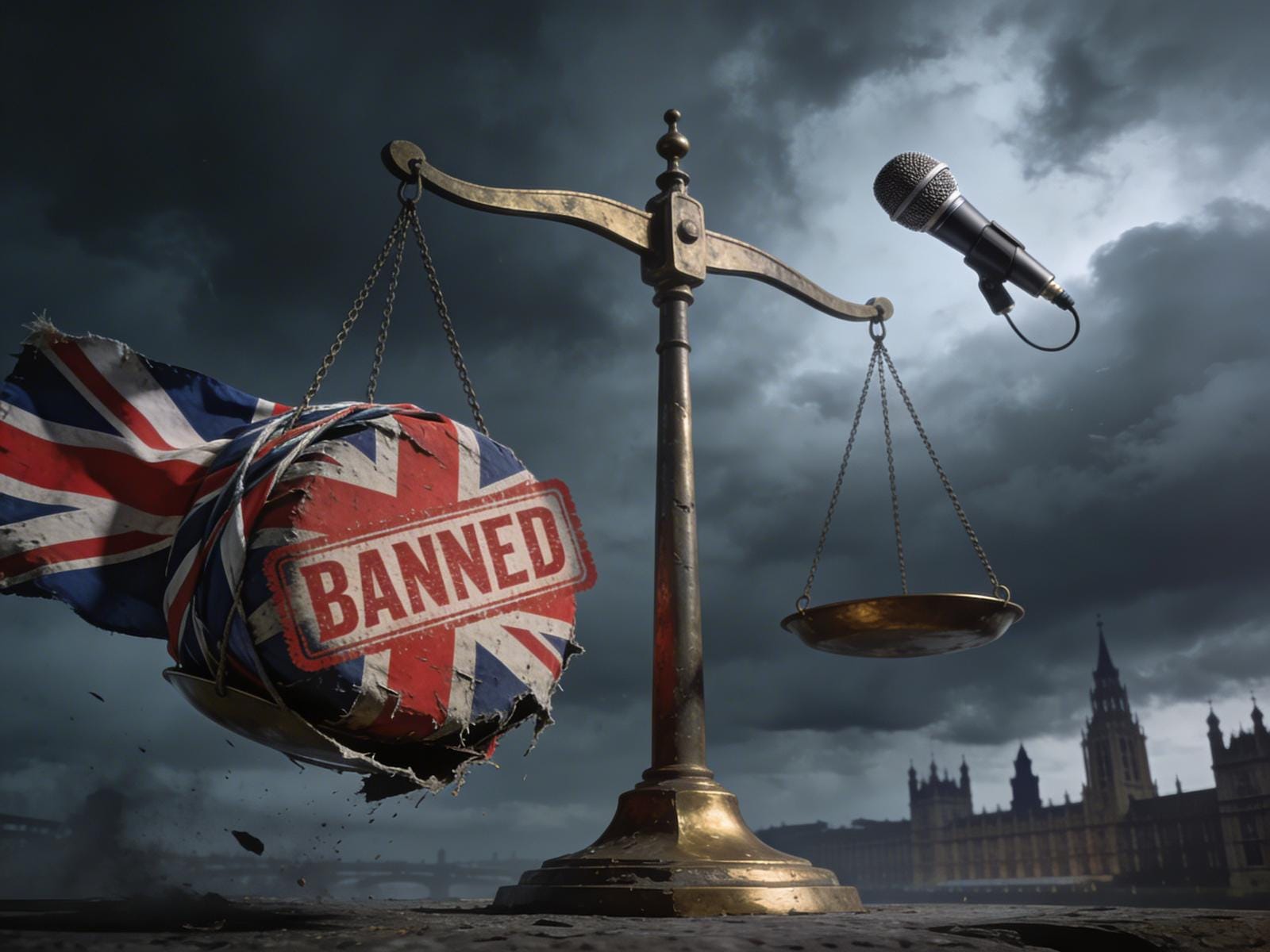
Yet that is exactly where Britain has landed, the Home Office has blocked Kanye West from entering the UK, shutting down the prospect of him performing at Wireless and helping to bring about the festival’s cancellation.
From a libertarian perspective, that should ring alarm bells; the state is not supposed to decide who is too offensive to be heard. Once you give government the power to exclude people on the basis of speech, unless it involves incitement of violence, you are no longer policing harm so much as policing opinion. And once that happens, the question is not whether that power will be used selectively, but how selectively.
Which brings us to Valentina Gomez. Gomez is a far-right American political figure who has built her profile through calculated provocation. She has staged anti-LGBT stunts, burned the Quran on camera, and declared that she wants to “end Islam”.
Her language is not subtle, she has used dehumanising language about Muslims, including calling for them to be expelled from Texas. She has posted: “I’m coming back to the UK whether you rapists muslims like it or not”. She has also leaned into ethno-nationalist messaging, writing “ENGLAND BELONGS TO THE ENGLISH” and “See you all in London on May 16th” for a Tommy Robinson-led protest, part of what has been dubbed the “Global Fight to Unite the West”, the latest iteration of Robinson’s “Unite the Kingdom” movement. When the rhetoric edges towards violence, one social media user even suggested she should “take your AR-15”, a lightweight semi-automatic rifle. Gomez showed no sign of restraint, replying: “Hahaha I’ll bring my flamethrower.”
Roshan M Salih, editor of the British Muslim news site 5Pillars, described Gomez as a “hate-filled Islamophobic Quran burner who called Muslims rapists”. When she appeared on Piers Morgan Uncensored, even Piers Morgan, not exactly a shrinking violet on these matters, pushed back after she claimed that “England is better off without Muslims”, telling her bluntly: “there’s something wrong with you.” So this is not a muddled or borderline case, it is explicit, repeated hostility towards a religious group.
Which brings us back to the supposed principle. If the government is justified in excluding Kanye West on the basis of offensive speech, then the case for excluding Gomez is at least as strong. If anything, her rhetoric is more directly targeted and less entangled with arguments about mental illness or disability mitigation. If, on the other hand, you take the libertarian view that the state should not be acting as a moral arbiter in the first place, then neither of them should be barred. That position may be uncomfortable, but at least it has the virtue of consistency.
What Britain currently has is the worst of both worlds. A state willing to intervene, but unwilling to apply its own logic evenly. That asymmetry is not hard to spot. Antisemitism, rightly, has become politically radioactive. It is treated as uniquely disqualifying, especially on parts of the right. Careers end over it, platforms disappear and access is revoked. Islamophobia is more often repackaged as cultural criticism, national security concern or blunt-speaking realism. Anti-black rhetoric, meanwhile, is sometimes dismissed in the same circles as “woke gone mad”, less a serious problem than another excuse for eye-rolling about hypersensitivity. The result may not be an official hierarchy, but in practice it looks very much like one. Some forms of hatred trigger immediate exclusion, others are debated, contextualised or quietly waved through.
Once you accept that the state can exclude people on the basis of their views, that distinction becomes very difficult to defend. Because the question you are left with is a simple one: which views, and who decides? If the answer is that it depends on the speaker, the target or the political mood, then what you have is not a principle at all. It is a discretionary power, dressed up as moral clarity and discretionary powers are rarely exercised evenly.
So there are only two serious positions left. Either the government should not be in the business of banning people like Kanye West or Valentina Gomez for their speech, however offensive it may be. Or it should be prepared to apply that standard consistently, regardless of whether the target is Jewish, Muslim, black or anyone else. Once the state starts picking and choosing whose speech is beyond the pale, the principle is already gone. What remains is judgement, shaped by politics, pressure and fashion.
Libertarians have long argued that equality under the law is the only real safeguard against that slide. Not because it guarantees perfect outcomes, but because it prevents power from being exercised arbitrarily. The alternative is a two-tier system, in which different groups are treated differently and different kinds of prejudice are weighed on different scales. That does not resolve tensions. It deepens them. It encourages people to see not a shared standard, but a system tilted for or against them depending on the moment.
If Britain wants a stable, cohesive society, it cannot afford that. It needs rules that apply to everyone, or rules that apply to no one.
Albie Amankona is a Voice for Freedom with Fighting for a Free Future. He is a broadcaster, financial analyst, and political activist. He is the co-founder of Conservatives Against Racism and a member of the Conservatives LGBT+ National Executive. He regularly appears across broadcast media and can be followed on X through @albieamankona.

Good article Albie. It's nice to have a regular reminder that sunlight is the best disinfectant.
Let people like Kanye air their bigoted views and let us see and hear them for the intolerant, small-minded people they are.
I suspect the real intention behind this move by the Labour government is that by banning one, high profile, obvious candidate like Kanye they unlock the door to banning thousands of people they passionately want to ban/silence/cancel. Those people will probably be the 'far right' and all in the name of 'the public good'.
They also get the bonus of being able to say:
"Look....we did something about anti-semitism".
Having allowed anti-semitism to fester over the last few years in the UK via pro-Palestine hate marches, banning Maccabi Tel Aviv fans from the UK for being Jewish, Jews living in fear in the country and having to hide their religion and constant government criticism of Israel.
Excellent and thought provoking article. Thank you for this