


Birmingham has become an “ungovernable mess” after the local elections left six parties jostling for power. […]
Prof Tony Travers, an election expert, told The Telegraph that if voters were hoping for change, what they were most likely to experience now was paralysis, adding that England’s second city “tells us something about the possibility of hyper-fragmentation across the country as a whole”.
Not just the usual Corbynite suspects, but a growing list of MPs and council leaders are saying, with varying degrees of ill temper, that Keir Starmer has fought his last election as leader and should now set out a timetable for his departure. Downing Street is scrambling to rally the Cabinet; senior figures offer performative support or studied silence.
This is not year nine of a clapped‑out government, limping to an overdue defeat. It is the aftermath of a local test of a young administration. If this is what government with a big majority looks like in 2026, it is worth asking whether something much deeper has gone wrong with the way Britain is governed.
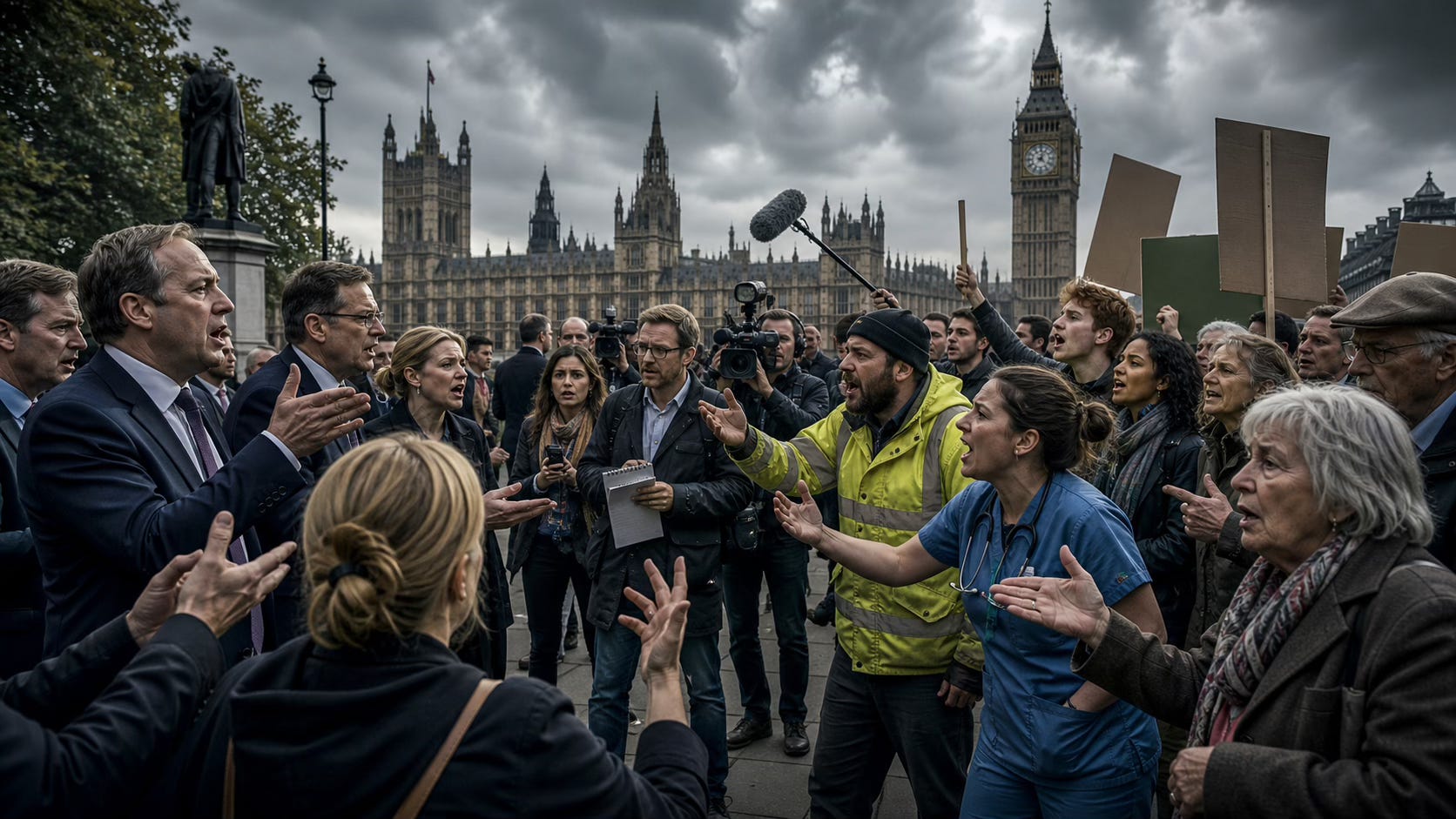
Is the UK becoming ungovernable?
Since Brexit, our centre of government, politicians and journalists seem to have had an addiction to chaos with six Prime Ministers since the referendum. Candidates to be the seventh are now limbering up for the job. It took over forty years to run through that many leaders before 2016. What is happening?
We are not suffering simply from bad luck with leaders, or only lingering division over the decision to leave the EU, or the peculiar viciousness of modern social media. Those things matter, but they are symptoms. The deeper causes are structural, and they were set in train long before the referendum. Until we confront them honestly, the chaos will continue – whoever is in Downing Street.
Politics is war minus the shooting
Theorist of war Carl von Clausewitz observed that war is a continuation of politics by other means. Turn it around: politics is war, minus the shooting.
This is not to be gloomy. I write it because naive ideas about how we “come together to decide what to do” make us blind to what is actually happening: conflict.
Politics involves seizing people’s property through taxation and redistributing it according to the judgements of those who hold power. It involves coercion and control, and a battle for those levers over other people. It will always attract intense disagreement. That conflict is managed, usually imperfectly, by democratic norms, accountability and the mutual understanding that the loser of today’s battle may win tomorrow’s. When those norms erode, management of political conflict breaks down.
One corollary is obvious yet frequently ignored: in any conflict, an exposed flank will be attacked. Boris Johnson locked down the nation with radical consequences for millions of families and was then seen not to have taken his own rules terribly seriously. Later, over Pincher, once trust in Number 10’s basic consistency was gone, ministers could not safely go out and defend him. They avalanched out.
Starmer has exposed his own flanks over appointments, over welfare and winter fuel payment cuts, through U‑turns, and now over the gap between expectations and delivery. His enemies are making the most of them.
These are not accidents of character, though character matters. They are the predictable consequences of a political environment operating at Gatling‑gun speed: mistakes that might have been survived in 1992 are lethal within hours today.
The acceleration problem
Social media did not create the human tendencies it exaggerates. Intra‑party factions are as old as the Corn Laws at least. WhatsApp groups replaced the smoke‑filled room: what changed is speed.
When MPs are under pressure from constituents expressing outrage in real time, they post a public position before they have heard the argument. Once they have posted, they are locked in. Daniel Kahneman’s fast brain has spoken before the slow brain engages; the amygdala has done its work. The fundamental attribution error does the rest: the other side must be wicked or corrupt, not merely mistaken.
I exploited this pattern ruthlessly in the Brexit years: if you could get someone to say “this deal sucks, I’m never voting for it” on X, you had their vote, because they now could not back down. The consequences would be too great.
The result is democratic deliberation systematically disadvantaged relative to performative commitment. Whips and ministers arrive too late to a conversation that social media concluded an hour ago. Today, the same mechanisms are being deployed inside Labour: mini‑power centres built around WhatsApp lists, organising against their own leader in days rather than months. And it seems to happen whether or however badly it is organised.
The deeper cause nobody wants to discuss
There is, however, a still more fundamental cause, one I have not ceased to articulate: our managerial system of government is breaking down under the weight of a welfare state we cannot afford and which fails to meet expectations.
Promises made to successive generations cannot be met from our productive output. The gap has been filled by debt and by the systematic debasement of the currency since Nixon closed the gold window in 1971. In the nineteenth century, a pound in 1900 bought roughly as much as a pound in 1800. Since 1971, the purchasing power of money has collapsed. That is not a coincidence. That is policy.
I put this thesis to Rishi Sunak in a private meeting. He readily agreed I was right. The room of some thirty MPs looked crestfallen, until someone said, “But we can’t do anything about it before the election” whereupon everyone relaxed and reverted to type. That moment encapsulates our problem precisely.
Liz Truss understood the fiscal reality and tried to act on it. She was also, simultaneously, spending enormous sums on an energy bailout. The bond markets noted the contradiction and drew their own conclusions. She was unlucky with undiagnosed structural problems in bond markets while caught between two incompatible imperatives. Her underlying diagnosis was not wrong.
It turns out reality is not optional. You can ignore it, but you cannot ignore the consequences of ignoring it. Rachel Reeves and the whole nation are discovering this now, after the Chancellor brought welfare cuts to MPs who told their constituents for years that austerity is a choice and said, “No thank you!”
Starmer’s current crisis sits at this junction: a government elected on the promise that “change” would be painless, running head‑first into the arithmetic they declined to discuss.
What this means
We are not in a crisis of personalities. We are in a crisis of governing model. The social‑democratic settlement of ever‑rising state promises, financed by debt and easy money, managed by a technocratic faith in state omnipotence, is today breaking down under the weight of its own contradictions. Absent a coherent reckoning, the public are voting for multiple, increasingly-radical parties in despair, and yet they are parties still failing to confront the fundamental issue: the failure of the managerial state.
Until a political party and a government are prepared to be honest about the trade‑offs and to seek a mandate for spending less, taxing less and devolving more to families, communities, individuals and markets, the pattern will repeat. The flanks will keep being exposed. The political Gatling guns will keep firing. Leaders of every stripe will discover that their majorities are as if made of sand.
The UK is not yet ungovernable. But it is being governed badly, by people operating in an environment their institutions were not designed for, making promises the numbers will not support.
That is a problem we can solve. Alas that solving it will not be easy.
I think that part of the problem with the governing model Steve is that it does not attract people of the calibre required to solve the problems. We need to attract people with more relevant and useful experience - and yes, pay them more. The issues we are facing are at least as complex as those faced by a FTSE100 CEO. Yet, we put half-wits in charge of running the show.
In years gone by I used to have huge admiration and respect for our politicians and used to think - no way could I do that.
Now, having spent time with many of them, and at the highest level ( you know who I mean). I think blimey - help!!