

The free market has garnered unfortunate branding. In the mind’s eye, the invisible hand manifests itself in the image of an overly-engorged cat, or an oil speculator straining the buttons of his waistcoat. Ergo, the free market is condemned as gluttonous and frankly, narcissistic.
The state - as evidenced in the very word for its interventions - appears, by contrast, as a benevolent pater with bottomless pockets, infinitely caring and wilfully ignorant of its encouragement of its children’s unending listlessness.
This characterisation is a masterstroke of marketing, softening the rhetoric flowing from the mouths of politicians seeking another “benevolent” redistribution or regulation. The heuristic runs deep: state intervention is empathetic to suffering, and to oppose it is callous, if not downright cruel. The mechanisms of the welfare state have been draped in a veil of good morals, when it is, in fact, just a machine. And paternalism’s moral high ground, however compassionate in intent, cannot be other than condescension - it is like an official talking down from his high-horse that his way of life is superior.
To challenge the “morality” of paternalism, supporters of liberty should embrace what has seemed to be anathema, and speak the language of empathy. It certainly helps that the free market has claim to being the truly empathetic force, although it has been awfully shy about it. The classical liberal is accused of pursuing “efficiency at all costs”, but no sane economist would sacrifice the good and beautiful in life for the sake of a well-oiled machine. After all, it is people’s goals that oil the machine - the fundamental belief of liberal economists that the free market is the best means for as many people to achieve as much peaceful fulfilment as possible. There is a tacit empathy in the free market, then, which lies far away from generalised, top-down sympathy.
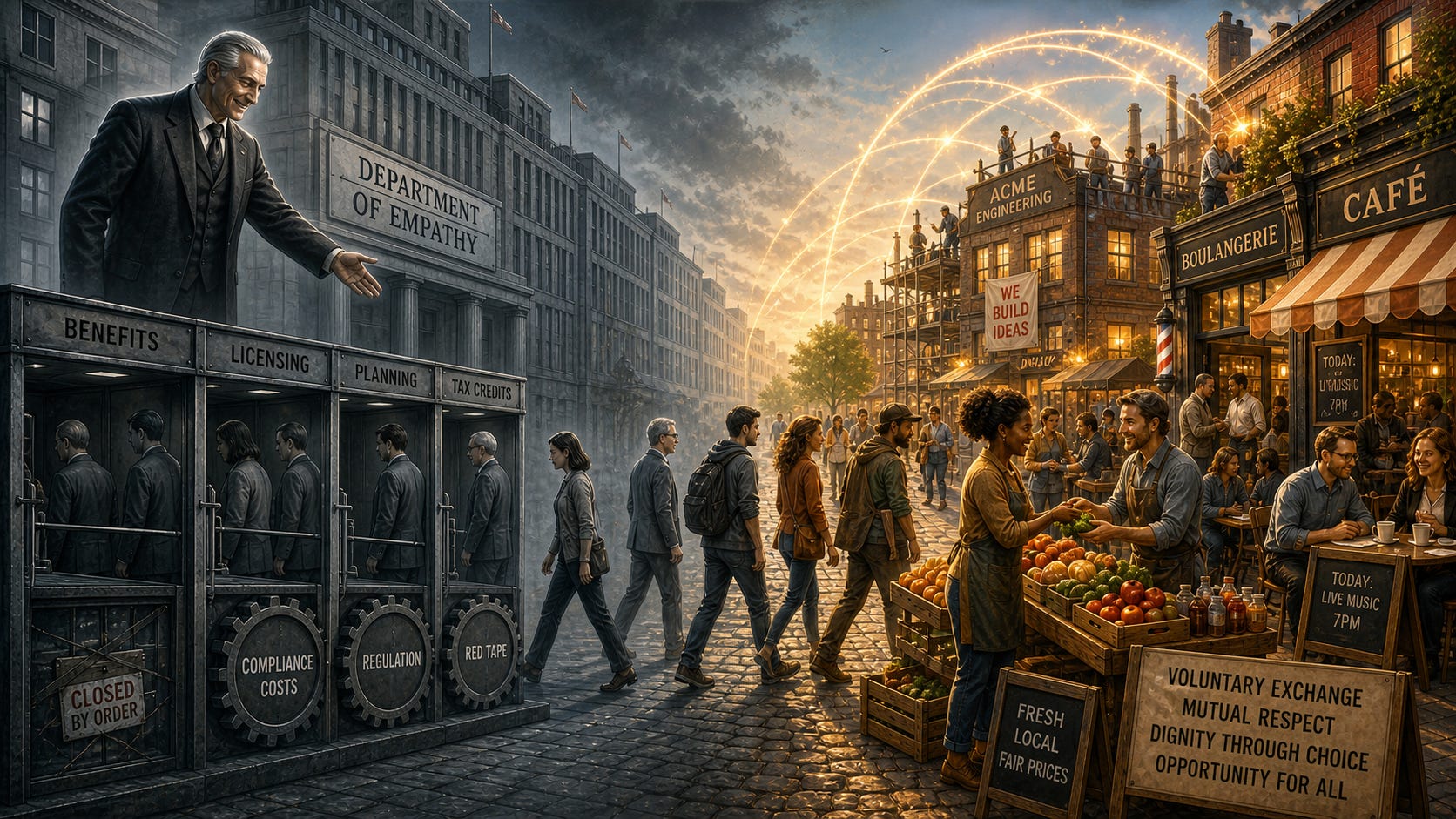
The free market does not shout about its empathy, precisely because its kindness comes from its wisdom that people are best left alone. Hayek’s knowledge problem remains prescient: a central authority, no matter how benevolent, cannot possess the requisite knowledge to provide for the infinite varieties of human lives. What we are left with is a line of best fit, which misses the mark for most individuals, determined from statistics sprawling somewhere in Whitehall. Whilst I’m careful not to disparage the value of statistics (a faux pas in the presence of economists, I fear), they can rarely peer into the living rooms, kitchens, and bedrooms of living people. The invisible hand, by contrast, can reach through walls, unimpaired by ideology or any incentives aside from the individual or family’s own.
The “empathetic” state, de jure, delivers for the bottom of the income distribution, to whom the left owes its rhetorical base. But de facto, beyond honeyed rhetoric, what is delivered is debilitating, serving only to satisfy the generosity that, admittedly, does exist in the left’s heart. The key is not to reject their kind intentions, but to expose them as misguided. Mountainous licensing rules - intended to protect - bar those with lesser means from entrepreneurship, as they are unable to afford the compliance advice that, say, finance and law can outsource. Planning restrictions - intended to preserve - build a wall preventing the flow of workers to where they would feel the most useful. And with these things surmounted, workers climbing in income consider working less to avoid a punitive marginal tax rate. Ultimately, the “empathy” of paternalism does not empower, but subordinates.
Reliance on the state is endemic, and dare I say needed, to provide the feeling of generosity that the paternalist so desires. Bastiat has most clearly elucidated the blindness that this “generosity” can engender. “What is seen” are the first-order effects: money is redistributed from those who have an “excess” of it to those who have a deficit, or planning permission is refused to preserve the 9pm bedtimes of those under Heathrow’s flight path. Both of these instances leave us, by virtue of their sheer visibility in the mind’s eye, feeling sorry for their sufferers. But what remains “unseen” is left in the cold: businesses unstarted, jobs uncreated, and the knock-on of a 50% increase in flights. Call to mind how many people could be lifted out of joblessness if a new factory emerged in the North East, just because a businessman was able to get into London on time and in a good mood.
The state is guilty of smashing the window of Bastiat’s parable through redistribution, forcing the taxpayer away from employing their money where it would be of best use, just as the poor man who has suffered his window being broken cannot now spend his money on, say, new shoes. That money would go, of course, where it would be of best use to the individual - but in a catallaxy, an individual’s choice tacitly becomes a business’s - and its suppliers’ - prosperity.
The taxpayer’s freedom to spend where they please, therefore, demands a re-frame to make it sound less like a fat cat pouncing upon its dinner. To appreciate the variety of people’s lives and choices - in effect, to respect them - is to cut the state’s ability to condescend. To recognise the infinite possibility of what is unseen is to open the doors to fulfilment - and, of course, economic growth (but that argument often fails to cut through, with a fat cat lying in its way).
Paternalism’s virtue does not work - “it’s the thought that counts” might as well be their brand. But the language of virtue is spoken through intervention, and to be silent is akin to being vicious. It will, no doubt, be a hard sell to prove that inaction is benevolent, but liberty must no longer shun its empathy - and, after all, it is true empathy, not mere sympathy, that respects the eclectic individuality of our lives.
Jennifer Holly is a student at Magdalen College, University of Oxford. She volunteers with Fighting for a Free Future and is committed to the fight for free markets and civil liberties. She can be followed on X through @jenniferaholly.
What I would like is honesty about the system we are currently operating within.
What we have right now is the paternalist, empathetic, caring, big state, socialist system you describe.
How would everyone say that is going?
I would say the country is in the worst state it has been in for 50 years, ever since the stagflationary 70's. Our unsound monetary policies, redistributive policies and anti-business and anti-free market economics have run out of road.
Society has been undermined by radical progressives from Tories and Labour over 30 years to create a siloed and polarised society. The harmony, community and safe society we once had is long gone.
How do we set ourselves up to live away from these failed policies and failed ideas? A breakaway state? A state that is explicitly free market?
I would prefer that to the current one where people pretend we have capitalism but instead we have a centrally controlled, highly regulated, high tax, low growth, managerial and redistributive state.