


Some of my most vivid memories of Boris Johnson’s election victory in December 2019 were the protests. One, in particular, sticks in my mind. A woman holding one of the mass-printed signs so popular with spontaneous, grass-roots movements; her eyes rolling back in her head as she repeated to the camera, “Not my prime minister, not my prime minister. Racist, fascist, sexist…”
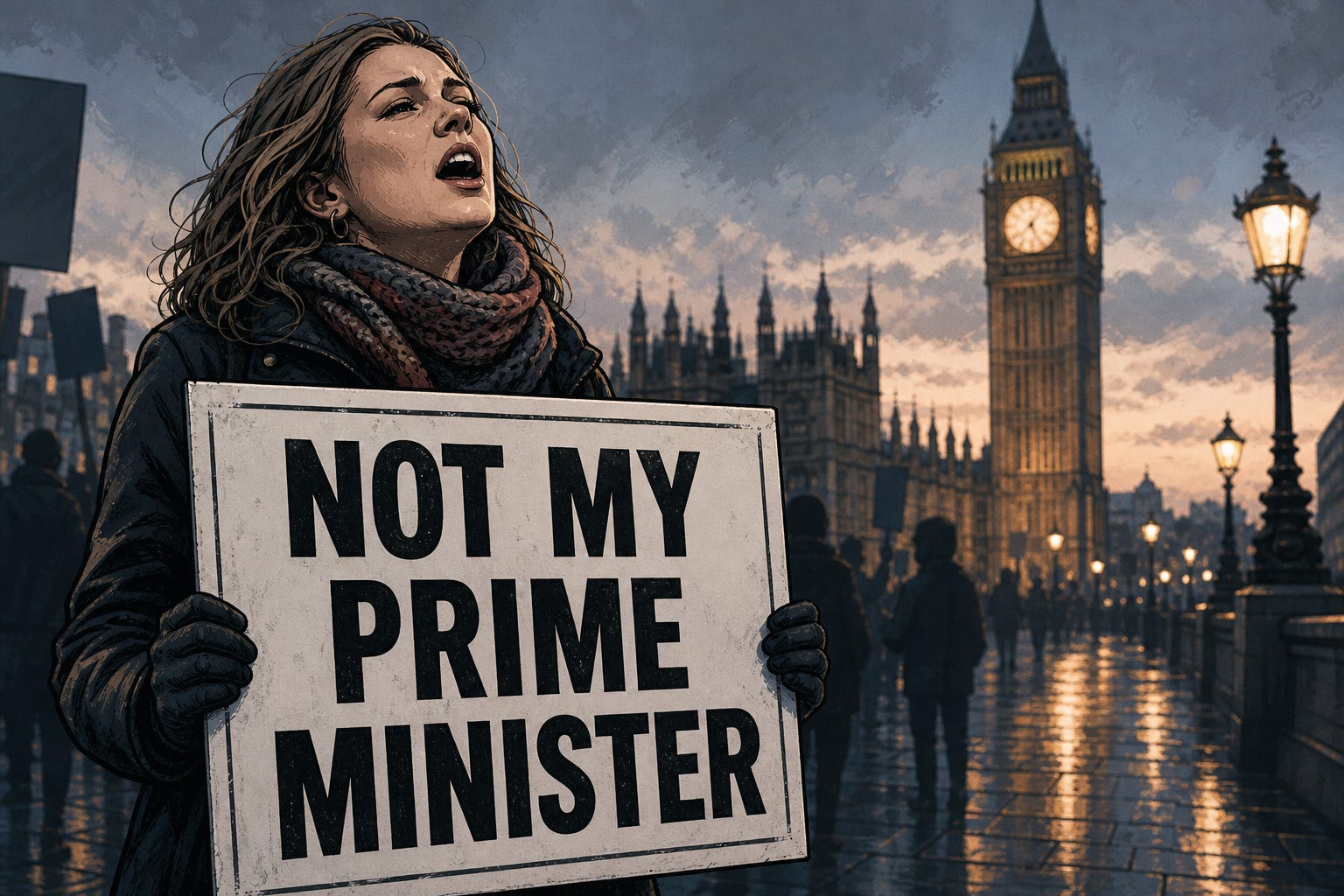
According to some of the more sober members of her company, what appeared to animate these people was the fact that Boris Johnson had won his “stonking” majority on only 43.6% of the popular vote, on a turnout of 67.3% of registered voters. This, they felt, did not confer upon him the mandate he needed to form a government and deliver us from the European Union.
As the revolving door of Tory Prime Ministers began to turn, the problem only got worse. Not only did the Tories have the support of a fraction of the electorate, but the leaders they were selecting internally often proposed radically different legislative offerings from those that Boris had originally campaigned on. And, to be fair, they had a point. The public did not vote for Truss or Sunak, and Labour members were keen to point out this constitutional travesty.
In the words of Angela Rayner, “the Tories have crowned Rishi Sunak without him saying a word about what he would do as PM. He has no mandate, no answers and no ideas. Nobody voted for this.”
So, imagine my surprise when, in July 2024, the same protesters were mysteriously absent from the streets of London. Not a peep was raised when the Labour party won their landslide win with a paltry 33.7% off a mere 59.7% turnout from registered voters. If Boris did not have a mandate to govern, Lord knows what the “loveless landslide” conferred upon the hapless Starmer.
And now a fresh leader waits in the wings. Andy Burnham looks to become leader without the say-so of the general public and with very little in the way of a coherent policy agenda. I would hope that Angela Rayner will be tweeting about the injustice of it all.
Andy Burnham does not have the mandate to govern. Not only is the government he intends to take over, one with foundations of sand, but he did not even become an MP in the election which created it! Andy Burnham? Not my Prime Minister.
Except, of course, that he is very likely to be. The response to his impending coronation has been to call for a general election. Some MPs have floated the idea of a law mandating a General Election in the event that the leadership of the party changes.
We elect a parliament, not a Prime Minister. The government must command the confidence of the house. If Burnham can do that, then more power to him. Whatever the apparent shortcomings of our “winner-takes-all” electoral system, it is still our system. Complaining about the results it returns after the fact is a bit like a losing rugby team complaining that they should have won with their beautifully worked try, despite their opponents slotting three penalties past them.
In case you needed further convincing, the current parliamentary Labour Party was individually elected by voters in 2024 and given a mandate to represent them. If those representatives give their support to Burnham, then that is where he derives his mandate from. Given that his politics more closely align with the PLP than Starmer’s ever did, it is arguable that he has more of a right to govern than Sir Kier.
So, Burnham is likely to be Prime Minister. Much good may it do him. He will shortly discover that Britain’s problem was not Starmer, but Labour being unwilling to make the difficult choices. And so the outcome is likely to be the same. Soon enough, we will be searching for a new messiah, or a very naughty boy.
Eve Lugg is a Voice for Freedom with Fighting for a Free Future. Eve Lugg served as Special Adviser (SpAd) in the Cabinet Office and brings with her experience in policy and comms, as well as knowledge of how Whitehall really operates.

Great article; love the Life of Brian referral!