


This series of The Insurgency is brought to you in association with Glint. Glint allows you to buy, save, send and spend real physical gold with a Mastercard®. Visit glintpay.com to find out more.
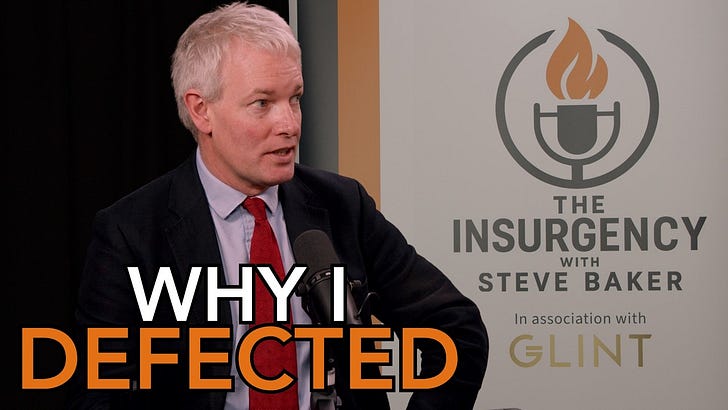
This week, Harry and Steve are joined by Bedford entrepreneur and podcaster Peter McCormack for a wide‑ranging conversation about why Britain’s politics and economy feel so broken, and what a genuinely anti‑establishment alternative might look like. Peter explains why he’s backed Rupert Lowe over Reform or the Conservatives, argues for a radically smaller state, and lays into Britain’s political class, welfare state and monetary policy for driving inflation, asset bubbles, and intergenerational unfairness.
The full episode is available, free of charge, on our YouTube channel. Please do like, share, and subscribe!
A write-up of this episode is available at the bottom of this post.
Heading into the new year, paid subscribers to Voices for a Free Future will have access to the exclusive Insurgency Post‑Show, where Steve and Harry discuss the political terrain more broadly with their guests. Subscribe today to watch!
This week on Voices
All the articles put out on Voices for a Free Future over the last week, in case you missed any.
The Counter-Insurgency: Mandelson, Starmer in China, Resident Doctors Strike

Welcome to the Counter-Insurgency, the Substack exclusive companion podcast to The Insurgency with Steve Baker. Every two weeks, Steve, Harry, and political consultant Laura Emily Dunn sit down to analyse the week’s events through the lens of the principles of a free society.

“Tories in Disguise”? Why Reform Doesn’t Mind Looking a Bit More Conservative
What is that I hear? Is it the sound of journalists pounding down Whitehall to yet another hastily arranged Reform UK press conference, lured by the promise of a fresh Tory scalp? In recent months, t…
Episode Write-Up
This week, Harry and Steve are joined by Bedford entrepreneur and podcaster Peter McCormack for a searching conversation about Britain’s political decay, monetary dysfunction, and what a genuinely anti‑establishment alternative might require.
Peter begins by explaining why he’s backing Rupert Lowe over both the Conservatives and Reform, arguing that Lowe is one of the few figures with integrity and coherent ideas rather than a reheated version of the political class. He sets out his view that Reform has drifted into the establishment it claims to oppose, staffed and shaped by defectors from the Conservatives, and now offers little more than tweaks to a failing system rather than a fundamental challenge to it. For Peter, the core problem is the growth of a sprawling state that interferes with every part of life and must be fed by levels of taxation that are politically impossible, forcing governments into chronic deficit spending and quiet monetary debasement. Against this backdrop, he calls not for a “best of a bad lot” government, but for a new movement that is explicit about wanting to dismantle large parts of the state, shrink its “surface area” for grift, and return government to a narrow role protecting life, liberty and property under a robust constitutional order.
From there the discussion moves into the mechanics and politics of actually delivering that sort of rupture. Steve & Harry discuss the idea that you can’t just parachute in a slate of political outsiders to smash Whitehall, pointing to Dominic Cummings’ failure to reform the civil service despite being one of the most powerful men in the country. They stress that ministers who lack experience of Westminster’s procedures and of how to work with officials will simply be “run rings around” unless they arrive with a clear programme, a solid majority behind them and an ability to operate within the rules while they change them. Peter agrees that sequence and process matter but insists that the aim should still be to hit the state across a wide front, using a strong mandate to force interest groups to pick their battles and to deliver a shattering, Milei‑style reset rather than yet another managerial rebrand. The three probe how far you can push this vision in a democracy bound by existing parliamentary procedures, equality law and international commitments, and whether it is realistic to draft radical bills in advance and ram them through on day one, or whether that too risks disillusioning voters when reality bites.
The conversation then broadens into Peter’s own story and how it shapes his political instincts. Steve asks him whether he would ever stand for Parliament, noting that in Bedford he has become a de facto civic leader through his businesses and activism. Peter is sceptical, arguing that he is better suited to working in the background, but he is willing to contemplate it if a serious anti‑establishment party with the right convictions comes forward and asks. This leads into a discussion of his past struggles: addiction, near‑bankruptcy and personal collapse, followed by recovery and success as a high‑profile Bitcoin podcaster and local investor. Peter reflects on the left’s inconsistency in preaching empathy for offenders while simultaneously weaponising his past against him, and on the tension in his own thinking between a libertarian sympathy for people who make bad choices and a hard‑line insistence on consequences. Steve, drawing on his own time visiting drug and alcohol rehab with serious offenders, argues that this mix of justice, responsibility and the possibility of renewal is precisely the kind of moral narrative the country needs as it approaches what he calls “rock bottom”.
From there they dive deep into economics, inflation and intergenerational injustice. Peter frames inflation as “the biggest con” played on ordinary people, a quiet way of transferring wealth from workers and savers to asset‑holders and the state. He illustrates the point with housing: his father could buy a four‑bedroom home on a modest income, whereas comparable properties for his own son now cost more than ten times as much, with wages nowhere near keeping pace. He and Steve agree that, once you look past headline inflation numbers, you see a steady erosion of living standards through shrinking product sizes, falling quality and young adults stuck living with their parents, unable to form households or have children. Steve brings in his historical work on prices back to 1750, noting that money held its value for centuries, with only modest inflation during the world wars, before the post‑1971 fiat era produced a dramatic collapse in purchasing power after Nixon severed the final link to gold.
The heart of their critique is the link between this monetary regime and the modern welfare state. Steve cites Alan Greenspan’s pre‑Fed writing to argue that welfare states structurally require chronic deficit spending, because their promises cannot be funded from tax revenue alone. The only way to sustain those deficits for decades is to debase the currency, steadily inflating away the real value of the debt while quietly taxing savers and salary‑earners. Peter extends this line of thought by pointing to how, in a debt‑based economy, new money flows first to those closest to the “spigot”: governments, banks and large asset‑owners, who see their houses and equities rise in price while everyone else struggles to keep up. He provocatively describes this as a kind of “universal basic income for the rich”, where the returns on leveraged assets and government bonds function as a permanent, inflation‑subsidised stipend for the already wealthy. For him, Bitcoin and hard‑money ideas are attractive precisely because they would force governments to live within their means and break this quiet, compounding redistribution.
In the subscriber-exclusive post-show, the three discuss this week’s ‘coup that never was’ against Prime Minister Keir Starmer, their reflections on it, and what comes next for the government and the country.


