


Fighting for a Free Future is pleased to continue our new series for Voices for a Free Future: Profiling Freedom. Each month, FFF Network Manager Ted Grainger will profile individuals who have bravely fought for freedom and represent the values that FFF espouses.
Welcome back to the series Profiling Freedom. For the second edition, I will be covering the life of John Lilburne, also known as Freeborn John.
John Lilburne was a parliamentarian and soldier who fought for the Roundheads during the English Civil War. He was arrested and imprisoned several times throughout his life, essentially for his absolute unwillingness to compromise on his principles and beliefs. This attitude meant that he was persecuted not only by the Realm, but also by the Commonwealth after the Civil War, despite fighting for its creation.
Lilburne was born around 1614, most likely in Sunderland. This was the year of the Addled Parliament, when James I recalled Parliament after a seven-year hiatus. It was dissolved the same year due to the parliament’s unwillingness to grant new taxes to the King. This is, of course, the backdrop to the Civil War, which began a few decades later.
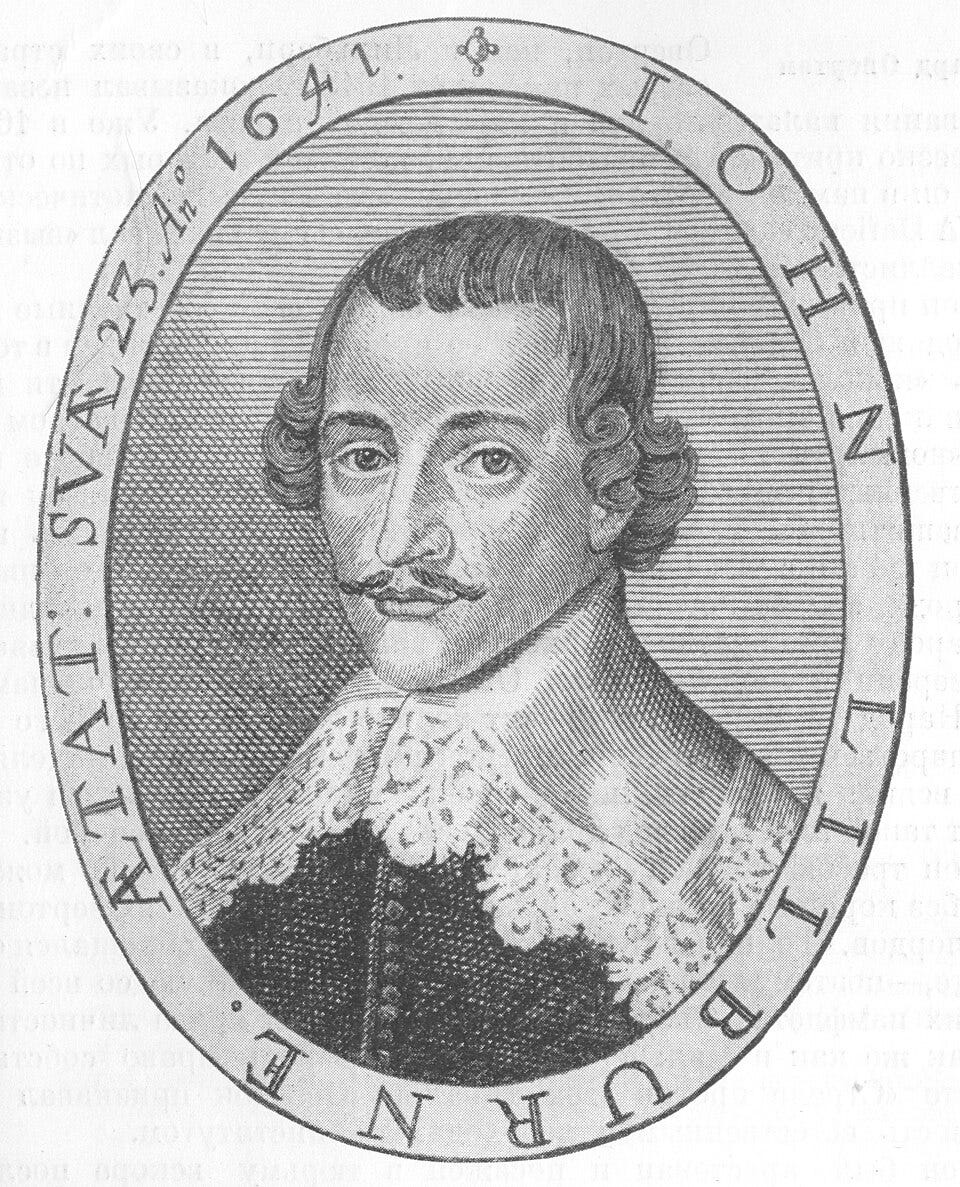
Prior to the Civil War, he had already gotten himself in trouble due to unauthorised publication of texts. At the time, all printing press publications required licensing from the Stationers’ Company in order to secure regime control. Upon his return from exile in 1637, he was arrested and brought before the court of Star Chamber in the Palace of Westminster. Crucially, he was asked how he pled despite the fact that he was not charged with any specific offence, and he refused. He also refused to take the ex officio oath that was required by the Star Chamber.
These are vitally important moments in the fight for liberty for reasons that were probably not immediately obvious at the time. John Lilburne refused to comply with the authorities because of the belief in “freeborn rights”. This was a fairly new idea: that rights were not something merely granted by the government, but something that all people were born with. In this case, Lilburne believed that all men were born with the right to know the specific charge they were charged with, as well as the right to not incriminate themselves as necessitated by the ex officio oath. If this sounds familiar, it’s because this belief, and this case, are directly responsible for the creation of the 5th Amendment to the United States Constitution. Lilburne was even cited in the majority opinion of the landmark Supreme Court case Miranda vs Arizona, which created the eponymous Miranda Rights in the US.
We very much take the right to a fair trial for granted. We often think about show trials as something that happens elsewhere. Not many people know of Freeborn John, but it’s to him that we owe a great debt, not just here but around the world as well.
This was far from the only occasion in Lilburne’s life where his refusal to comply resulted in clashes with authority. During the Civil War, he naturally signed up to fight for the Parliamentarians. Despite becoming friends with Oliver Cromwell, he resigned from the army in 1645 over his refusal to sign the Solemn League and Covenant. This was an agreement between Scotland and the Parliamentarians that would guarantee the existence of the Reformed Church in Scotland. Lilburne was not a Presbyterian but a Puritan at this point. He had no qualms with the Presbyterians and defended their right to practise their faith, but he refused to support any plan to ensure that it was the only faith that could be practised in Scotland.
This was a recurring theme for Lilburne after the Civil War. He fought to overthrow the monarchy because of its inability to ensure freeborn rights. He quickly, though, became disgusted with the extent to which the Commonwealth under Cromwell simply replaced the dogma and tyranny of the monarchy with its own form.
The point of this series is not just to go through the biographies of great heroes and just say how courageous they were. The point is to learn how these figures achieved their great feats and what tactics we can take from their struggles and heroics.
In this case, it’s Lilburne’s campaigning and popularity with the general public which is so striking. It might be hard to imagine such popular support for a philosopher advocating for freeborn rights in this day and age, but he achieved this on such a scale. In 1648, he presented a petition to Parliament on a written constitution that was signed by a third of all Londoners. In 1649, he was put on trial for high treason at the Guildhall. When he was acquitted, the public cheered so loudly and for so long that the trial could not be formally ended for half an hour.
This is what we need to recapture. John Lilburne’s ideas were able to reach popularity in a time of crisis because the populace were politically engaged. This was a population which largely was not even able to vote at this time. In order for us to succeed, freedom needs to be popular again, and as Lilburne has shown, we need popular figureheads in order to achieve it.
Ted Grainger is the Network Manager for Fighting for a Free Future. He has previously worked as a parliamentary aide, as the red tape researcher for a Shadow Minister, and for Popular Conservatism.