


Fighting for a Free Future is pleased to introduce a new series for Voices for a Free Future: Profiling Freedom. Each month, FFF Network Manager Ted Grainger will profile individuals who have bravely fought for freedom and represent the values that FFF espouses. This series will replace our previous Tyranny of the Month series.
Welcome to the first instalment of my new series for the Voices for a Free Future Substack, Profiling Freedom. I thought I would start this new series by giving a brief explainer on what it's about and why we at FFF decided to start it.
In each instalment of Profiling Freedom, I will be exploring a different figure from history, either recent or older, and their personal struggle for freedom. The aim being to focus on what lessons we can learn from these brave and righteous individuals who often sacrificed everything in pursuit of freedom. Quite frankly, storytelling is one of the most powerful devices at our disposal. We love stories as they make us feel alive, and make us, well, human. And yet I feel those in the liberty movement underutilise storytelling. There is no reason for this to be the case, not least because the story of liberty is one of the most powerful stories man has to tell. I can be certain that I will not run out of stories for this series.
This week we will be profiling the story of Sophie Scholl. Sophie was a member of the White Rose, a non-violent Nazi-resistance group that existed in Germany from 1942-1943. Sophie was raised in an ordinary household. She was the fourth of six children born to Magdalena and Robert Scholl, who was the mayor of their town in the Weimar state of Württemberg. The Scholls were a devout Lutheran family, and faith became central to Sophie’s beliefs.
Whilst Sophie’s politician father was always an anti-Nazi, the same was not always true of his children, including Sophie. At age 12, she joined the female branch of the Hitler Youth against the wishes of her father. As she grew up, she became disillusioned with Nazism as she began to witness the persecution of her Jewish friends. In 1937, her brothers, including Hans, who had also originally been members of the Hitler Youth, were arrested by the Gestapo for being members of the German Youth Movement, which led to her further disillusionment with Nazism.
Upon graduating from secondary school, Sophie initially became a kindergarten teacher. Only a year later, though, she was forced to leave this job to become a nursery school teacher in Blumberg as part of her National Labour Service requirements for entering university. After her six-month service had concluded, she enrolled at the University of Munich studying biology and philosophy. It was here in Munich where she would make the friendships that would later form the White Rose.
However, what I find most intriguing is that this friendship did not begin as a political resistance operation. It was far more ordinary than that. They bonded over their shared love of music, of theatre, of art. I am a big believer in the beauty of the ordinary and how greatness can, and often does, come out of it.
Rather quickly, this group of ordinary friends became the White Rose. It was started by Sophie’s brother Hans and Alexander Schmorell, who wrote and published their first four leaflets in the summer of 1942. Around this time, Sophie also joined by helping to distribute their leaflets. This was the way in which they operated. The White Rose was committed to passive resistance by publishing pamphlets aimed at the German intelligentsia, whom they saw as those able to be influenced by alternative ideas. They spoke through the ideas of Goethe, Schiller, the Bible, and Aristotle to influence change.
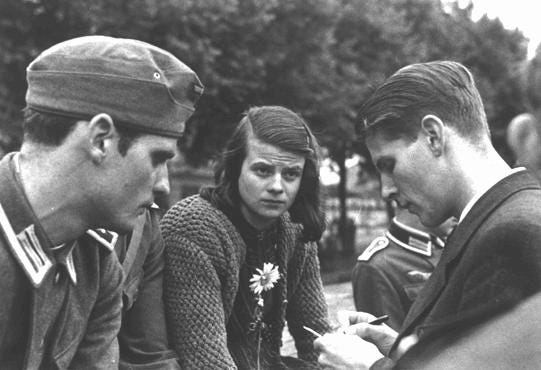
They recognised that tyranny cannot survive through terror alone. It also needs the educated to fall silent, to rationalise, to avert their eyes, and to carry on without dissent. Therefore, they had to reach these people and make it so that ignorance was no longer an option. Friedrich Hayek later made a parallel argument for free societies. Political change, he said, begins not only in parliaments or polling booths, but among the people who decide which ideas are worth taking seriously.
In February 1943, Sophie and her brother Hans were arrested by the Gestapo whilst disseminating leaflets at the University of Munich. Hans confessed first and sought to protect the culpability of other White Rose members. However, seeking to do the same, Sophie admitted her own guilt, despite initial beliefs among the Gestapo that she was innocent. In court, she is recorded as saying,
Somebody, after all, had to make a start. What we wrote and said is also believed by many others. They just don’t dare express themselves as we did.
I trust that as the reader, the poignancy of this comment is not lost on you. Her reported last words to her cellmate were somehow even more poignant:
How can we expect righteousness to prevail when there is hardly anyone willing to give himself up individually to a righteous cause. ... It is such a splendid sunny day, and I have to go. But how many have to die on the battlefield in these days, how many young, promising lives. What does my death matter if by our acts thousands are warned and alerted.
This is the lesson that we must learn from Sophie Scholl and the White Rose. We must make sure that within ourselves, the defence of liberty is not optional. To be ignorant, consciously or otherwise, is to be culpable. Sophie Scholl was prepared to sacrifice her life, as she did on the 22nd February 1943, when she was executed by guillotine, in the name of liberty.
Ted Grainger is the Network Manager for Fighting for a Free Future. He has previously worked as a parliamentary aide, as the red tape researcher for a Shadow Minister, and for Popular Conservatism.
I like this new series Ted. Just the right length. You summarise Sophie's story, and the lesson to be learned, perfectly.
Makes me shudder to think of what she and others like her had to endure.
Looking forward to the next instalment.