


One Saturday morning, I was walking to Whitstable parkrun from the station when I passed a hedgerow sprouting various protest signs. The garish design stared me down as I braved the winter seaside winds. Then I passed another. And another. “SAY NO: EVEN MORE HOUSES FOR WHITSTABLE”; “STOP 1,400 HOUSES.”
These are pretty wild statements to me as someone of the YIMBY persuasion, but nonetheless the slogans achieved their goal: make me feel something unwelcome was happening to a beloved place.
Twenty minutes later, I jogged along with a few hundred others, many of whom, if polled, would likely say Britain needs more homes. Nationally, of course. Not here, though.
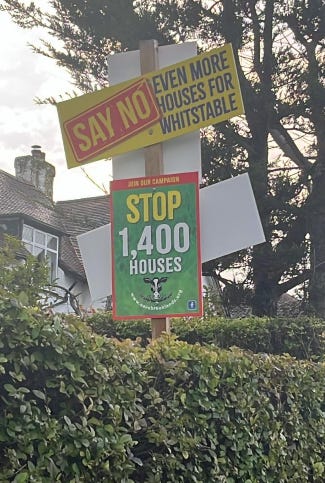
This is a wide-ranging phenomenon across the country. And it’s why Britain keeps losing the housing war, one planning committee at a time.
In our labyrinthine system, every project becomes a mini-referendum where a small, highly motivated group faces a larger, lightly interested majority. Only one side turns up on a wet Tuesday night, and, usually, gets its way. Then comes the under-supply, pushed-up prices, and the occasional election of a new party with grand promises to fix it this time, we promise! Round we go.
All this is a product of our own doing. Since the 1947 Town and Country Planning Act, the right to develop land has effectively been nationalised. Councils decide, case by case, who may build what and where, making house building infuriatingly piecemeal. We’ve effectively created a planning state that turns land use into a political rationing exercise, and then we are surprised when it happens.
At the national level, a different story emerges. Support for “more homes” has grown, especially among under-40s, renters, and workers priced out of commutable areas. According to YouGov, 10% of voters listed housing amongst their top 3 most important issues in deciding who to vote for in 2024, particularly Labour voters.
But national sentiment is weak currency in a parish hall. The decision is local, the loss feels immediate, the gain is abstract, and the people who stand to gain most (the yet-to-comes) aren’t enfranchised. The result almost always ends up in a stalemate.
Even when development passes, sometimes the process is so hair-splittingly arduous that only deep-pocketed developers see it through, which deepens public distrust. People feel developments are “done to them” by suits who won’t live with the consequences, so they mobilise to say no, regardless of the long-term benefits.
Back to Whitstable. There’s some context I’ve left out.
The development is planned for productive farmland. Critics warn of road safety and congestion to sewage overflow, pressure on local services, and nature loss. These are valid worries. But when the rallying cry becomes “No More Homes,” the message goes from “build better” to “don’t build.” That sort of blanket rejection entrenches the exact dysfunction it opposes.
The development, in its current form, admittedly doesn’t meet all the tests a good pro-housing policy should. But that doesn’t mean it’s a lost cause. Fix the siting, build stable infrastructure first, safeguard wildlife corridors, do *something* productive, and it could still deliver much-needed homes with added bells and whistles to appease locals. At a time when Whitstable, much like the rest of the country, does need homes, shouting down development benefits nobody.
As mentioned before, most people would agree that the housing crisis is urgent, but it’s someone else’s fault to solve, somewhere else. Certain voters will say yes to more homes in the abstract, then protest the moment a nearby plot is flagged for development. Why?
Because your average voter loves free stuff, or, alternatively, more stuff; cheaper housing, lower taxes, better pensions, and so on. But there is always a point where “free” and “more” encroach on things they value.
In this planning regime, the trade-off seems bleakly binary: keep your view and your slower development, or accept change imposed from outside. Faced with that choice, rational people defend the status quo, and the cognitive dissonance of “more homes, just not here” sets in.
When “not here” is the starting point in every community, you get paralysis. The abstract goal of building more homes keeps colliding with the visceral discomfort of building anything nearby. And so, we live with the consequences: sky-high rents, stagnant wages, and younger generations locked out of ownership.
Obviously, no single reform will fix this on its own. But every delay, every plan shelved, every local uproar chips away at our credibility. At some point, we must decide whether we actually want to solve this crisis or just keep pretending to.
This isn’t necessarily some moral failing. If a system centralises development rights and then allows every application to be fought over, why wouldn’t that mindset seep elsewhere? So, if the government insists on being the flagbearer for housebuilding, it should act like it.
Labour, to its credit, dared to try loosening planning reform. But unless they’re willing to gut the bureaucracy (or just get rid of the Department for Levelling Up entirely – some of you reading mightn’t complain), those ambitions will be buried under more consultations and guidance PDFs
The simplest solution is usually the best. Set clear national rules, reward affordability and infrastructure delivery, then get out of the way.
Secondly, localism needs to grow up. Communities should have a say, but not a full veto. Planning should be rule-based and outcome-focused, not a drawn-out arm-wrestle over every brick. Bridging the democratic gap set up by housing-resistant locals might mean experimenting with citizen juries and/or renter representation, or encouraging positive sentiment by letting citizens contribute to design codes, rewarding streets that opt in, and by delivering visible upgrades first. At least then, they’ll rest assured the diggers are operating with their preferences in mind.
There may be resentment towards ‘outsiders’ weighing in, but realistically, it’s as much their desire as locals’ that the place they move to has the best amenities for their needs. If the conversation centres around this and focuses on Brown/Grey Belt posing as Green, building upwards, or collaborating with local planners to ease worries about traffic, infrastructure and nature, you’ll hit a harmonious balance much easier (particularly if you reward those who say yes).
One may also suggest building more new towns from scratch. But if they become another exercise in central micromanagement and building for the sake of it, they’ll go the way of eco-towns and other stillborn blueprints. The best approach would let local or private actors propose sites, fast-track planning where pre-set criteria are met, and auction plots transparently with clear build-out expectations. Done right, it could spark real competition not just between developers, but between places, too.
The same logic can apply at street level. Instead of every extension or extra storey running the town hall gauntlet, neighbours could be allowed to agree on binding design codes. That way, you use contracts and local bargaining to govern change, as a liberal society should.
Third, we need to make saying yes feel like the rational choice. Right now, local authorities take on all the blame for approving homes, with little of the upside (or they just vote-win by steadfastly saying no). If infrastructure lags and services strain, they have to deal with it, so why stick their neck out?
Worse, the thicket of funding rules and permit hurdles leaves councils too under-resourced and over-bureaucratised to work constructively with developers or local entrepreneurs.
Rather than funding more from the centre, remove the blockers. Let councils retain more revenue, streamline planning obligations, and make it easier for local actors to deliver homes and amenities together, even if that means devolving past council wards.
There are other options floating around, of course; chief among them, the Greens.
Their package of phasing out private landlordism, rent controls, scrapping buy-to-let, and paying for mass builds via LVT, while optimistic, would freeze the market we need to mobilise. Price caps deter new supply; removing buy-to-let chokes off private capital, and LVT likely becomes another inevitably mismanaged revenue stream. No landlord-eating can fix that.
Ultimately, you end up rationing housing rather than expanding it.
All this may sound appealing to voters in manifesto speak, but this is the “more stuff” problem all over again. No tax system could ever sustainably support this, let alone have it work in practice.
It may seem harsh to frame opposition to local development as part of the problem, even if there are genuine concerns worthy of bringing up. But that’s the uncomfortable reality.
We cannot say “yes” in theory and “no” in practice forever. If every community treats its green edge as sacred, its roads as enough, and its skyline as finished, romanticised ideas of preservation inevitably lead to stagnation.
Nationwide, jointly kicking the can down the road makes economic opportunity suffer to where even basic housing becomes a luxury, particularly for younger generations. Embracing friction is now necessary. No one will love every change, but they may come to appreciate what it makes possible.
Uphold the status quo, and we’ll keep getting Whitstables on a Saturday morning: towns that love themselves enough to say no, at the cost of a country that needs so many places like it to find a way to say yes.
John Abbott works at Smart Thinking, a think tank network connecting London’s think tank world. He has previously worked at prominent free market institutions such as the IEA and EPICENTER.

Serendipity strikes again - this link was in my inbox today
https://mises.org/mises-wire/why-have-homes-become-so-unaffordable
Worth a read.
High house prices are not a function - primarily - of a supply shortage. The ONS stats indicate that we have built roughly enough dwelling units to cover the population increase. Except for immigration - possibly / probably.
High house prices are a function of government failure. Failure not only with planning but principally with taxation policy, subsidy policy, currency failure and unwarranted currency expansion.
In the UK we tax production - labour, capital and entrepreneurs - and subsidise and / or under-tax land. And land is parasitical.
So to sort out house, aka land , prices you must:
Have sound money and stop credit expansion.
Shift tax from wealth creating production to rents
Stop landlord subsidies like housing benefits etc
Sound Money is the key. And you'll have fun getting that past The Blob. The idiot socialists and the rent seeking Tories.