


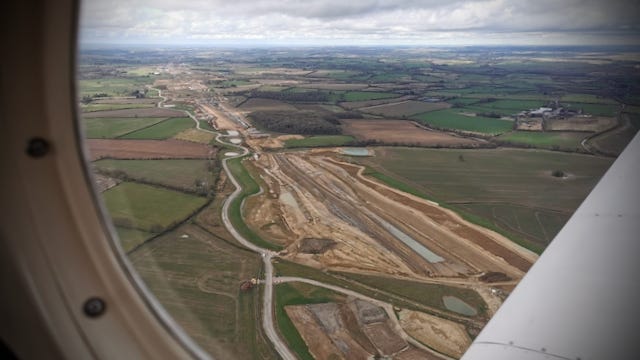
In 2010, I stood up in Parliament’s Westminster Hall and asked whether it could possibly be right to drive a railway viaduct across the Colne Valley and the Chilterns AONB in pursuit of the supposedly overwhelming national benefit of HS2. Sixteen years on, HS2 has given us an answer. The beauty has been blighted, the property rights have been overridden … and we reap hideously expensive failure.
This is not a story about trains. It is a story about institutions: about how a politicised rail system, prestige politics and concentrated interests produced a project that looks, in retrospect, uncannily like a case study from the Institute of Economic Affairs.
From Chilterns viaducts to cancelled phases
When the scheme was first sold, ministers talked in terms of roughly £32–33 billion for a Y‑shaped network from London to Birmingham, Manchester and Leeds. Credible estimates for even the truncated London–Birmingham core now run in the £70–80 billion range at current prices. Phase 2 to Manchester has been cancelled; HS2 Ltd alone has booked more than £2 billion of one‑off losses on sunk assets for the northern leg and related scope changes.
Even the surviving core is delayed beyond the already‑slipped 2033 opening date, with no firm new date and no contracted train fleet. The National Audit Office and the Public Accounts Committee now describe HS2 in language that would have been dismissed as the rhetoric of its early opponents: out‑of‑control scope, fragile business case, serial cost overruns and poor transparency.
This matters for more than the Chilterns. In 2010, I argued that if the economic and environmental case were not overwhelming, the project could not justify “so grotesque an intrusion into property rights and local collective enjoyment of the natural environment”. That condition has not been met. What remains is an over‑extended state project with very visible costs and increasingly hypothetical benefits.
HS2 as public choice in action
Eamonn Butler’s short IEA book Public Choice – A Primer starts from a simple idea: people do not become angels when they enter public life. They pursue their interests, notably votes, budgets and careers, just as firms pursue profits. Once you apply that lens to HS2, the pattern is depressingly familiar.
First, concentrated versus diffuse interests. HS2 offered intense, focused benefits to a relatively small set of players: large engineering firms, consultants, parts of the rail supply chain, and some city‑region lobbies betting on land values and regeneration. The costs – tax, disruption, environmental damage – were spread thinly over millions of taxpayers and thousands of affected households. Each individual had only a small financial stake and very high organising costs. As Butler puts it, “small groups with sharply focused interests have more influence…than much larger groups with more diffused concerns, such as consumers and taxpayers”.
Second, rent seeking. Gordon Tullock coined the term for the effort spent lobbying the state for monopolies, privileges or transfers, instead of creating value. HS2 was almost designed as a rent‑seeker’s playground: a multi‑decade, politically protected capital programme with huge discretion over routes, tunnelling, station locations, compensation regimes and procurement. It would have been astonishing if affected interests had not spent millions of pounds lobbying to shape those choices in their favour.
Third, logrolling and coalition‑building. To hold the project together politically, successive governments stitched different goals into HS2: long‑distance capacity, regional “rebalancing”, a Heathrow link, a Northern Powerhouse badge, and a national engineering showcase. Each bolt‑on brought in another supportive interest group. Each also added complexity, cost and fragility. Once the fiscal tide turned, the coalition frayed – and the “Y‑network” quietly collapsed into a single, truncated arm to Birmingham.
In other words, the project looks very much like Butler’s world of rational self‑interest in the political sphere: minorities dominating representative democracy, logrolling to expand the state’s budget, and “government failure” at least as severe as any supposed “market failure” in rail.
They meant well
D. R. Myddelton’s They Meant Well – Government Project Disasters surveys six large twentieth‑century projects: R.101, the groundnut scheme, nuclear power, Concorde, the Channel Tunnel and the Millennium Dome. His conclusion is unambiguous: “each of the six projects aimed to promote the national interest, but each resulted in huge losses”, with any technological or prestige benefits coming “at huge expense”.
Several of his recurring pathologies are starkly visible in HS2:
Prestige politics. R.101 was an imperial project; Concorde and the first nuclear programme were about national greatness; the Dome was sold as a millennial emblem. In a similar way, HS2 was presented as “the principal infrastructure project of our time”, proof that Britain could still do the big things. Once the scheme became a prestige symbol for prime ministers and Chancellors, mundane questions about opportunity cost were crowded out by the fear of losing face.
Optimism bias and opaque costs. Myddelton notes that initial estimates are routinely “purposely too low” and that government accounting tends to conceal true costs. HS2’s journey from c.£33 billion to sums more than double that – without an equivalent expansion in capability – is entirely in line with his earlier cases. The NAO has had to work hard to piece together the full fiscal picture, including Phase 2 write‑offs and Euston‑related costs.
The “too late to stop now” syndrome. In Myddelton’s case studies, projects that should have been cancelled early – the groundnut scheme, Concorde – staggered on because ministers could not bring themselves to admit failure. HS2 has followed that script. Parliament was repeatedly told that billions had already been spent on land, design and early works, so cancelling would “waste” that money. Only when Phase 2’s economics became completely indefensible was it finally dropped, at a cost of more than £2 billion in formally recognised write‑offs.
Soft budget constraints. In the market, a failing project eventually runs out of investors. In the state sector, it runs into the Treasury. Myddelton observes that, as a result, “governments often choose to continue projects…even after it has become clear they are not commercially viable”. HS2 is a textbook example: every warning – on geology, costs, demand, governance – produced not a reset but another round of cash, scope changes or timetable slips.
The result, again, is not malevolence but misaligned incentives. They meant well; they did not pay.
Rail without prices
In 2010, I suggested that British Rail was “neither fish nor fowl”: a system of franchises whose contracts descend into specifying “biennial talent management programmes”, ministerially constrained fares, and constant structural tinkering since 1948. That is not a market: it is a hybrid bureaucracy in which “economic calculation is likely to be hampered, if not irrational”.
HS2 magnified that problem. In a genuine market, capacity and alignment decisions would be disciplined by price signals and revealed demand. Here, long‑distance fares are politically constrained, and the business case rested heavily on DfT’s value‑of‑time assumptions – including the quaint view that business travellers cannot work on trains. Remote work, videoconferencing and laptop culture have quietly shredded those premises.
Meanwhile, William Niskanen’s budget‑maximising bureaucrat seems to have found a home in our transport institutions. Officials and delivery bodies had every plausible incentive to favour a large, complex, long‑lived project with a growing budget and correspondingly little incentive to champion incremental upgrades and removing bottlenecks on existing lines. Yet the latter – longer trains, better signalling, targeted four‑tracking – are exactly the kinds of investments that can be evaluated, tested, corrected and, in extremis, stopped.
We have therefore ended up with the worst of both worlds: a politicised pseudo‑market in which neither prices nor profits reliably guide decisions, and in which the coercive powers of the state can be deployed to override local communities without the discipline that a real balance sheet would impose.
A different way of doing infrastructure
Public choice theory is sometimes accused of cynicism. In fact, Butler and his colleagues are simply asking us to take human nature seriously and then design institutions accordingly. If we do that, HS2 offers some clear lessons.
First, constitutional restraint matters. Long‑lived, high‑risk capital projects that trample property rights and protected environments should not be authorised by a simple whipped majority on the back of a headline promise. Buchanan and Tullock’s instinct – higher voting thresholds, hard budget limits, explicit time‑limited mandates – should not be reserved for academic seminars.
Second, we should prefer modularity over grandiosity. Almost every Myddelton case would have been less damaging if government had favoured small, testable increments over single “silver bullets”. Rail is no different. A serious, classical liberal approach to capacity would start with timetabling, signalling, platform extensions, rolling stock utilisation and targeted new links, not with an all‑or‑nothing, multi‑decade bet.
Third, we should take ownership and incentives seriously. The more the state controls both the customer interface and the investment decision, the more politics – not value – will drive choices. A classical liberal approach would treat rail and road as industries rather than permanent candidates for discretionary capital grants: open access, genuine competition where feasible, real prices, and risk borne by investors who can lose.
None of this means abandoning infrastructure, any more than abandoning Concorde meant abandoning aviation. It means abandoning the notion that national greatness can be ordered up from Whitehall by edict, regardless of prices, incentives or knowledge. And it means being honest that HS2 does not show the dangers of doing too little – it shows the dangers of doing the wrong thing on the wrong terms.
The Chilterns will not recover quickly. Nor will the public finances. But if HS2 finally persuades thoughtful people that a state‑centric, prestige‑driven model of infrastructure is failing, and that we need a more modest, plural and constitutional way of doing these things, it may yet have performed one useful service.
Just not the one advertised.
I worked in the rail industry for c. 18 years, Steve and I was always a bit sceptical about the case for HS2, wondering (as you wrote) whether the money might be better spent on things like signalling upgrades or additional targeted investment (eg better east-west links in the north).
Excellent analysis.