


For a country obsessed with football, the UK makes it surprisingly difficult to actually watch it.
For decades, supporters have faced a fragmented broadcast landscape. If you want to follow your club, you’re either paying hundreds of pounds yearly across several platforms, googling VPNs or dodgy streams, or staring at The Guardian’s live updates page for 90 minutes. What was a collective, week-in-week-out ritual has become a logistical and financial headache.
From a free-market perspective, that’s an odd place to be in. You have millions of willing buyers, dozens of willing sellers, and a product already being filmed and shown worldwide. Yet domestic fans are blocked by regulation and cartel-style rights packages that would be laughed out of most other markets.
This wasn’t always the case. For most of the 20th century, live league football on TV was practically non-existent, with the rare televised game considered a novelty. That changed in 1992 with the formation of the Premier League and its exclusive landmark deal with Sky Sports, making live top-flight football a regular presence in British homes.
Sky’s stranglehold was challenged by a 2006 European Commission ruling forcing the league to split its rights into packages available to other broadcasters. BT Sport (now TNT) entered the fray, as did Setanta, ESPN and Amazon, at various points, all offering their own unique subscription plans.
While the intention was understandable, the EC executed it poorly. Instead of promoting competition for viewers, oligopoly blossomed. Matches were split individually between broadcasters, making fans spread themselves thinner between companies to watch their teams. The league still sells the same rights bundle; they’re just sliced and re-sliced behind different paywalls.
And then there’s the blackout.
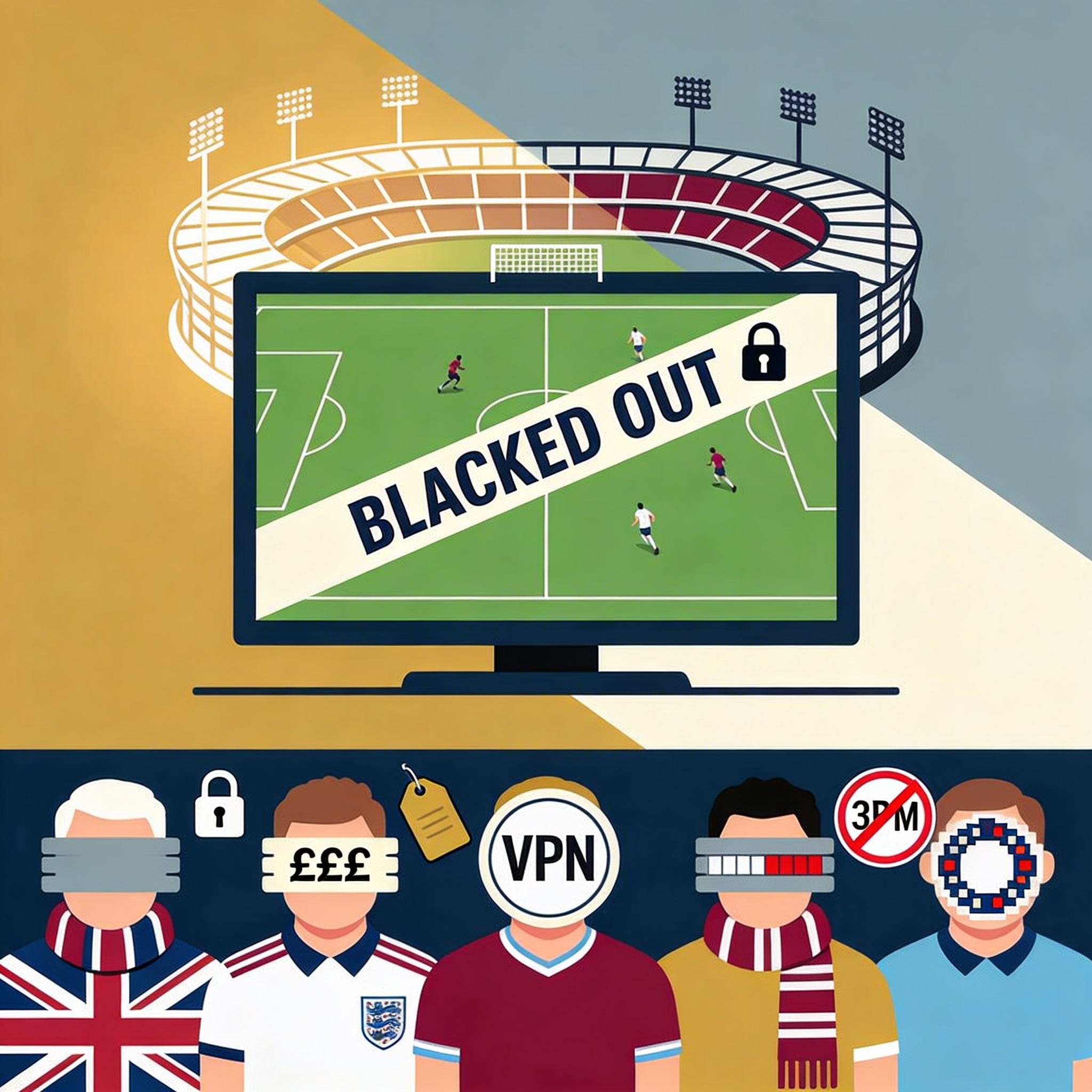
Since the 1960s, live football has been legally banned from broadcast between 2.45pm and 5.15pm on Saturdays. It’s from a bygone era when televised matches were believed to hurt lower-league attendance. If you can’t watch Man City on TV, maybe you’ll watch Stockport County in person instead.
Perhaps this made sense in the age of two channels and one televised match a month at most. But we’re not living in the past anymore. If a team and broadcaster want to sell you a 3pm stream, and you’re willing to pay for it, the only reason you can’t is that the government and the FA long ago agreed you shouldn’t.
The average fan just doesn’t attend local games out of some vague sense of duty. They’ll either go to great lengths to watch Prem matches another way, often illegally, or not bother whatsoever. Lower-league clubs gain a smattering of extra attendees at best, who’ll probably be checking their phones for updates instead of watching the match anyway.
Thankfully, things have improved. The PL’s 2025–2029 broadcasting deal finally had all non-blackout games televised, broadcasters reduced to two (Sky and TNT, though Netflix is sniffing around), and more matches moved away from 3pm. The Championship and Leagues 1 and 2 saw similar changes.
But that still leaves uncompetitive broadcasting and 3pm kick-offs completely inaccessible to Brits. If it’s a Saturday 3pm kick-off, the EFL won’t let you watch it.
That is the definition of a rigged market. The product exists, the technology exists, the demand exists, yet the “rules” say no.
The problems go beyond TV; live attendance is now a luxury. I’ve been told before, “just go to matches.” As a Tottenham fan, I regularly pay over £100 per match if I do. That doesn’t include travel, away day accommodation and food. The same goes for season tickets: £1,071 for Spurs, just for home games.
Even if you pull up your bootstraps and earn enough to become a reliable match-goer, no amount of saving guarantees you a season ticket at Anfield if you’ve been in the queue for years, nor extra shifts manifest more seats at Stamford Bridge.
Let’s be frank: football is an economic anomaly.
Demand is strongly fixed (due to familial/cultural ties, location, etc.), and fans won’t switch allegiances even if it’s expensive, while stadiums have finite capacity. It’s tribalistic, sure, but sports are a cultural phenomenon built on identity. It’s economically advantageous for teams to cultivate it.
But when you have global fanbases and corporate hospitality eating into available seats, there simply aren’t enough other tickets to go around, especially to locals.
Consequently, you get sky-high prices, impossible lotteries, and predatory resale markets. For many supporters, “real fans go to matches” is increasingly elusive, so broadcasting is the best substitute.
It’s worth looking at what the PL and EFL are in economic terms.
On one level, they are private associations selling a private product like any other. They organise competitions, auction rights, and split revenue.
On another, they are monopolists. If you want to watch PL football, there is exactly one seller. Same with the EFL. They then use their joint-selling arrangements and regulatory privileges (like the blackout) to constrain how and when others can enter the market. It is difficult to form, say, 12 different Aston Villas in 12 different leagues and have them compete at similar levels.
The question of “where are we seeing genuine competition and where are we seeing unnecessary interventionism?” gets lost in this mix.
Meanwhile, the selling of rights in big exclusive bundles is more ambiguous. You can argue for antitrust action, but the liberal MO should be to fix the regulatory distortions first and only then decide if EC-style heavy-handed competition law is justified.
Compare this with other major sports. F1 is entirely behind one Sky Sports subscription. Cricket too, with occasional live games and highlights on the BBC and Channel 5. Rugby competitions are clearly split (the Premiership on TNT, Six Nations on BBC/ITV, URC on Premier Sports) and darts between Sky and ITV. Hardly perfect, but easy.
Meanwhile, football, by far the UK’s most popular sport, remains a fragmented minefield of pay- and literal walls.
So why not have broadcasters compete through flexible payment models?
A version of this was very briefly trialled during the pandemic, to severe backlash, when Sky and TNT offered pay-per-view PL games at £14.95 each. This failed not because of the model, but the execution. Why pay £15 per match on top of your subscription to only catch the all-important Burnley vs. Norwich game? Why not show it anyway, given no fans were there to see it?
Instead, give multiple broadcasters access to all matches and offer three tiers: per-match, club-specific, and full-league season passes. Broadcasters will then trial other means to attract viewers: quality commentators, analysis and non-game content.
CBS are renowned for their Scott-Henry-Carragher-Richards panel, while Sky boasted the likes of Jeff Stelling, Chris Kamara, Roy Keane and Gary Neville, so there are clear innovation opportunities beyond live broadcasts.
Then there’s the 3pm blackout. I would abolish it entirely. But if the EFL desires to keep the “integrity” or novelty of an outdated tradition, then relax the rule for licensed pubs and sports bars only.
It’s easily enforceable through existing commercial licensing systems, negligibly competes with local attendance, and greatly benefits the local economy. What better way to support hospitality and local communities, and reduce piracy, all without scrapping the blackout entirely?
This is the free future we fight for. Stop criminalising market behaviours in the name of a theory from the 1960s. I really doubt lower-league football will wither unless Newcastle fans are physically prevented from watching Newcastle play at 3pm.
What about nationalised broadcasting? In the 2024 election, the Lib Dems pledged to have at least ten PL games broadcast on free-to-air channels every season, with a vote even going to Parliament in July 2025.
On paper, it’s an easy win. Free football! There’s precedent too: before 1992, all broadcast matches were free-to-air, and our international matches still are.
In practice? Not so easy. Broadcasting rights aren’t abstract evils. The financial model of the Prem relies on broadcasting revenue. It’s what made it so commercially attractive and powerful.
Free-to-air games either mean expropriating value from existing contracts or accepting that the state will tax you more to afford market rates. You can’t just “turn on” ten free games.
Some argue you can skirt this by forcing rights-holders to show ten games for free.
But if you mandate certain matches be requisitioned below market value, broadcasters just bid less next time, hurting the league’s finances. The money must come from somewhere. Clubs won’t sit idly by as ministers move money out of the game in exchange for a handful of headline-friendly fixtures.
Then, politicians must decide which fans matter more. Do you prioritise big-six fixtures for ratings, relegation battles for “fairness,” or derbies for drama? Why ten matches, and not 25? 100? 380? Dragging specific matches into ministerial hands drags it deeper into the culture war.
Clubs, leagues, and policymakers need to decide: must they serve supporters, or preserve tradition? Sometimes, the two are at odds. Sometimes, they can be reconciled. But what can’t continue is a policy fundamentally opposed to what football should be.
Football is a communal experience. Always has been. From neighbourhood alleyways to Wembley, it thrives on shared energy. Making matches more accessible through smart, liberal broadcasting policy is prime British culture (and, incidentally, ripe for the kind of innovation and competition big firms love).
We don’t need a state broadcaster to “rescue” the game. We need to stop treating willing adults like children, retire a blackout older than yellow cards, substitutions and penalty shootouts, and let genuine competition for viewers decide how we watch the sport we care about.
It’s called the world’s game for a reason. It’s time the country that invented it caught up.
John Abbott works for Harrow Council and is a former Westminster think tank wonk. He has previously worked at prominent free market institutions such as the IEA and EPICENTER, and at Smart Thinking.
