


Our satirical series, Tyranny of the Month, continues...
A. J. P. Taylor’s English History, 1914 - 1945, famously opens:
Until August 1914 a sensible, law-abiding Englishman could pass through life and hardly notice the existence of the state, beyond the post office and the policeman. He could live where he liked and as he liked. He had no official number or identity card. He could travel abroad or leave his country for ever without a passport of any sort. He could buy goods from any country in the world on the same terms as he bought goods at home. … Since 1911, it helped to insure certain classes of workers against sickness and unemployment. This tendency towards more state action was increasing. Expenditure on the social services had roughly doubled since the Liberals took office in 1905. Still, broadly speaking, the state acted only to help those who could not help themselves. It left the adult citizen alone.
How far we have fallen! Imagine, for a moment, if a person were to fall asleep in 1914 and wake up today in 2026. What might the man from 1914 say?
Back in the halcyon days of 1914, 86p was a fortune. It was a sum our sensible, law-abiding Englishman would have thought twice about leaving unattended on a table.
Seventeen shillings and two pence, as it was then known, would have bought six full grocery baskets, each with a large loaf, a pint of milk, a pound of sirloin beef, a quarter-pound of tea, six eggs, and a pound of sugar. Thirstier readers could have stretched the same coin to more than 40 pints of beer, at two-and-a-half pence apiece.
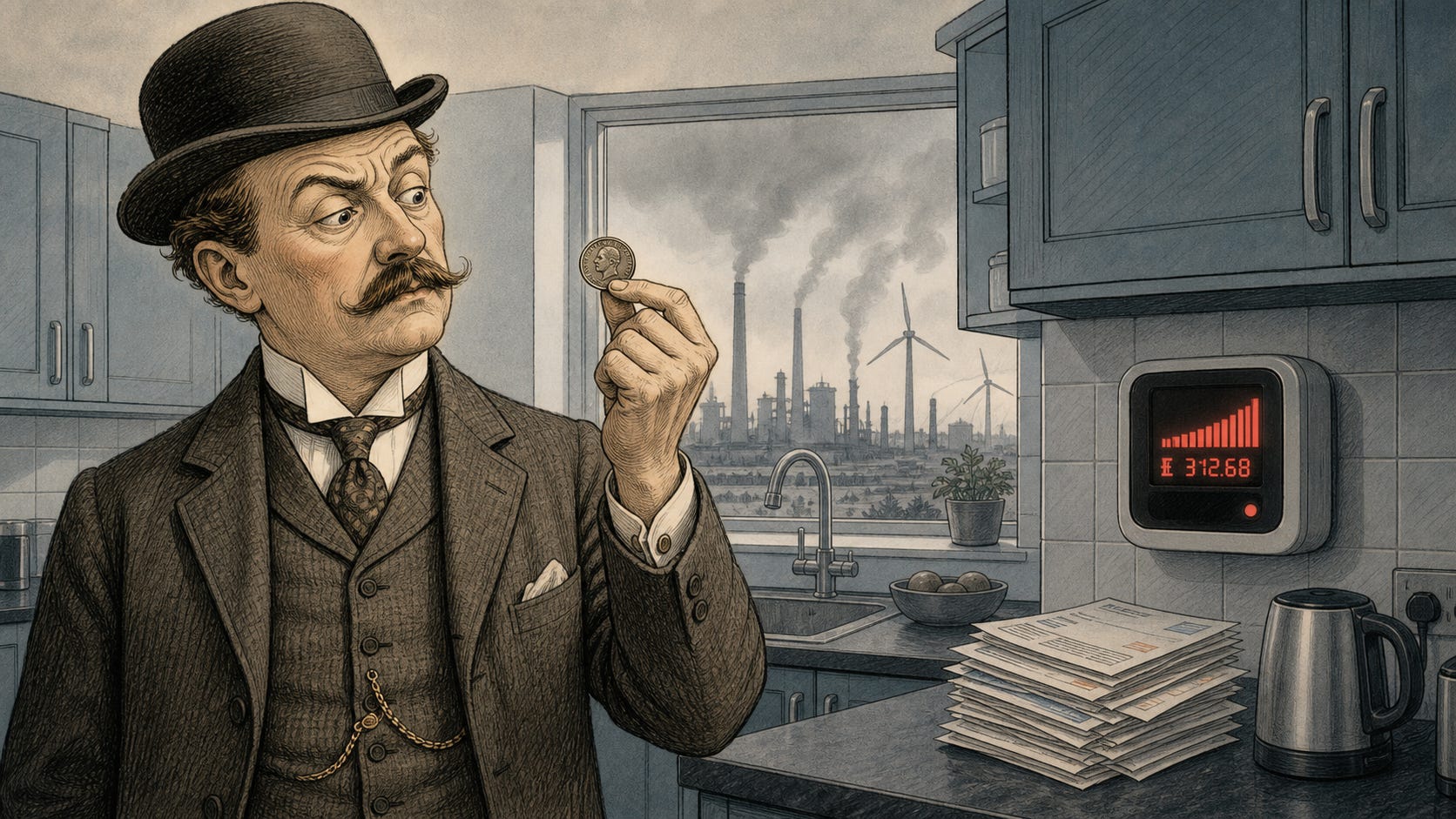
How times have changed. From 1 October, the government proposes to save us 86p a week off our energy bills by removing VAT from domestic electricity. Somewhere, one imagines, a civil servant is still hard at work drawing up the commemorative plaque.
In 2026, far from a week’s shopping, 86p might just stretch to a pint of milk. In London it barely counts as spending money. Enough, perhaps, for something from the reduced shelf at Tesco. Yet the government presents this as a triumph: the classic reflex of a state that watches the billions pile up on its own balance sheet and pats itself on the back for managing to give back as it does so.
It’s worth asking where this modest largesse actually comes from. The £45 a year isn’t funded by growth, or by any newfound thrift, but by cancelling the previous Prime Minister’s £1.8 billion hair-brained Digital ID scheme - a scheme this column once had cause to lampoon.
One tyranny, it seems, has been quietly sacrificed on the altar of another. Sadly, the loose change handed back barely covers the collection plate.
The real bill is elsewhere. Those sums are a drop in the bucket next to what’s been thrown at Net Zero. The grid operator’s own figures put the cost of building a Net Zero electricity system at some £1,300 per household per year. Net Zero Watch warns the true bill, once operating costs are factored in, could run 20 per cent higher still.
No minister will announce this figure with nearly as much fanfare. It’s a permanent annual charge, quietly folded into every bill in the land, for a policy nobody ever voted on directly and few could explain if pressed.
Industrial electricity tells the same story from the other direction. Back in 1914, industry expected cheap, abundant energy, and got it. Today, British manufacturers pay the highest industrial electricity prices in the developed world: some 75 per cent above the average of our peers, and over four times what an American factory pays for the same power. We are, by some distance, the least affordable place in the world to keep the lights on in a factory. The government congratulates itself for handing back 86p while quietly pricing industry out of the country that invented the industrial revolution.
And what is all this sacrifice actually for? This spring, the climate scientists behind the world’s most-cited warming scenarios retired the very model, RCP8.5, that has underpinned the most alarming predictions of the last fifteen years, on the grounds that its assumption of a fivefold rise in global coal use was, in their own words, “implausible.”
The ghost of Christmas Future, it turns out, was reciting from a draft its own writers have since revised. That the policy machine built around the old script grinds on regardless - extracting £1,300 a year from every household, pricing industry out of the country, and handing back 86p a week as though it were relief - would have struck our man from 1914 as a curious sort of governance: one that updates its warnings but never its bills.
For further reading: Roger Pielke Jr.’s excellent breakdown of how RCP8.5 met its end. It was a development significant enough to make headlines everywhere except, it seems, in the corridors of Westminster. For further viewing: any episode of Yes, Minister will do, though even Sir Humphrey never dreamed of a government proud enough of 86p to make such a fuss about it.