


Our satirical series, Tyranny of the Month, continues...
A. J. P. Taylor’s English History, 1914 - 1945, famously opens:
Until August 1914 a sensible, law-abiding Englishman could pass through life and hardly notice the existence of the state, beyond the post office and the policeman. He could live where he liked and as he liked. He had no official number or identity card. He could travel abroad or leave his country for ever without a passport of any sort. He could buy goods from any country in the world on the same terms as he bought goods at home. … Since 1911, it helped to insure certain classes of workers against sickness and unemployment. This tendency towards more state action was increasing. Expenditure on the social services had roughly doubled since the Liberals took office in 1905. Still, broadly speaking, the state acted only to help those who could not help themselves. It left the adult citizen alone.
How far we have fallen! Imagine, for a moment, if a person were to fall asleep in 1914 and wake up today in 2026. What might the man from 1914 say?
In 1914, a young man who wished to better himself had two paths before him.
The first was the workshop, the counting house, the apprenticeship. A direct exchange of labour for instruction. He learned by doing, earned while learning, and arrived at competence without detour. The second, reserved for a small and privileged minority, was the university. It was funded by family wealth, scholarship, or charitable endowment.
Let us be honest about this, because honesty is what this argument requires. Only the few went. A system that confined higher learning to those who could shoulder its extraordinary fees was an impassable barrier to most. It kept out many who would have thrived in higher education, and society would have been better off for it. It deserved to be replaced.
And yet.
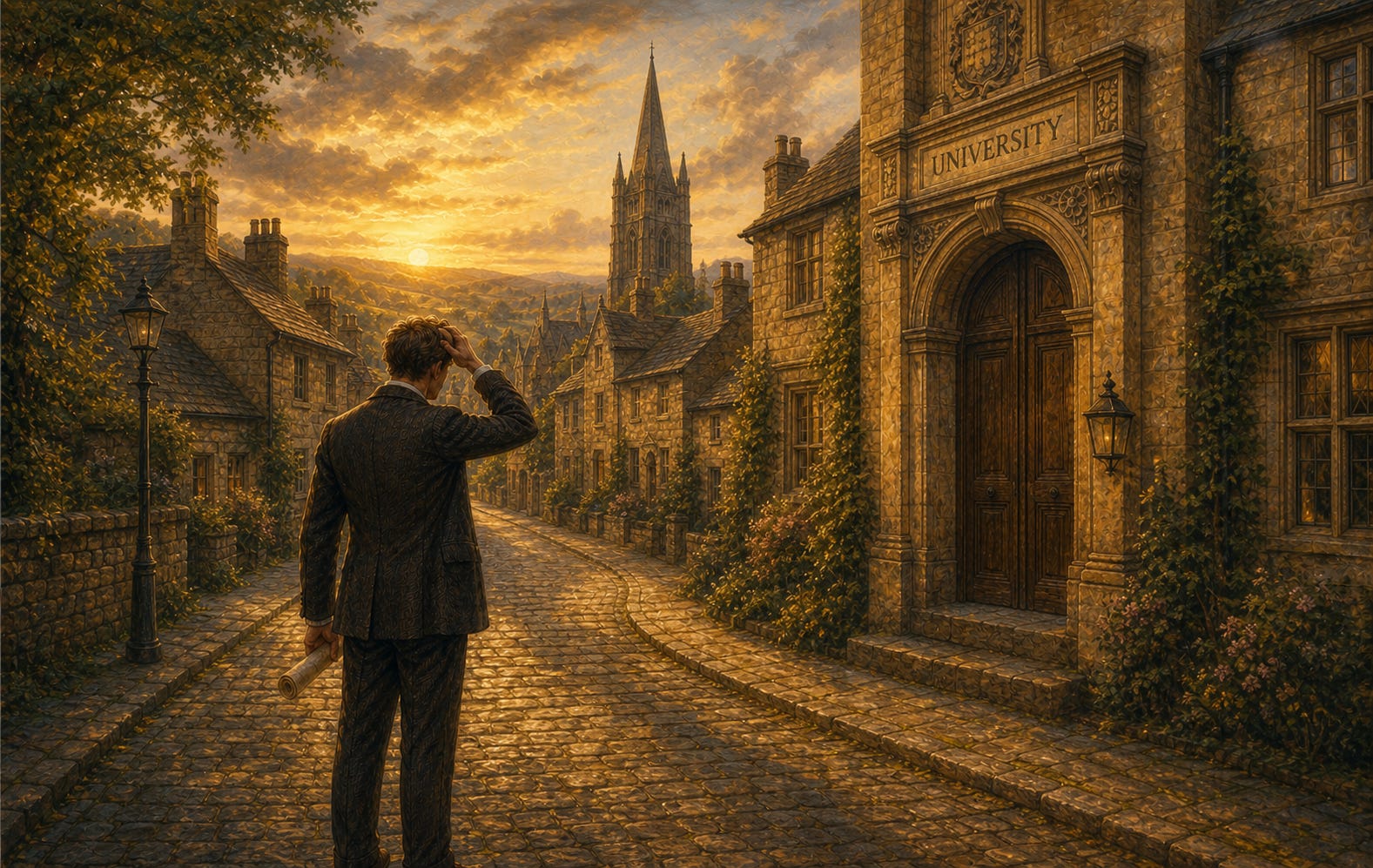
Coming from 1914, I might have imagined that any evolution of the system would be an improvement on that sorry state of affairs. It is true, plainly, that the intelligent sons of labourers were not, in the main, reading Greats at Oxford. Yet the remedy for a system that excluded too many has become a system that exploits nearly everyone.
Today, roughly half of young people in England are ushered through the gates of a university. At first glance, this looks like an admirable achievement. Look more closely and it becomes something more sinister. Students attend not because half of all young people need a degree, but because the state has made it the default path, and because the institutions that profit have every incentive to wave them through, their best interests be damned. Through fear and coercion, the great achievement of the state has been to turn a Morton’s fork – two bad options – into a Hobson’s choice, no real choice at all.
They arrive at eighteen, often unsure what they want or why they are there. For the most part, they are exploitable optimists, made to feel they are making an intelligent choice that may pay off later in life. Only when they leave at twenty‑one, with a qualification of variable worth and a debt that most will never fully repay, do they realise they have been duped.
If a man in 1914 were told that his grandson would pay a surtax on his ambition well into middle age, he would demand to know what revolution had overturned the rights of free men, and how he had failed to notice.
Such a state of affairs ought to fuel the outrage of several generations of parents and students. Yet it still has to be stated plainly: the majority of graduates will never fully repay their student debt. More than four in five graduates will not clear their loan before it is written off after thirty years. For those enrolled after September 2023, the term is forty. This is not a loan in any meaningful sense your bank manager would recognise. It is a graduate tax with a deferral mechanism and a dishonest label.
The state has decided that the appearance of a market, with its fees, statements and repayment schedules, is preferable to an honest admission. An admission that it has created a three‑decade surcharge on the act of following the path it declared, quite bluntly, that you must follow.
The man of 1914 who entered a skilled trade was, within a few years, earning. At twenty‑five, he was not calculating what percentage of his salary would be taken before he could begin saving for a home he would already struggle to afford. Apprenticeships then were as imperfect as the higher education system. Entry was uneven. Progression often depended on whom you knew. The trades were not equally respected or rewarding. But the principle was sound. You learned a skill. You were paid to learn it. You emerged owning your own labour, without a lien against your future earnings.
Today’s apprenticeships are often better than they are given credit for. Higher and degree routes usually offer something genuinely valuable. Yet they remain treated as the system’s embarrassed stepchild. Careers advisers suggest them only after university has been dismissed as unsuitable. Employers and parents treat them as a consolation prize. Meanwhile, the graduate who studied Marketing Communications at considerable expense is assumed to be the success story. Few pause to compare the state of their respective finances a few years into work.
What, then, is the financial return on this story? In 1999, the average graduate salary was about eighty per cent higher than that of a non‑graduate. Today, that premium has fallen to around forty‑five per cent, and it is falling still as graduates continue to vastly outnumber graduate roles. Once adjusted for inflation, average graduate salaries are now about thirty per cent lower than in 2007. The promise has not merely dimmed. It has been quietly withdrawn, while the fees have continued to rise.
So the honest question is this: for how many of the people now sitting in lecture theatres is a degree the best use of three years, and the best part of thirty thousand pounds of their own future money? It is a question today’s careers advisers do not ask, a question universities have a financial interest in never asking, and a question that government has been too cowardly to answer.
The state did not create mass higher education out of pure malice. There was a genuine aspiration to see future generations better off than their parents. To open doors. To build human capital. To extend opportunity. Those are not contemptible goals. They are valuable correctives to a system born in class‑based discrimination.
But, as with every campaign the state wraps its tentacles around, the road from aspiration to outcome has been paved with perverse incentives. Universities are funded per student, so of course they invent courses and recruit into them. Governments measure participation rates as proxies for equality, so of course they chase higher numbers. Employers, drowning in graduates, use the degree as a crude sifting mechanism for roles that do not require one, so of course they demand it on job listings. Most importantly, the young person, entirely rationally, concludes that not going is a risk they cannot take. In many cases it is not even presented as a choice at all, even if going means mortgaging a significant portion of their financial life for a certificate they needed only because everyone else has one.
This is not a tyranny of old‑fashioned discrimination. It is something arguably more insidious. A tyranny of credentialism that bears down on everyone. An economic tyranny that uses the state to generate demand for the credentials it sells, and extracts payment for both, to the benefit of the very few and the detriment of everyone else.
In 1914, the injustice was that too many were excluded from the summit, and even the paths open to them were imperfect and flawed. In 2026, the injustice is that almost all are coerced into climbing, whether there is a worthy summit up there for them or not.