


Our satirical series, Tyranny of the Month, continues...
A. J. P. Taylor’s English History, 1914 - 1945, famously opens:
Until August 1914 a sensible, law-abiding Englishman could pass through life and hardly notice the existence of the state, beyond the post office and the policeman. He could live where he liked and as he liked. He had no official number or identity card. He could travel abroad or leave his country for ever without a passport of any sort. He could buy goods from any country in the world on the same terms as he bought goods at home. … Since 1911, it helped to insure certain classes of workers against sickness and unemployment. This tendency towards more state action was increasing. Expenditure on the social services had roughly doubled since the Liberals took office in 1905. Still, broadly speaking, the state acted only to help those who could not help themselves. It left the adult citizen alone.
How far we have fallen! Imagine, for a moment, if a person were to fall asleep in 1914 and wake up today in 2026. What might the man from 1914 say?
As we approach the end of the financial year, our hero considers HMRC’s powers.
He arrives, poor chap, blinking into the strip‑lit banking branch of 2026, and discovers that the post office has been replaced by an online portal, the policeman by a chatbot, and that both of them, somehow, work for HMRC.
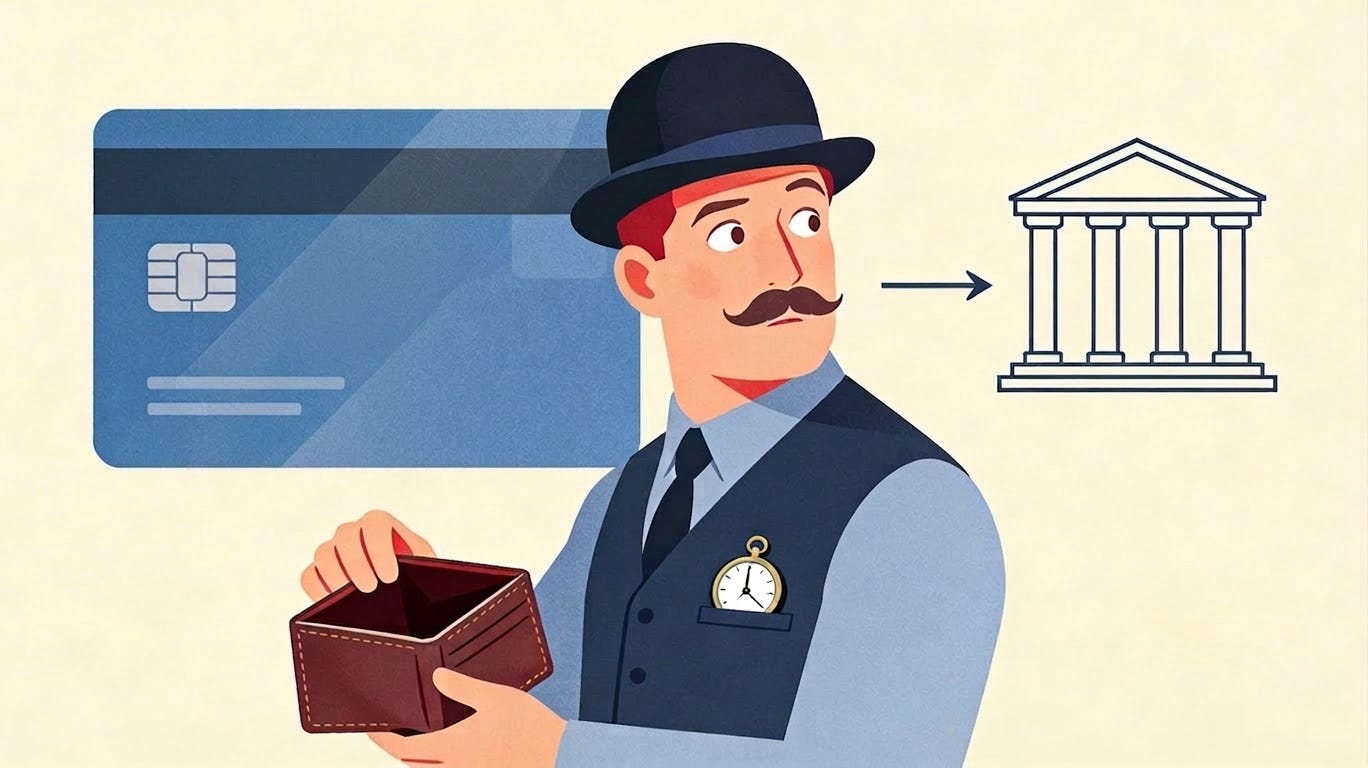
The state he barely noticed in 1914 now lives in his pocket, his payslip and, rather more intimately than he would like, his current account. At first he is reassured. The income tax form, which used to be a gentlemanly exchange of letters with a local inspector, has become a friendly online portal that tells him what he earned last year with unnerving accuracy. “We have pre‑filled this for your convenience,” it explains cheerfully, like a butler who has not only laid out your clothes but worn them for a week and drawn a few conclusions.
Somewhere in Whitehall, a system has quietly hoovered up his salary, his dividends and half his life, and now invites him to agree.
Then he learns about Direct Recovery of Debts. Since 2015, and now actively re‑started after a pandemic pause, HMRC has statutory power in defined circumstances to instruct banks and building societies to transfer money directly from a debtor’s accounts, including cash ISAs, to the Exchequer, without going to court first. It may only be used where HMRC says there is an established debt of at least £1,000 and that the person “can pay but won’t pay,” with a minimum of £5,000 to be left across their accounts. But the crucial point is that the same body which decides there is a debt can begin the process of seizing the funds. The polite assurances about “only a small minority” begin to sound less like a comfort and more like a targeting criterion.
In 1910, the Crown, like everyone else, had to queue up at court if it wanted its money; now the taxman can, in certain circumstances, simply reach into your account and help himself, provided he leaves a bit behind for groceries and the gas bill. HMRC’s own briefings emphasise “safeguards”: yet all of these protections are triggered after HMRC has initiated its own process, based on its own assessment and internal review.
In other words, the citizen must fight to bring an independent tribunal or court into the picture; judicial oversight is no longer the gate through which enforcement must pass, but a remedy the taxpayer must actively seek once the machinery is already in motion. “It’s not a power we expect to use very often,” officials murmur, in the historical tone of people who have just discovered a useful new tool and a large budget gap.
Our traveller, accustomed to liberty under law, peers around for a magistrate, perhaps a jury, at the very least a stern clerk demanding to see the paperwork. Instead he finds an algorithm, an internal review, and a set of “safeguards” described in a PDF. The roles that once belonged to commissioners, judges and bailiffs have been consolidated in a single, rather harassed‑looking organisation which now assesses the tax, decides there is a debt, applies the penalties and, should the mood take it, sends a polite instruction to his bank to move the funds.
It is not that anyone has set out to be a tyrant. This is, after all, a modern, progressive tyranny, the kind which is conducted by spreadsheet and consultation document. Each new power was introduced as a modest, targeted measure against a specific abuse: the sort of thing no “sensible, law‑abiding” man could possibly object to, until he discovers that the definition of “abuse” is now being worked out by the same people who want his money.
The Inland Revenue might have been a slightly stuffy presence at the edge of his affairs; HMRC, he realises, is now a lodger in his wallet and bank account. Looking up from the small print, he has the unmistakable sense that the constitution has been quietly redrafted and his rights thrown away in his absence.
HMRC today combines the roles of investigator, assessor, penalty‑setter and first‑instance enforcer, underpinned by extensive data‑gathering, information‑sharing with banks and platforms, and increasingly automated debt‑chasing, with Direct Recovery of Debts sitting at the hard end of that spectrum.
Once, the state taxed by Act of Parliament and enforced by court order; Acts and orders remain, but now HMRC powers raise the rights of the state over those of the individual. Our hero remains the same moderate, reasonable, professional man, but the England he loved for leaving him alone has discovered that it can visit his bank account without so much as knocking, and is wondering what else it might do once it’s in there.
And then there is the wider quango state with equal arbitrary power. Just try and challenge the FCA , as an example taken at random...
As George Orwell famously wrote, "Big Brother is indeed watching you"...