


Our satirical series, Tyranny of the Month, continues...
A. J. P. Taylor’s English History, 1914 - 1945, famously opens:
Until August 1914 a sensible, law-abiding Englishman could pass through life and hardly notice the existence of the state, beyond the post office and the policeman. He could live where he liked and as he liked. He had no official number or identity card. He could travel abroad or leave his country for ever without a passport of any sort. He could buy goods from any country in the world on the same terms as he bought goods at home. … Since 1911, it helped to insure certain classes of workers against sickness and unemployment. This tendency towards more state action was increasing. Expenditure on the social services had roughly doubled since the Liberals took office in 1905. Still, broadly speaking, the state acted only to help those who could not help themselves. It left the adult citizen alone.
How far we have fallen! Imagine, for a moment, if a person were to fall asleep in 1914 and wake up today in 2026. What might the man from 1914 say?
There was a time, not so very long ago, when it was the solemn responsibility of a parent to prepare their child for a world of a great many risks.
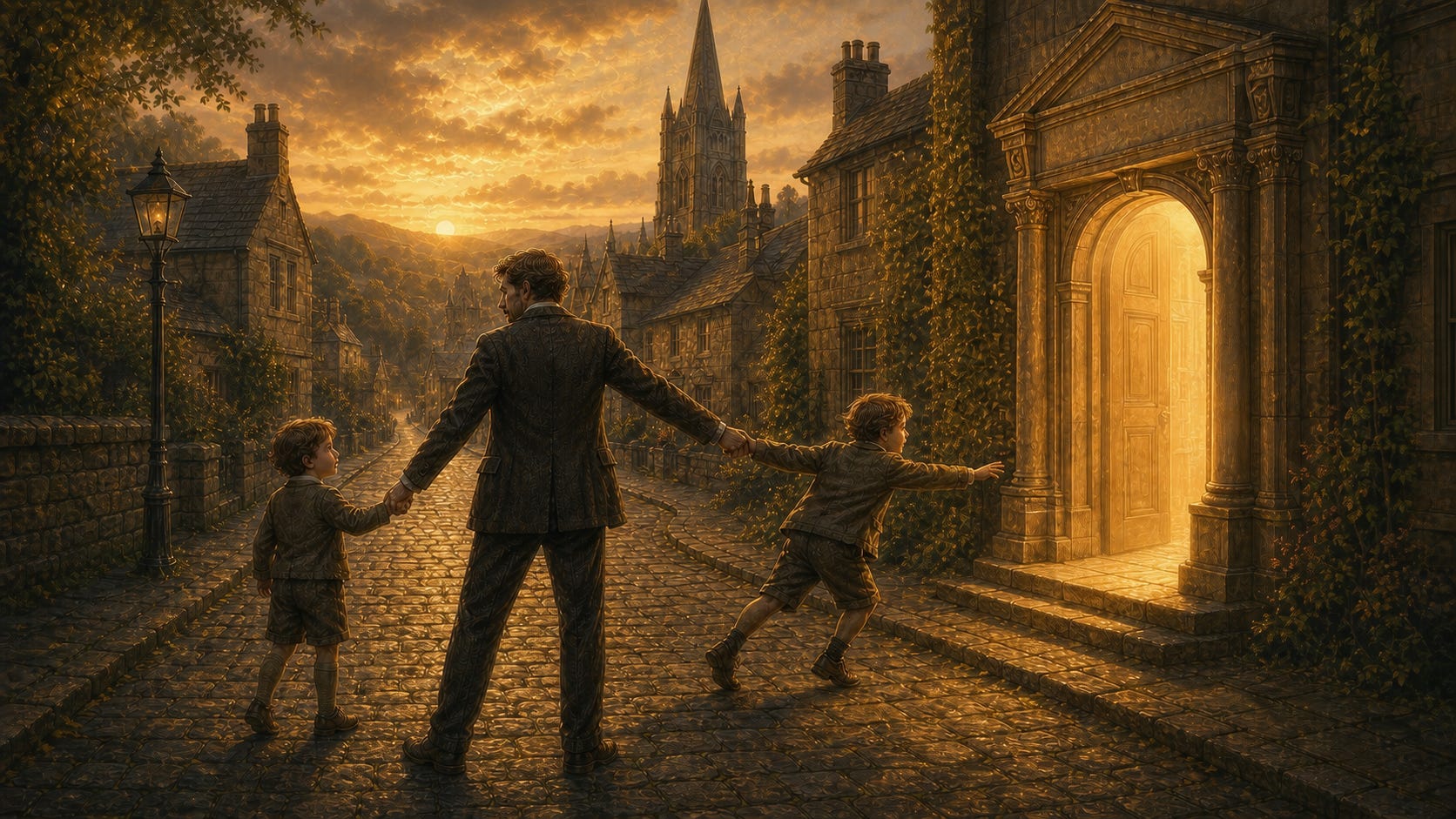
They would keep them from harm by holding their hand in the street, teaching them the difference between strangers and friends, and trusting that, in time, the child would learn to judge such things for him- or herself.
Inevitably, difficulties and complexities arose. But despite that, the family managed. Many promising children were raised into great men and women, and because of it civilisation advanced at pace.
That arrangement, it seems, is soon to go through another deliberate change.
On 15 June, Keir Starmer announced that children in the United Kingdom will be banned from social media until the age of sixteen, with major platforms required to exclude them or face penalties. The law is to be legislated before Christmas, with enforcement to follow in the spring.
Having already issued stringent instructions to children on what to eat, how to exercise, what to think, and how long to sit in a classroom, the state now proposes to decide which parts of the modern public square they may enter, and at what age.
The Prime Minister calls this “giving children their childhood back.” If this is giving children their childhood back, one shudders to think what confiscating it might look like. He does not pause to ask whether the childhood he remembers is even available in a world where friendship, culture and politics are now lived as much online as off. For today’s teenagers, social media is not a curious add‑on to everyday life. It is not some novelty that they can cast their minds back just a few short years to remember a world without. It is the essential forum by which they organise their lives: be it arranging a walk in the park, sharing homework, discovering music, or encountering the arguments that will shape their view of the world.
Whether that is a good or bad thing is a worthy question, but it is not the immediate one. It simply is how the world now operates. Every generation faces a horizon its parents did not quite recognise, and it has always been the role of the parent to help their child through it. Whitehall’s response, however, is to try to legislate large parts of the new reality out of existence.
So let us begin with the only proposition that really matters: it is not the business of the state to raise children. Even if that were in dispute, governments do not have a good record of running private life from the centre. Whenever they assume responsibility for shaping how we live - be it schooling, health, morals, or now digital life - planners tend to overpromise, under‑deliver, and generate unintended harms. The further the state pushes aside the family and assumes its role, the more likely it is to damage the very children it claims to protect.
The principle at work here is simple enough. It is the belief that the state knows better than the parent and that bureaucracy can substitute for private judgement. Most problematically, it assumes that children must be rescued from the world rather than prepared for it. It is precisely this instinct that animates the ban.
Ministers do not trust parents to supervise their children’s online lives, so they will try to abolish those online lives by law. They do not trust teenagers to learn to navigate risk, so instead they will attempt to simply erase them.
This is, of course, all said to be in the name of safety. Yet even some of those most anxious about children’s welfare recognise the trap here. Save the Children has warned that sweeping bans risk creating a comforting illusion of safety while doing little to equip young people for the world as it is, and that the hard work of supporting families, tackling poverty and improving mental health cannot be outsourced to an age‑gate on a smartphone.
That isn’t even to mention that efforts by the state to manage childhood from the centre have a habit of failing even on their own terms. That is not just a lesson from history, though we would not be short on examples. It is visible in the present. Australia introduced its own under‑16 social media ban in December 2025, and Britain is plainly borrowing from that example. The Adam Smith Institute, in a piece by Tim Worstall published the day after the announcement, made the obvious point: Australia is already running the experiment, so the sensible course would be to wait and see what it produces before copying it. Instead, the British state has preferred the old political habit of acting first and learning later.
The Institute of Economic Affairs has made a deeper criticism. Matthew Lesh, the IEA’s Public Policy Fellow, described such a ban as “utterly ill‑conceived” and argued that the proper answer is “educating and letting parents decide, rather than restricting access and stunting growth.” The IEA has further argued that bans of this kind create a false sense of security for parents, undermine open family conversations about online safety, and encourage young people to seek workarounds rather than develop critical judgement. That is the central weakness of this policy. It diminishes responsibility while pretending to increase safety.
Nor is the likely result difficult to foresee. Teenagers will not obediently retreat into some imagined pre‑digital innocence. Many, perhaps most, will evade the ban. In Australia, more than sixty per cent of twelve to fifteen year‑olds who had social media accounts before the ban were found to still have access to at least one platform. Others will drift toward smaller, less accountable, and less regulated online spaces. If even the best‑case version of this policy replaces parental judgement with administrative control, the worse version does so while also making children decidedly less safe online.
The government is obviously not proposing to collectivise the whole of childhood. It is doing something milder than that, but no less revealing: inserting itself, yet again, between parent and child, insisting that the risks inherent in growing up can and must be managed from the centre. Where once a parent took a child’s hand and taught him how to cross the road, a bureaucrat now drafts a code of practice to fence off the pavement. Where once a mother or father watched over the first tentative steps into the wider world, a minister now issues a mandate cordoning it off.
If history teaches anything, it is that the state is a clumsy surrogate parent. When it confines itself to upholding the law and defending the realm, it can be a necessary servant. But when it begins to supervise the inner life of the next generation - deciding what friendships they may form, what information they may see, and which conversations they may enter - it intolerably becomes something else entirely.
That is the line this government is now edging across.
As the only way they can make this work is for us all to have an on-line digital identity it clearly has net zero to with the 'safety of children' but 100% to do with controlling everyone's access to the internet and the free flow of information and learning. As I was typing this comment serendipitously this popped up https://order-order.com/2026/06/19/exc-new-starmer-social-media-crackdown-imminent-as-labour-targets-content-creators/#comments