


Our satirical series, Tyranny of the Month, continues...
A. J. P. Taylor’s English History, 1914 - 1945, famously opens:
Until August 1914 a sensible, law-abiding Englishman could pass through life and hardly notice the existence of the state, beyond the post office and the policeman. He could live where he liked and as he liked. He had no official number or identity card. He could travel abroad or leave his country for ever without a passport of any sort. He could buy goods from any country in the world on the same terms as he bought goods at home. … Since 1911, it helped to insure certain classes of workers against sickness and unemployment. This tendency towards more state action was increasing. Expenditure on the social services had roughly doubled since the Liberals took office in 1905. Still, broadly speaking, the state acted only to help those who could not help themselves. It left the adult citizen alone.
How far we have fallen! Imagine, for a moment, if a person were to fall asleep in 1914 and wake up today in 2026. What might the man from 1914 say?
The United Kingdom is a magnificent country. From the chalk downs of Sussex to the rolling hills of the Scottish Highlands, the good Lord blessed the British people with a glorious canvas with which to make their mark on the world.
And for centuries, we did exactly that. We built cathedrals and coaching inns, market towns and mill terraces, garden squares and harbour villages. Generations of Britons laid their ambition gently on the landscape, and the landscape rewarded them for it.
Now, imagine how different our national monuments would have looked had a board of stuffy bureaucrats been given the opportunity to appraise their keeping with the character of the area, or whether the foxes and hares might raise a procedural objection.
It is as inconceivable for someone today freely to build a new castle as to add a permanent office in their garden. At a stroke in 1947, with the passing of the Town and Country Planning Act, the right to build upon your own land was nationalised. Not your house - the state was gracious enough to leave that in your possession. Just the permission to do anything with it. In other words, the key component of ownership.
The Great Britain I knew in 1914 was built before the Act. Before committees, viability assessments, fourteen rounds of planning conditions and a heritage officer with a clipboard invariably declaring that your proposed dormer window represents a material harm to the character of the conservation area. The great testament to the system which allowed the British people to be the custodians of this land is the towns and villages that people cross continents to photograph. The great testament to our state land-use planning system is the car park.
We have been blindly led into what can only fairly be described as a housing crisis. Consider a young couple (a family that is yet to be, because they cannot afford to form one) facing the seemingly hopeless process of trying to purchase their first home.
Despite being victims of an artificial shortage dating back to 1947, they are told by the abbots in Whitehall and the town hall, dispensing their indulgences, that the sensible answer to this crisis is more government: more targets, more affordable housing quotas, more section 106 obligations, more officials and more nutrient-neutrality assessments. A state-created shortage, worsened by the state, now to be cured by the state.
It is worth pausing to appreciate the sheer audacity.
The human cost deserves to be stated plainly. Britain’s homeownership rate among under-35s has roughly halved since the 1980s. Young people are not enduring the grinding uncertainty known as renting because they prefer it. They are renting because the ladder has been almost fully pulled up.
The planning system inflates land prices by rationing supply. Help to Buy spent billions of taxpayers’ pounds to inflate the very prices it was meant to bring within reach. Stamp Duty compounds this effect, taxing the very act of moving. And leasehold, that feudal relic the government has been reforming for thirty years without meaningful progress, means that even those who do manage to buy a home find they have purchased not a property to do with as they please, but a very long tenancy from a freeholder who can charge ground rent for the privilege of existing on land that is nominally theirs.
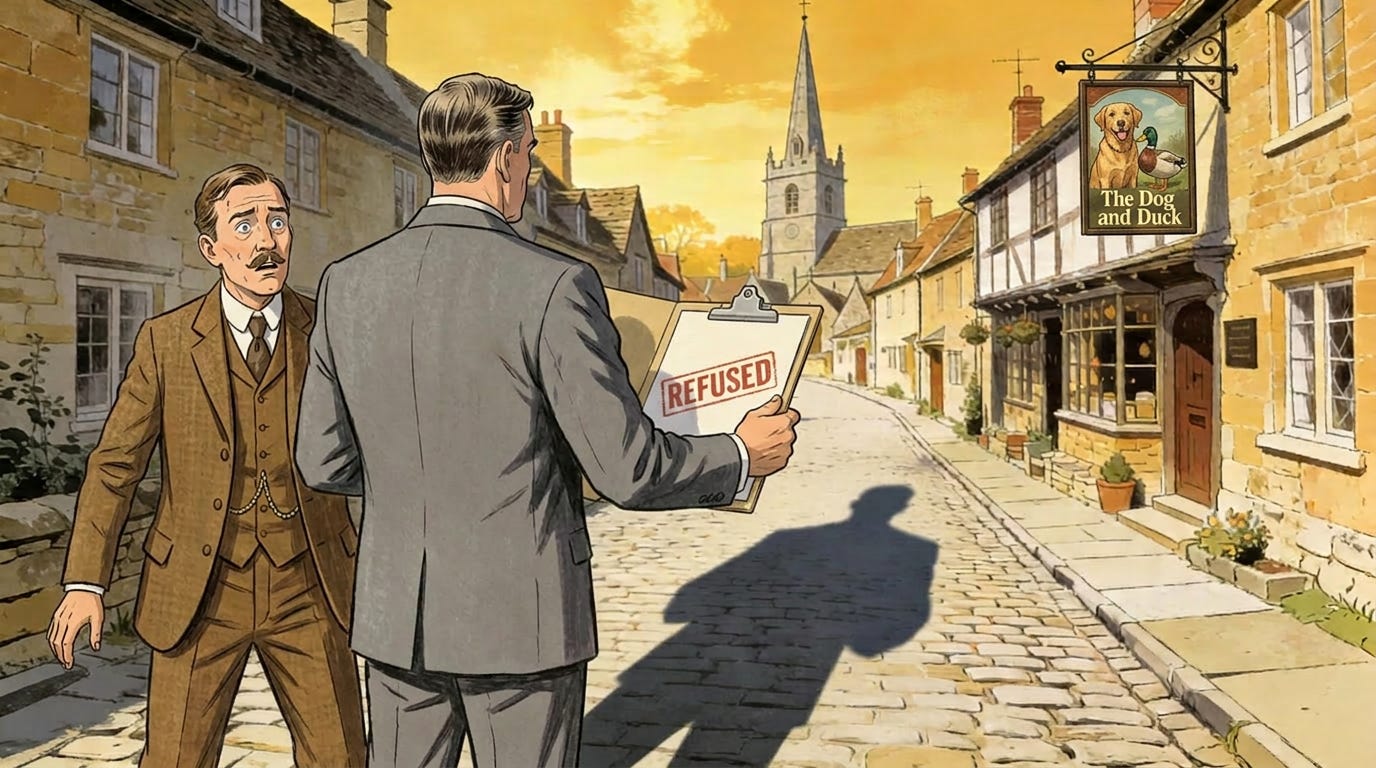
The system moves into outright absurdity in the commercial realm. Consider, for a moment, the landlord of a pub who wishes to rename his establishment. Perhaps the old name is tired, perhaps his customers are different now, or perhaps he simply wants a fresh start. This private decision about a private business ought to be trivially simple.
Not so fast. If that pub sits in a conservation area - and in England, there are around ten thousand of them - changing the name on the hanging sign may require advertisement consent from the local planning authority. The application must be made in the correct form, to the correct department, assessed against the correct policies and potentially referred for comment to Historic England, the parish council, or anyone else who happened to wander past the consultation notice on the lamp post.
The process can take months. It frequently costs more in professional fees than the rebrand itself. Crucially, it can be refused. As if whether a tavern was the Dog and Duck or the Mallard and Mongrel is of any consequence worthy of a petty tyranny.
This is not an edge case, nor some temporary overreach that can be amended. The system is working exactly as intended, extended now into every corner of commercial and residential life. You often cannot build an extension without permission. You cannot paint your shopfront a different colour without permission. You cannot, in some cases, cut down a tree in your own garden without permission. The foundational, liberal presumption that what is yours is yours to use as you please has been quietly, legislatively inverted. We are left asking permission like a child wanting to decorate their bedroom when we wish to exercise basic property rights.
You are now presumed to require justification for any change. The state is presumed to require none for any restriction.
Once again, I am left with the troubling conclusion that the people of Great Britain have been boiled like frogs, led into a piecemeal tyranny that quietly swallows the most basic freedoms of human life. The only difference seems to be that a boiled frog will scarcely struggle to find a place to rest when it’s finished.
I built a 12 sq.m garden room in my terraced, 3 bed semi garden (new build, shared ownership, section 106. I had to pay to ask permission to build said garden room). I made it into a tiny home. Rented it to guy getting evicted, on benefits. The council found out and started charging council tax. He moved out, then the Council sad it was an empty 2nd home. Started charging me £370 pcm in C Tax for garden room, and £170 pcm per month for the house. Thinking about burning it down.
Combine all that with bad money and unremitting credit expansion and you have a perfect storm. When you look at the data in real terms there has not been a major increase in land aka house prices since 1945. But there has been a collapse in real wages - except for between 1979 and 1990, when real wages increased.