


Among the laws that rule human societies, there is one which seems to be more precise and clear than all others. If men are to remain civilised or to become so, the art of associating together must grow and improve in the same ratio in which the equality of conditions is increased. – Alexis de Tocqueville
A free society depends less on government design and more on the strength of civil society: the voluntary associations that stand between the individual and the state. But modern societies increasingly look to the state to solve problems once handled by voluntary associations, concentrating power and weakening the social foundations of freedom.
As society becomes more fragmented, governments are increasingly intervening by managing social isolation, cultural conflict and economic insecurity. Despite this expansion, communities appear more polarised, less cohesive and less trusting. This suggests that political solutions do not address social problems.
What is missing is the role once played by institutions that existed independently of the state. These institutions addressed social needs at a human level by providing support, enforcing norms and fostering responsibility without coercion or obligation. As these institutions weaken, the space between individuals and the state narrows.
When associations collapse, and governments expand, the state becomes the default provider of social order, welfare and meaning. Freedom is not abolished outright but gradually displaced by regulation and reliance as they relate to the state less as participants in a shared civic life and more as dependents of administrative systems.
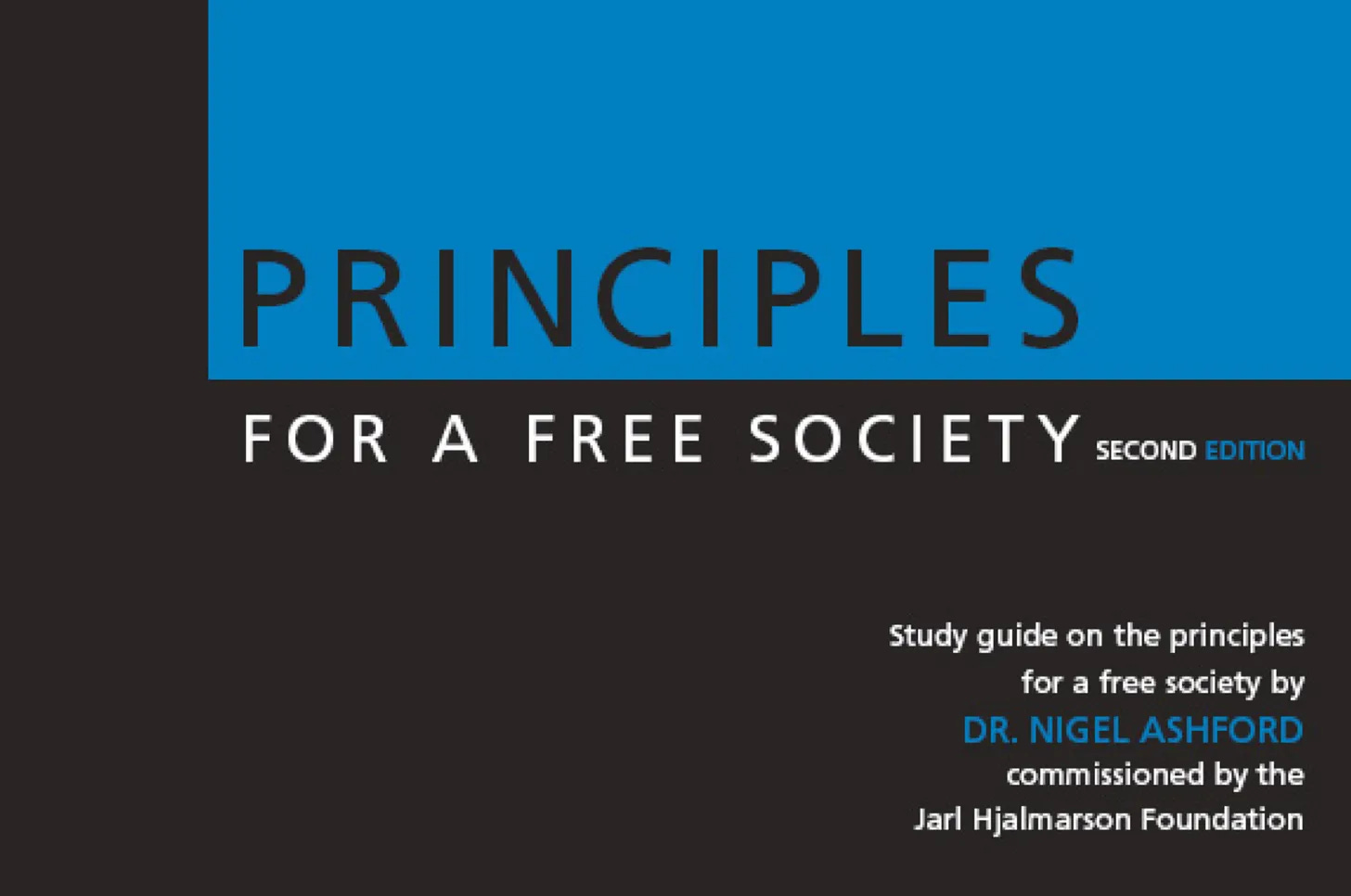
The first principle of a free society, identified by Dr Nigel Ashford, is civil society, a foundational condition of freedom. To be able to question government power, law or economic policy, there must be a space in which individuals cooperate freely outside of the direct control of the state. Without this separation, social problems become closer to political authority, tempting the government to expand into areas once governed by civic responsibility.
In just 92 pages, Principles for a Free Society presents 12 principles with clarity. These principles form the basis of much of what Fighting for a Free Future fights for.
The principles are:
Civil society
Democracy
Equality
Free enterprise
Freedom
Human rights
Justice
Peace
Private property
The rule of law
Spontaneous order
Toleration
Ashford defined civil society as “all those voluntary organisations that exist between the individual and the state, such as the family, churches, sports and music clubs, and charities.” These institutions are formed voluntarily and sustained by shared norms; they enable individuals to associate as independent agents whilst detaching from political power. They are neither an extension of government nor isolated individualism. Alexis de Tocqueville observed, where the art of association flourishes, equality can coexist with liberty; where it declines, the state increasingly fills the void left behind.
Our modern concept of civil society did not materialise fully-fledged; it has grown and developed alongside changing understandings of law, citizenship and politics. In the classical world, early notions of civil society were tied to the idea of a community governed by law. Aristotle defined this civil society as having community welfare and civil participation in the polis. The Roman concept of civitas described this as the collective body of citizens bound by law. This emphasised early on the legal framework for individual rights.
This distinction faded during the feudal period as the political and social realms were not separated. Associations existed but were largely embedded in the manorial system with authority flowing through hierarchical relationships based on land ownership, military obligation and loyalty.
The modern understanding of civil society emerged with the decline of feudalism and the rise of modern states. The separation of social and political life allowed civil society to encompass economic activity, social cooperation and moral life instead. Enlightenment thinkers such as Locke, Ferguson and Montesquieu began to identify the separation of state and society and reconceptualise civil society as voluntary association among free and equal individuals.
It was this modern conception that Tocqueville observed in practice. Civil society was not just a collection of institutions, but a habit of cooperation that restrained state power by redistributing social responsibility. His concern was not that democracy would give rise to overt tyranny but that it would create a subtle form of control called “Soft Despotism”.
Tocqueville’s concept describes a subtle, paternalistic government that manages citizens’ lives. As equality weakens traditional social bonds, individuals become isolated from one another and detached from the voluntary. In response, the state assumes responsibility for organising social life, regulating behaviour and providing support, often with popular support. Citizens come to rely on administrative systems rather than their own free associations, becoming what Tocqueville called a docile “flock of timid and industrious animals” led by a powerful shepherd. Liberty is not outright abolished but steadily diminished as formal rights persist whilst self-governance disappears.
Civil society is not a luxury of free society; it is its precondition. When voluntary associations weaken, the state does not retreat; it expands to fill the void. Civil society is therefore not merely a component of a free society but the foundation. It is through families, churches, charities, clubs and other associations that individuals learn cooperation, responsibility and self-governance. These institutions disperse power, cultivate trust and create bonds that no state can replicate without coercion.
Tocqueville’s warning remains as relevant today as it was in the nineteenth century: as conditions of equality grow, so does the temptation for the state to centralise authority. Where citizens fail to create their own associations, the government will inevitably step in. The result is a gradual erosion of liberty, not through tyranny but through dependency.
Luke Lucas is a Fighting for a Free Future Associate and runs Voices for a Free Future’s monthly column, What is Happening in Argentina!

Hi Luke. Thank you. I'm attracted to the principle of civic free associations to separate individual from State and limit centralised autocracy. But does Capitalism give rise to these being soft-owned by the rich - who could be either benefactors or self-interested or even twisted power players?