


Ideology seems like a bad word. You can attack your opponents by calling them ideological. But a world without ideology would be a world without discussion, debate, and even, I would argue, intellectual progress. Roger Scruton wrote in The Meaning of Conservativism, “It is part of conservatism to resist the loss of ideology. The ‘value-free’ world is not a human world”. But why has ideology gained such a bad reputation?
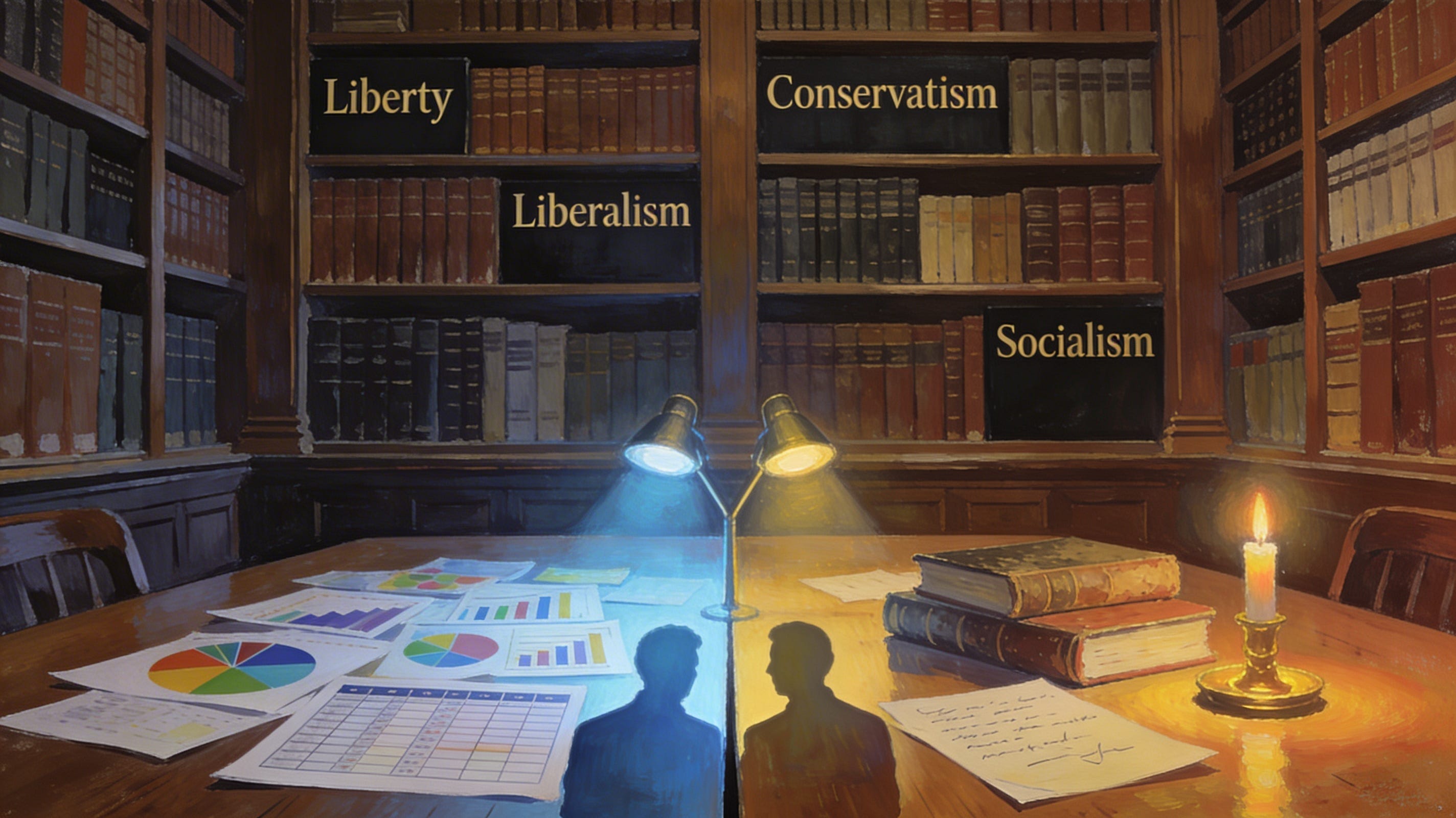
The dream of a world without ideology is an integral part of the managerial revolution: questions are no longer about principle, but only about evidence—supposedly scientific evidence. It sounds appealing, but is it true? Are all problems merely matters of evidence and empiricism? Even to rely on evidence, one must first decide which data to examine. There is an a priori step: which data to look at, which data to select, and which data to ignore. These are all part of the scientific process, and they are inevitably shaped by the ideas and assumptions of the researcher. Ideology, therefore, still exists—it is simply less visible.
At this point, we must turn to the Austrian School. There is a profound misunderstanding of data in social life. The data we obtain in social science is inherently different from that in natural science. In social science, we face two challenges. First, the nature of the data is subjective, making it impossible to fully capture; it is constantly changing, as knowledge is continuously created and destroyed. Second, there is a misunderstanding of macro phenomena. We are not dealing with macro phenomena in the same way that natural sciences do. Even if we obtain data, as Hayek argued, that approach rests on a flawed assumption that: “If we cannot know all the individual facts which determine individual action and thereby the economic process, we must from the most comprehensive information which we can about them, and that is the statistical figures about aggregate averages.” In social sciences, we deal with organized complexity, “where we cannot expect to find permanent constant relations between aggregates or average”.
Does this leave us in a position where we cannot understand anything in the social sciences? Quite the opposite. We can understand general patterns, but we cannot achieve the exact knowledge found in the natural sciences. This strengthens the case for ideology. Ideologies, as systems of beliefs about the world, allow for meaningful discussion and disagreement. The end of ideology is the end of discussion, and the end of discussion is the transfer of power to those with the “Pretence of Knowledge”. In such a world, every question becomes a matter of execution: simply apply the latest scientific research in economics to solve economic problems. But we should not forget what Hayek said in his Nobel Prize speech. He noted that people look to economists for solutions to inflation, but “it must be admitted, has been brought about by policies which the majority of economists recommended and even urged governments to pursue.”
Science does not progress in a straight line. Our understanding advances along a winding path. This is precisely the insight of The Structure of Scientific Revolutions by Thomas Kuhn. Each paradigm passes through four stages: a pre-paradigm phase, the development of a mature paradigm (normal science), a period of crisis, and finally a scientific revolution. Ideology is not anti-science; it is an integral part of this process—whether in shaping consensus in the early stages or in challenging it during periods of upheaval.
But what is politics without ideology? We are seeing its consequences today. As Harry Richer has written for FFF, we now have politicians who are largely ignorant of political texts. This results in politics without principles—and what replaces principles? Interest. Politics becomes less about fundamental questions and more about assembling coalitions of interest groups, a process that has been accelerated by monetary expansion to sustain the welfare state.
Our Politicians Don't Read. That's Why Britain Is Failing

Most MPs couldn't name three works of political theory if their seats depended on it. And yet we trust them to govern our country.
Ideology matters. Engaging with classic texts—both those we agree with and those we oppose—is crucial. This is not merely an academic exercise. It gives politicians historical awareness: the debates we face today have appeared, in different forms, throughout history. Such engagement fosters humility, reminding policymakers of the limits of what they can know and achieve. Yet this is no longer fashionable. Many voters expect the state to solve every problem. Due to the lack of rigorous intellectual education, it is not an exaggeration to say that French political thought has, in many ways, supplanted the British tradition of thought in this country. Increasingly, people look to the state rather than to communities for solutions. The welfare state has displaced personal responsibility, and interest has replaced principle. Unless we revive genuine intellectual debate, we risk continuing down the path that Margaret Thatcher once described as the “orderly management of decline”.
Mani Bahsarzad is a research associate at the Institute of Economic Affairs, Asia Freedom Fellow at LSE, and his work as an economic journalist has been published widely, including in the Spectator and National Review. His book “In Defence of Shock Therapy”, a defence of radical economic liberalisation, will be published this summer.
Sources:
Roger Scruton, The Meaning of Conservativism, p. 127
F. A. Hayek, Knowledge, Evolution and Society, p. 25
