


In case you missed it, Rt Hon Steve Baker FRSA will be hosting a live Question and Answer session here on Voices for a Free Future for paid subscribers in two weeks, 18:30 GMT on Thursday the 4th of December. Find out how to submit a question here.
When is a Budget not a Budget?
Answer: when it’s an ideological, jealousy-driven tax grab
In case you haven’t noticed – and I can’t believe you haven’t – we had a so-called Budget on 27th November, which threw even more money at Labour’s vassals and took from people who actually earned money for themselves and make the UK economy work.
There are a few things that were different from a normal or usual budget. Firstly, the Office of Budgetary Responsibility (and only one of those words is actually true, and that is “Office”) managed in its usual totally incorrect and shambolic way to release its forecasts and commentary about an hour before actual delivery. Which meant Rachel from Accounts could have simply stood up and said, “You’ve all read it” and sat down again. Sadly, we had to hear her blame everyone and everything for her total incompetence – apart from herself, of course.
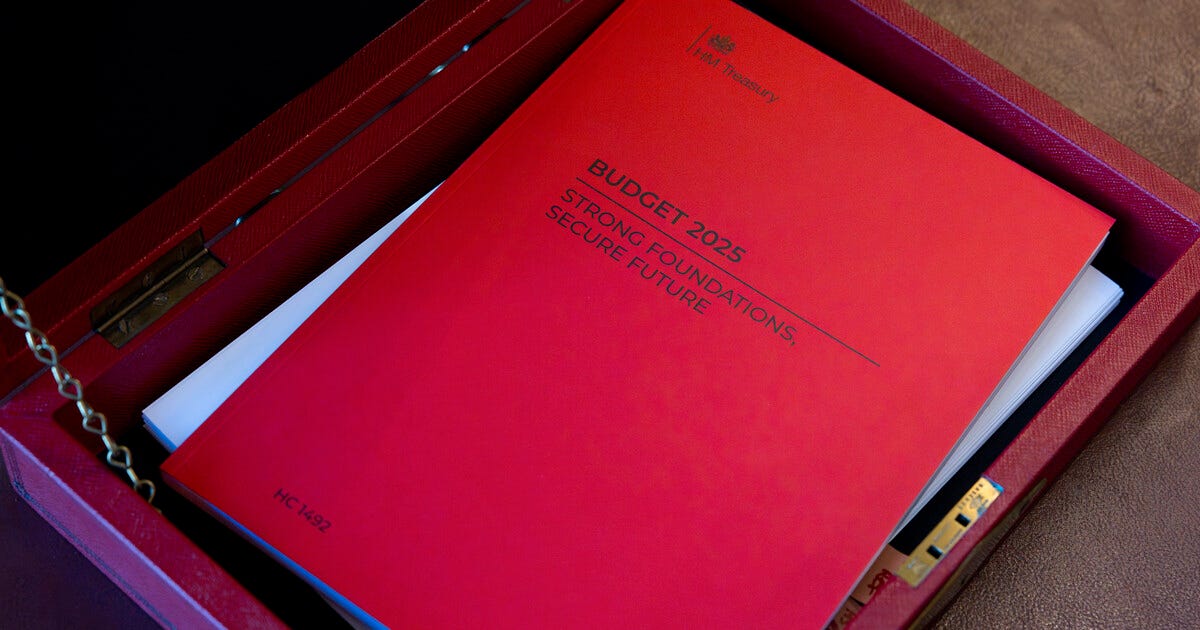
The other thing (and again the OBR is involved), and you may have missed it, but in early November, Rachel gave an extraordinary performance justifying breaking every manifesto commitment and laying the pitch for Income Tax to increase. Lo and behold, a few days later, there was a screeching U-turn spun by the Treasury and Government that further information had come to light, as outlined by the OBR, which meant things weren’t that bad and no, she would not be breaking that particular manifesto pledge.
Except, of course, it was all lies. The OBR has confirmed that they gave no additional information to anyone after 31st October. What do we make of all that? Firstly, the OBR is, as we all know, completely unable to produce anything that actually has relevance, and in fact, they would probably do better by just guessing.
Secondly, the Government – and by extension the Treasury – actually has no idea at all what to do to make anything better. They have effectively killed any hope of growth within the UK. You all know that things have to be paid for, and as things stand, we cannot afford to pay for what is already being given away. Now, there is even MORE being splurged (lovely word) and being paid for by people who can ill afford it. If Nigel Farage had wanted someone to ensure his winning the next election (whenever that may be, and it may be sooner than you think), Rachel pretty much just did it for him.
Within the budget, there is not one single measure that will lead to growth. Paying a higher minimum wage should, in theory, lead to some existing workers being slightly better off, but the problem with that assumption is that, between the increase in National Insurance on employing people and having to pay them more, there will be fewer employed. Which means fewer people to tax and more to pay out for unemployment. There is a pattern here. Do something to hail a success (and the good old MSM in general will play ball), but don’t think it through, and as a result have exactly the opposite effect than that intended.
Ideally, you should only be taxed once on what you earn, either when you earn it or when you take it out to spend. If you don’t stick to that, you are making people less inclined to work and save, and one of the serious problems we already have in this country is the low savings rate
By the way, the Government can’t even get its figures to add up. SEND means children with Special Educational Needs and Disabilities, and there was a grand announcement that £6 billion was to be earmarked for what is a really, really important thing. Except they haven’t bothered to say where it is to come from. No one knows. The best guess is that it is to come from the existing education budget, which will mean a near 5% contraction in other areas. Although I can guarantee that the teachers won’t be any worse off.
Another totally counterproductive measure is the around 45 pence increase in the price of a packet of cigarettes. We are already beyond the top of the Laffer curve in this respect. As recently as 5 years ago, the tobacco tax raised around £10 billion. Now that is below £8 billion, and 40% of all cigarettes smoked in the UK come from smuggled goods. Not only is this bad for the Treasury, but it’s also bad for lowering the criminal threshold that people are prepared to cross. I’m not in any way suggesting that smoking is a good idea (it’s not), but every time you raise prices using tax, you turn people away from the straight and narrow. And of course, “something must be done” to stop the smuggling, which means more and more is spent every year to try to prevent it.
If a Government wants to encourage growth, the formula is incredibly simple. Lower taxes. Do away with red tape, aka government interference. Simplify taxes, do away with exceptions. Don’t fiddle. Let the market do its stuff (which it always will). Let people spend what they earn on what they want. In no time at all, the economy will start to improve. And especially if you do away with the unproductive government employees (who, in general, prevent progress). The Blob, as it is called, has grown by another 15% and its productivity has dropped. The effect is that you could get rid of 25% of said Blob, and just as much (or as little) would be achieved. Horrific.
The real problem, of course, is that once you give people something, it is incredibly difficult to take it away. As it stands, I can see no combination of circumstances whereby Labour will get in at the next election - but you never know. What I do know is that to take back what has been given won’t happen. The best option would be to freeze payouts, which will for sure cause an outcry, but which would, in a couple of years, have the desired outcome.
But as things stand, there are no incentives rewarding work. Welfare spending is not controlled. As a side issue, the “Mansion tax” will likely have unimagined consequences. Not least will be people who will NOT upgrade their properties if they are near the limit, which in itself could damage workers and their numbers.
I don’t want to keep picking up on areas that are counterproductive, but let’s just finish with one big smack in the face. The OBR states that the Government needs to run a primary surplus of some £47 billion per year over the next 5 years. That excludes interest. The huge problem is that the same Government is already running a DEFICIT on a like-for-like basis of around £46 billion. Allowing for how badly the OBR works things out, let’s just call that as starting at £100 billion the wrong way. Good luck if you think things will improve.
Temple Melville is the Director of The Scotcoin Project and writes on crypto and economics for various publications, including The Digital Commonwealth and CityAM.

Thanks Jilan. Writer's love appreciation!
Great post.
The Government, intervening in the market and trying to stimulate spending with ultra low interest rates for over a decade is also a major reason for a low savings rate.
Most incredible indeed is that we have had a view in the majority that the problem is a lack of spending.