


Thoughtless accusations of propaganda are ubiquitous in modern politics. See something that offends your priors? Propaganda. Disagree with a simplification in a political message? Propaganda.
The word gets thrown around so carelessly that it has all but lost its meaning. So what happens when someone uses it accurately? People lose their minds, apparently.
That much was made clear this week. It turns out many people don’t actually know what propaganda is. Either that, or people are conveniently unwilling to accept that their own side can do it too.
The Crime of Calling It What It Is
It would have been easy to miss the minor controversy that brought this into focus. Sam Coates of Sky News made the apparently terrible mistake of articulating political spin when he saw it. On Tuesday, he called the smiling photographs from the Prime Minister’s visit to the London South Bank Technical College “propaganda”. More pointedly, he described them as “as close to fake news as you can get,” urging viewers to take them “with a huge health label on them” and to “trust pictures from PA” instead. His conclusion: the audience should “distrust the implied story” from Number 10.

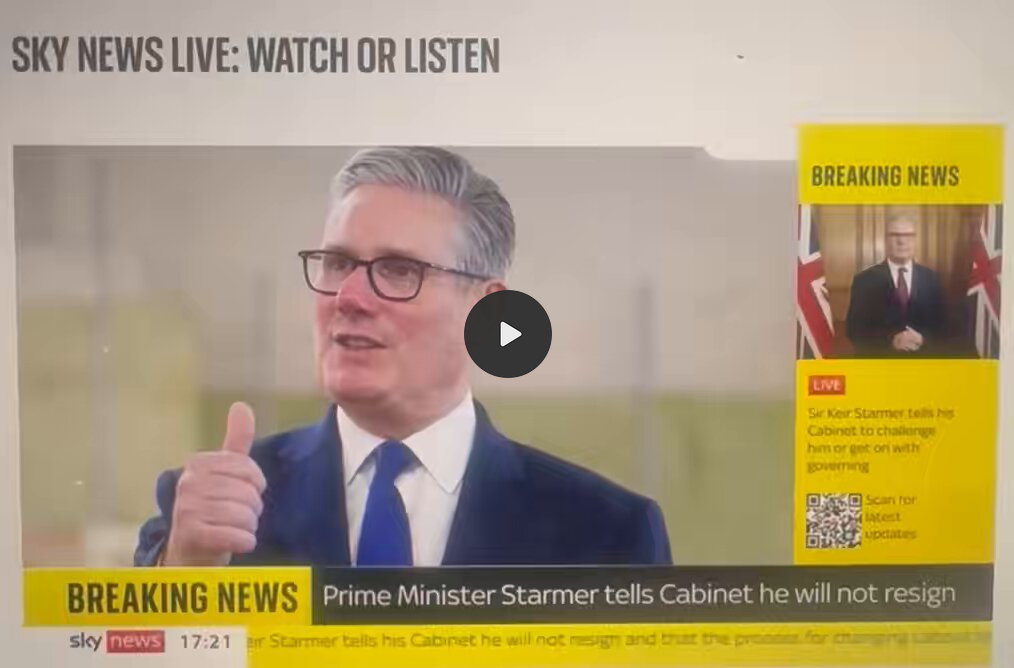
Coates was quickly forced to clarify that the images were, in fact, from the PA. He wasn’t willing to back down, though. Good. As a libertarian, doubting the narrative from powerful institutions is just common sense. Governments are permanently mired in political incentives. They have every reason to curate the truth, and no incentive not to.
And frankly, aside from his use of the loaded phrase “fake news” which was bound to wind everyone up, Coates’ comments were entirely unobjectionable. The point he ultimately made was that viewers should not “take these as concrete proof that [the Prime Minister] is happy.” That much seems obvious. It is simply absurd to think that on that Tuesday of all days - with ministers resigning, journalists camped outside Number 10, and difficult questions being howled at anyone unfortunate enough to wander through that famous black door - Sir Keir Starmer could have been anything other than thoroughly miserable. I certainly would have been.
Yet there he was, beaming in conversation with an apprentice. It was helpful to the Prime Minister and his administration for us to see them, and to accept the story that those photographs implied.
The outrage from the Prime Minister’s supporters was immediate and total. Accusations of bias, Ofcom complaints, the usual mob mobilising to defend the Government against any and all criticism. Of course, most of that happened on social media, so who knows how many complaints Ofcom actually received. Still, Sam Coates was branded a rogue. A bad actor. A man in urgent need of a disciplinary procedure.
All for the capital crime of accurately using the word “propaganda.”
What Propaganda Actually Is
Start with what it isn’t. Propaganda is not an exclusively sinister tool reserved for totalitarian regimes and wartime disinformation campaigns.
The Cambridge Dictionary defines it plainly as “information, ideas, opinions, or images, often only giving one part of an argument, spread with the intention of influencing people’s opinions.” Merriam-Webster is blunter still: “ideas, facts, or allegations spread deliberately to further one’s cause.” The Oxford Learner’s Dictionary adds that it may involve statements that “present only one side of an argument” to “gain support for a political leader,” stating that propaganda may be false but need not be.
Notice what every one of these definitions omits: any requirement that the information be false, that the government be authoritarian, or that the intent be malevolent. Propaganda simply means curated messaging designed to shape perception. By that entirely mainstream definition, a flattering photograph of the Prime Minister at a Technical College, released via the PA from a visit conducted as an official engagement of his own administration, must be propaganda. It would be dishonest to classify it as anything else. That the photographs were distributed by the PA rather than directly by Number 10 is beside the point - propaganda is defined by its intent and effect, not by who presses send.
The Discomfort Is the Point
The issue was never whether the word was accurate. It’s the implication that makes people flinch. That discomfort is both important and entirely by design. We have been culturally conditioned to associate propaganda with the tactics of the enemy: Soviet posters, Nazi rallies, North Korean pageantry. To apply the word to an oddly deployed photograph of Keir Starmer at a routine visit is to puncture a very convenient myth.
Deploying that word about something as mundane as a nice picture on a bad news day was, in that sense, a genuine public service. The connotations were uncomfortable precisely because they were apt. Democratic governments across the world manage information daily, and in doing so they quietly shape our understanding of reality. Calling it out isn’t bias, it is just what journalists are supposed to do.
We extend enormous latitude to governments we like. Simultaneously, we scrutinise the messaging of those we distrust with forensic intensity while passively absorbing the same techniques from our preferred side. The shock at accusing this Government of propaganda is itself evidence of how successfully that management of perception operates.
The lesson from this event is not that we shouldn't accuse democratic governments of spreading propaganda. It's that we should be actively prepared to take a sceptical view of any information powerful institutions give us.
A Word of Thanks
So yes: even nice, democratic governments curate information to sway audiences. In the social media age, it is part of the essential infrastructure of governance. Every government has a comms operation. Every image is released for a reason. The question is never whether this is happening. The question is whether the public is willing enough to notice.
Cheers, Sam Coates, for making more people notice.
I am only sorry so many responded by claiming they had filed Ofcom complaints. The irony is almost too much to bear - yet another attempt at information control, deployed in fury at someone for simply naming information control for what it is.
Liam Noble Shearer is an ex-Parliamentary aide and the Operations Manager for Fighting for a Free Future.