


I welcomed Dr David Starkey onto the Free Future Podcast last week, expecting direct and consequential views, well-founded on historical evidence. We were not disappointed. It was one of his best interviews yet, viewers have told me.
My first question? “Why should the normal person care about the constitution?”
“Unless it is sorted out, nothing else will happen.”
We found David’s arguments captivating, with enough good material for two episodes. As expected, there were areas where I could not have agreed more and some areas where I have differences of emphasis and substance.
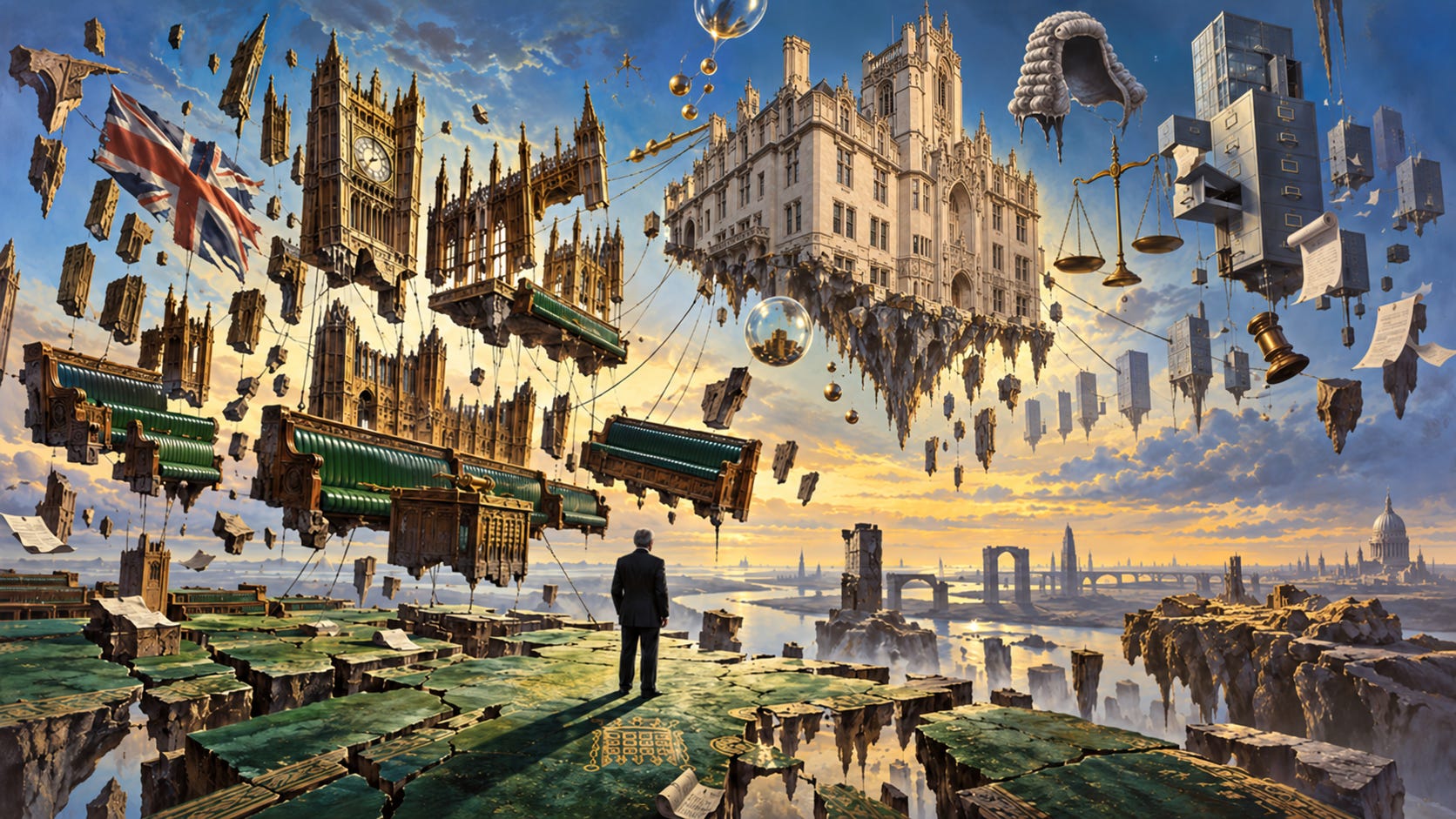
Starting with where we agreed: I believe that David’s theory of British decline is pretty much spot-on. For the uninitiated, Dr Starkey is the man most responsible for popularising the theory that so much of where British governments have failed over the last twenty or so years is the direct result of the constitutional changes, or vandalism, of Tony Blair. For Starkey, the quangocracy that Blair created through the adoption of the Human Rights Act, the creation of the Supreme Court and the Climate Change Committee, as well as a host of other radical constitutional innovations, has stripped power away from Parliament, the democratic decision-making body in the country, and from ministers.
I saw this first-hand as a Member of Parliament for fourteen years in the aftermath of the Blair Settlement. When I was first elected in 2010, I was concerned that too much power had been taken from MPs and ministers, but I had not appreciated the scale of it nor the extent to which ministers would be bound and unable to escape their bonds. In this paper for Net Zero Watch, I explore these issues and the threat to liberty and democracy from the institutions of Net Zero. The situation is not pretty.
Over many years, through the growing adoption of secondary legislation and the empowering of “independent” institutions, the House of Commons has been transformed into something resembling a Potemkin parliament. Check my work on this with the Hansard Society. It is a phenomenon railed against by Hayek in The Road to Serfdom: I believe he foresaw it would advance so far.
As we listened, the team and I were left with the impression that if someone seriously wishes to create change in our country today, then they might be better off becoming a judge, not an MP or minister. Vital as good judges are, that can’t be right, and it must change.
I winced a little over the discussion of rights. David accused me of adopting the language of rights, and it is true: I do believe in freedoms from oppression, whether by the state or other people. Those are so-called “negative rights”. I too object to positive rights, or entitlements. The key test is whether a “right” is universal and reciprocal: if it is, then it is probably allowable, but if it implies a cost to someone else, it isn’t.
For example, consider the much maligned European Convention on Human Rights:
Everyone’s right to life shall be protected by law.
No one shall be subjected to torture or to inhuman or degrading treatment or punishment.
No one shall be held in slavery or servitude.
No one shall be required to perform forced or compulsory labour.
Everyone has the right to liberty and security of person. No one shall be deprived of his liberty save in the following cases and in accordance with a procedure prescribed by law: (a) the lawful detention of a person after conviction by a
competent court; [etc]
[…] everyone is entitled to a fair and public hearing within a reasonable time by an independent and impartial tribunal established by law.
No one shall be held guilty of any criminal offence on account of any act or omission which did not constitute a criminal offence under national or international law at the time when it was committed.
Everyone has the right to respect for his private and family life, his home and his correspondence.
Everyone has the right to freedom of thought, conscience and religion […].
Everyone has the right to freedom of expression.
Everyone has the right to freedom of peaceful assembly and to freedom of association with others, including the right to form and to join trade unions for the protection of his interests.
These are reasonable rights which everyone can enjoy universally and reciprocally without imposing costs on others. I commend the text to you. It is a very great pity that the jurisprudence of the Court – the body of its decisions over time – has established rights and restraints on government policy which we now cannot tolerate.
To put it another way: if you think everyone’s right to life need not be protected by law, or that torture and slavery are fine alongside arbitrary detention and secret justice, or that people’s privacy need not be respected by the state, then the Fighting for a Free Future project is probably not for you…
I think the truth is that rights do matter, in the sense of freedoms from the abuses and oppressions which have blighted even Europe in living memory under the various doctrines of state collectivism and totalitarianism. To reject all rights has historically been extremely dangerous, which is why I tested David on that point, especially in relation to minorities. If people are doing no harm, let them alone.
Maybe the issue is that ultimately David is a conservative, or perhaps paleo-conservative, whereas my views are classical liberal to libertarian. This is the range of debate the country needs: whether merely to avoid too much change or to drive decisively in the direction of freedom consistent with our norms and traditions. That was the Hayekian direction: I commend to you “Individualism: True and False” in his collected essays Individualism and Economic Order.
Dr David Starkey makes a compelling, and I think correct, case that we must have a constitutional restoration which overthrows much of the Blair settlement if there is to be any chance of placing this country on the path to a future which is prosperous, happy and free for the vast majority within it. But let’s not forget that successful democracies and civilisations protect everyone’s rights to be free from oppression and tyranny, including minorities where they are doing no harm.
To learn more, download the short book by Nigel Ashford, Principles for a Free Society, here. Enjoy our interview with Dr David Starkey here.