


To the uninformed “wet”, the Scandinavian social democracies are utopian ideals. In launching his 2016 presidential campaign, Bernie Sanders justified his attacks on the billionaire class by pointing to the Scandinavian model. In his telling, Scandinavia represents a humane alternative to “exploitative” American capitalism — a society where taxation functions as a social dividend.
This perception is commonly held, but wrong. Sweden, for example, has not been meaningfully socialist since the 1980s — coincidentally the period when Sanders was touring the globe in search of the utopia he so often invokes.
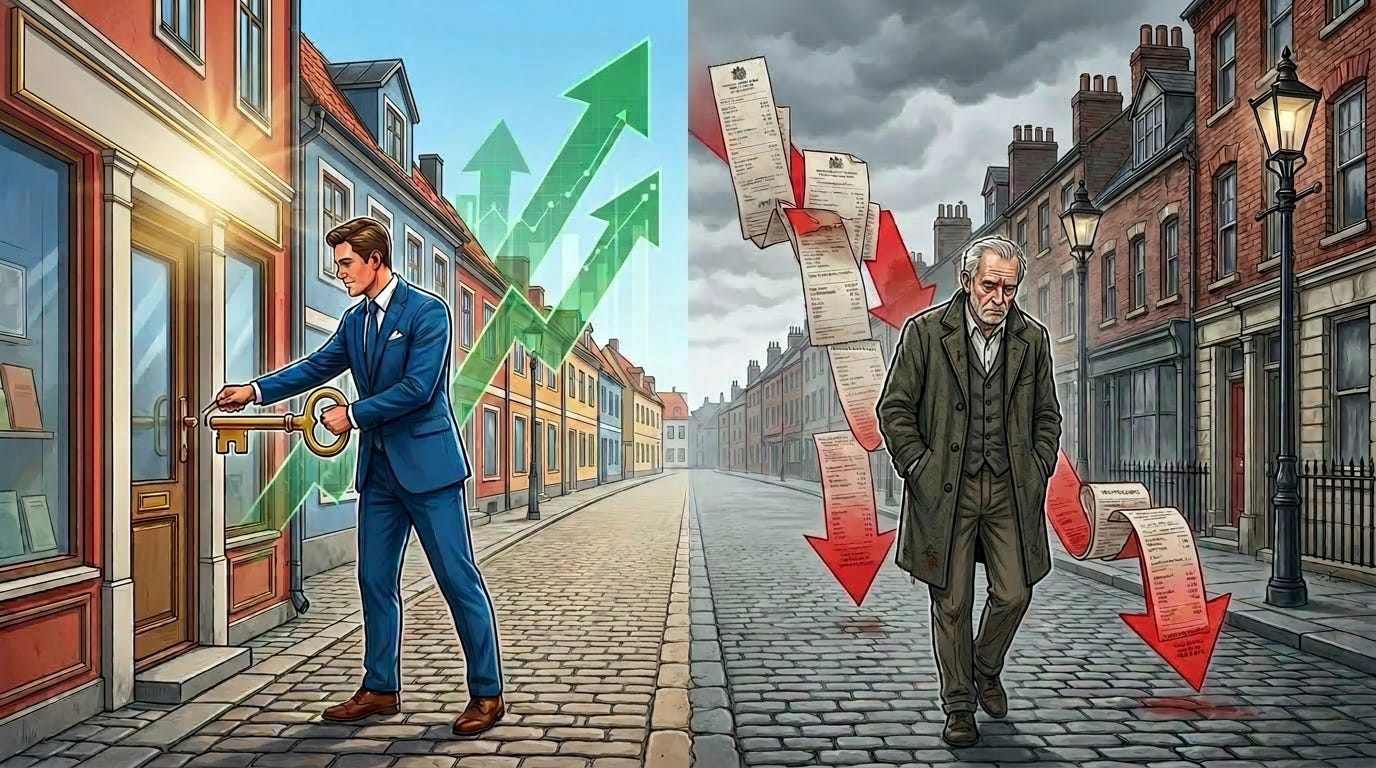
Instead, Sweden — the largest Scandinavian economy — is today ranked 11th on the Heritage Foundation’s Index of Economic Freedom, with Norway 8th and Denmark 7th. The economic freedom Swedes enjoy today is newfound and in stark contrast to the late 1970s and early 1980s, a period in which Sweden found itself in a profound economic hole. Its tax system became notoriously punitive. Inheritance and gift taxes reached top rates of 70 per cent, stifling capital formation and driving some of Sweden’s most successful entrepreneurs abroad. IKEA founder Ingvar Kamprad left Sweden in 1973, citing precisely this confiscatory environment, and remained in tax exile for decades.
The system’s absurdity reached its apex in 1976, when the celebrated children’s author Astrid Lindgren — the creative mind behind Pippi Longstocking and Sweden’s equivalent to Beatrix Potter — faced an effective marginal tax rate of 102 per cent. In protest Lindgren penned the satirical story Pomperipossa in Monismania, exposing a system in which the state could claim more than an individual earned. In doing so, she helped shift the Overton Window decisively in favour of a lower-tax, pro-enterprise model.
Reform followed. Between 1979 and 1992, Sweden’s peak marginal tax rate fell from 87 per cent to 51 per cent. In 2004, a Social Democratic government abolished inheritance tax, and in 2007, the wealth tax was scrapped. Both were widely acknowledged to be economically destructive, administratively burdensome, and ultimately counterproductive.
By contrast, the UK appears to be moving in the opposite direction. An increasing number of estates are being pulled under the umbrella of inheritance tax via fiscal drag, as the £325,000 threshold has remained frozen since 2009. At the same time, calls for a wealth tax are no longer fringe, but are steadily entering mainstream political discourse.
Sweden experimented with these redistributive taxes and chose to embrace liberalisation instead. Socialism had actively undermined Sweden’s prosperity, and in response, Sweden deregulated key sectors and reduced corporate taxes to foster a highly competitive environment for business formation and capital accumulation.
The result was a remarkable turnaround. Sweden transformed itself from an overtaxed economy stifled by stagflation into one of Europe’s most dynamic hubs for wealth creation and retention. It should be noted that this achievement was also realised against a backdrop of fiscal sustainability. In 2025, Sweden’s debt-to-GDP ratio registered at a meagre 34.2 per cent.
The central irony of the so-called “Scandinavian model” is that, in Sweden’s case, the prosperity it delivered can been attributed, not to socialism, but to its dismantling.
Indeed, modern Sweden ranks 11th globally not only for economic freedom, but also for wealth inequality. Sandwiched between Yemen and Oman, above oligarchical Russia, and far beyond the UK, wealth inequality in Sweden is among the “worst” in the world. This should not be surprising. A country that rewards entrepreneurship and encourages capital accumulation will inevitably generate disparities in wealth. Inequality is naturally not something to be sought after, but it is the lesser evil compared to an overarching state that seeks to artificially reduce it. The relevant question is not whether inequality exists, but whether prosperity is rising — and in Sweden, it is.
Looking to the present, Sweden’s centre-right government is among the most effective in the world. Its policies bear little resemblance to the interventionism increasingly seen in Britain. Sweden has strengthened its respective “non-dom” regime, doubled citizens’ tax-free savings allowance, and further reduced marginal rates on higher earners. These are not the policies of a socialist state.
As a result, Sweden now has its lowest tax burden relative to GDP since 1975. Britons, by contrast, now face their highest tax burden on record.
The lesson is clear. From Sweden’s high wealth inequality to Norway’s reliance on oil and gas, and Denmark’s hardline immigration policies, the Nordic countries are not paragons of left-wing idealism and they should not be mischaracterised as such. Instead, they often act as examples of how economic freedom can underpin prosperity — even within a broadly “progressive” social framework. Being “progressive” and economically liberal is therefore not mutually exclusive — and that is a lesson the British Government should learn.
Viggo Terling is Research Associate at the Adam Smith Institute and Board Member of the London association of the Swedish Moderates, the largest party in the governing Swedish coalition.
