


In an economy hindered by weak long-term growth, limited consumer choice, and dissatisfaction with essential services, centre-left politicians present nationalisation as a credible alternative. They argue that public ownership makes essential industries more accountable to workers and consumers.
They are wrong. Nationalisation restricts economic liberty more than it strengthens accountability. If an employer mistreats its workers, workers can call on the state to act as an independent referee by mediating disputes between the two sides. However, this separation is weakened when the state is the employer; workers must appeal to the same institution they are bargaining with for protection. Where competition exists, dissatisfied consumers can take their business elsewhere. Where nationalisation creates an exclusive state provider, that exit power disappears.
A genuinely free market requires competition and limits on concentrated power, whether that power belongs to a corporation, union, or government.
Collective Self-Defence Part 1: Trade Unions in a Free Economy

Many free-market thinkers see trade unions as the enemies of the market economy. That scepticism is understandable, since unions have often been closely aligned with the Labour Party and, at their wo…
Nationalisation changes ownership, not power
While nationalisation changes an industry’s ownership, it does not necessarily reduce a single provider’s power. Neither a private monopoly nor a state monopoly provides consumers with meaningful choice. Where nationalisation establishes an exclusive public provider, it replaces private economic control with political control. This makes little difference; it doesn’t matter whether an industry is publicly or privately owned if there is no competition in the market. The important question is not who owns a company, but what mechanisms hold an owner accountable and ensure services run efficiently.
While nationalisation is arguably more accountable, as the Prime Minister can sack an underperforming minister, consumers do not take part in daily decisions or operations; they simply want a reliable service. Elections concern more than the workings of a single industry; voters’ issues range from healthcare and immigration to defence and taxation, to name a few. So voters cannot express a separate judgement about one provider. Otherwise, a consumer may rely on their elected representative to take it up in Parliament. However, a free market where genuine competition exists can discipline a poorly performing business through lost customers and the consequent loss of revenue; arguably the strongest message a dissatisfied consumer can send.
A nationalised business may not be held accountable if ministers see it as an industry too politically important to fail. Accountability becomes blurred: managers and ministers blame each other, while inefficiencies continue, costs surge, and the taxpayer pays. Nationalisation does not effectively improve service quality unless competition and clear financial discipline reinforce it.
Engulfed by severe financial difficulty, the government took over British Leyland in 1975. Politically, the company was viewed as too big to fail. This made it more than a company; it became a political object, prompting the government to pump more financial support into it. By December 1980, ministers reported that approximately £1.075 billion in public funding had been made available since the rescue. Consequently, this spending raised questions about the government’s financial decisions, particularly whether they were driven by commercial or electoral interests.
Nationalisation leads to weaker financial discipline and blurred accountability, as ministers’ decision-making is influenced more by political interests and objectives than by a responsibility to balance the books and protect the value of the acquisition for taxpayers.
The state cannot be both employer and referee
In a free, competitive economy, employers and unions negotiate wages and working conditions directly, with the state serving as a referee to maintain dialogue between employers and workers. The state uses its power to enable either side to enforce contracts through courts or tribunals when necessary. This separation is important because it prevents the state from becoming the decision-maker in disputes in which it has no direct interest. Nationalisation compromises this separation by giving government a financial and political interest in the settlement.
Under nationalisation, the state’s relationship with workers becomes paradoxical. The government becomes the sole authority, determining the legality of contracts, salaries, and the settlement. This leaves unions without an independent referee to ensure that neither side oversteps its authority, while the state now determines where power lies in negotiations. Ministers become less independent in negotiating settlements as they have greater power to shape negotiations in favour of the government’s political and financial objectives.
The 2022 rail dispute demonstrated this tension before Britain’s operators were fully brought into public ownership. The Department for Transport already controlled substantial funding and rail policy, giving it the power to refuse to fund a settlement unless accompanied by workforce reforms. As the operators led the negotiations, the ministers controlled funding and rail policy, effectively rendering the operators powerless; they could only agree to a settlement the state would allow them to offer. This matters because it clarifies that a mutually agreeable settlement between workers and employers cannot be achieved where the state has any financial or political interest in the dispute.
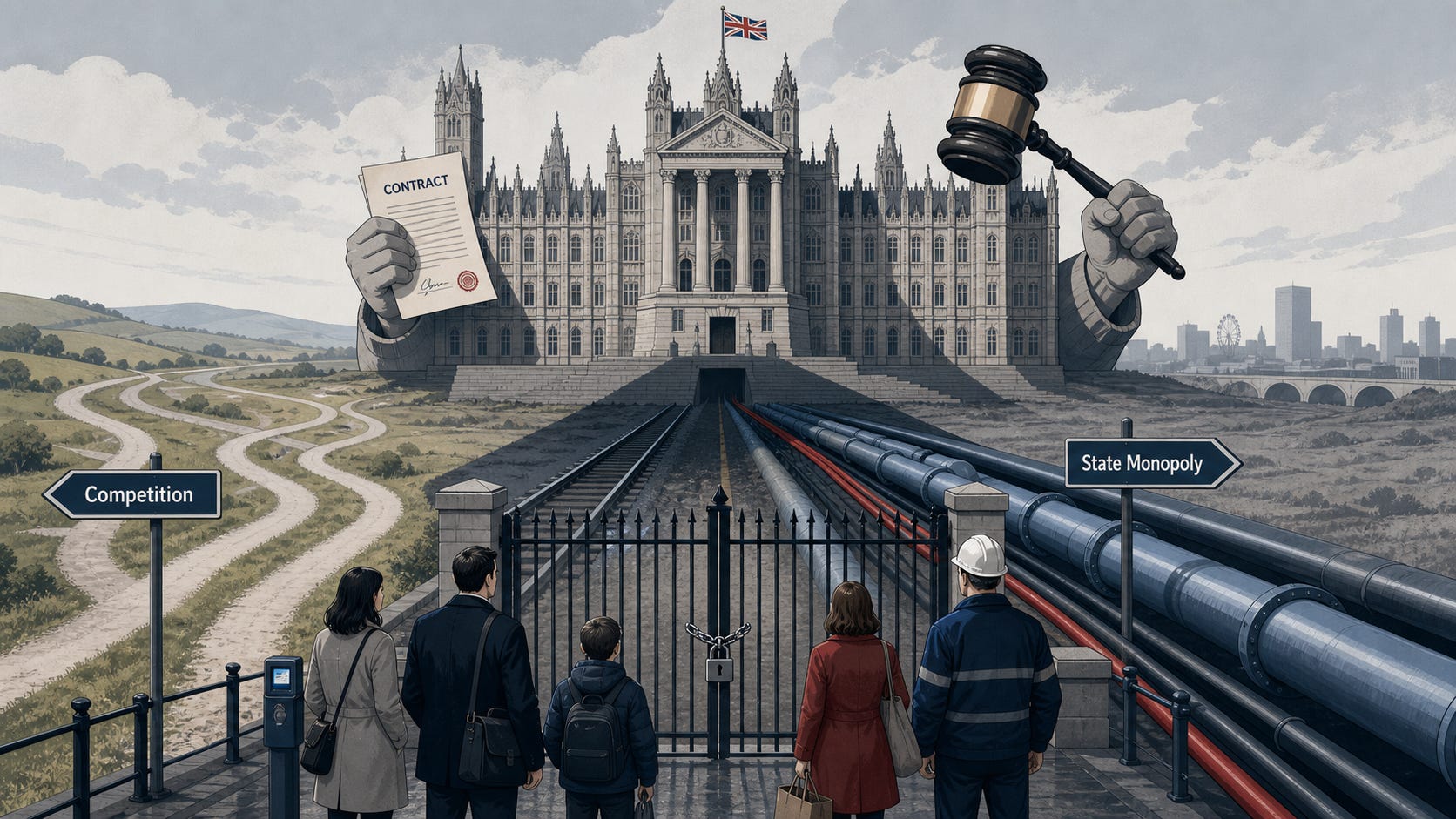
Competition where possible, regulation where necessary
Not every industry can be competitive. Water pipes, electricity grids and railway tracks are geographic monopolies; consumers have no choice over which set of pipes or tracks reaches their home or town. Therefore, an unregulated private monopoly would offer little consumer freedom.
Hayek recognised this, arguing that the state, as an institution separate from the utility company, can regulate a private monopoly because the state’s political interest aligns with consumer interest, whereas a nationalised industry puts the regulator and the regulated under the state’s umbrella. This means the government may then become reluctant to expose mismanagement or inefficiencies, as doing so admits failure in its own decisions and appointees. Along this reasoning, Hayek’s objection was “not state enterprise as such but state monopoly”, as he believed the government could use legal and financial advantages to shelter its provider against competition.
The essential safeguard against monopoly power is independent regulation, not nationalisation. Household consumers of Scottish Water cannot switch providers, so public ownership gives them no direct way of demonstrating dissatisfaction. Instead, they must rely on regulators to scrutinise their prices, investment and performance.
This separation matters because government cannot credibly own a provider and act as its sole regulator. Nationalisation changes who can appoint the board and who bears the financial risk, but it does not restore consumers’ power to take their business elsewhere. Where public ownership is considered necessary, the provider should operate at an arm’s length from ministers and face genuine independent scrutiny. This prevents the same institution from owning, directing, and judging the monopoly.
Unavoidable monopolies do not have to be state monopolies
Nationalisation is attractive because it promises to place essential industries under democratic control. However, empowering the state does not equal democratic control; it places consumers further from the decisions being made. By becoming owner, funder, employer, and regulator, the government can influence appointments, funding, objectives, and the legal framework governing scrutiny. This shows that changing a company’s owner does not solve the underlying problem of unaccountable power.
One of the greatest concerns of nationalisation is the paradoxical relationship it creates between the state and workers: shifting the state from referee to employer means workers must bargain with the institution that sets the rules and controls the finances.
Public ownership may sometimes be justified where monopoly is unavoidable, and independent regulation cannot adequately protect consumer interests. But even then, Hayek’s warning remains relevant: state enterprise must not automatically become a state monopoly.
The alternative to nationalisation is not an unregulated private monopoly. Competition should be allowed where it is possible in industries like train operators and energy providers, as consumer choice means that companies base their commercial decisions around the consumer’s interests, rather than a state’s political objectives. Unavoidable monopolies do not have to be state monopolies; ministers should decentralise financial and political power away from their departments so they can act and make decisions without direct political or financial interests. Within a free society, the state must protect economic liberty by enforcing the rules, rather than owning the businesses subject to them.
Harry Curtis is a student at the University of Warwick, reading politics and international relations. He has worked and run campaigns for the Conservative Party, including during the 2024 General Election.

Great article Harry. Good though it is and necessary, it is annoying to say the least that you have to write it at all.
We thought that this argument had been fought over, won and put to bed in the 1970/80's.
Yet here we are again. With a new generation I suppose who have been brought up to believe that state intervention is the answer to every problem.
With fondness I think back to the days when if you wanted a new gas cooker you had to apply to the gas board and they would come and install it in 6 months time (choice of white or beige). The GPO would, if you were lucky, install you with a phone line within 12 months. And of course British Rail was the envy of the world!
All the best Harry and keep up the fight!