


Yesterday, Fighting for a Free Future was delighted to announce Voices for Freedom with our first two voices: former SpAd Eve Lugg and political commentator and broadcaster Albie Amankona. Each Voice for Freedom will be an advocate for liberty, fighting for freedom and free markets. On the last Thursday of every month, Eve Lugg will bring her insights and analysis of the latest in Westminster and British politics to our subscribers at Voices for a Free Future.

The Home Secretary, Shabana Mahmood, insists that she is restoring order. But the direction of travel under Labour looks less like reform and more like a quiet expansion of the surveillance state, increasingly subjecting law-abiding citizens to scrutiny while allowing criminals convicted of serious crimes to walk free and migrant gangs to remain notably un-smashed.
Of course, the growth of the surveillance state did not begin here. The Labour government recently tried to resurrect Digital ID, allegedly to help tackle illegal immigration. The Chief Secretary to the Prime Minister, Darren Jones, informed us that it could “become the bedrock of the state”. The backlash spooked the government into yet another u-turn but the public ought to be alert - they are trying again.
Last weekend, Home Secretary Shabana Mahmood was questioned on BBC’s Laura Kuenssberg about remarks she has made describing her “dream” that the eyes of the state could be on all people at all times. She was forced to clarify that these comments were made in the context of the impending collapse of the country’s prison system, and that the government has introduced changes to sentencing including community sentences, such as tagging, so if a criminal is serving a sentence outside of prison, the eyes of the state can be on that person if they’re serving their sentence of prison, as well as within.
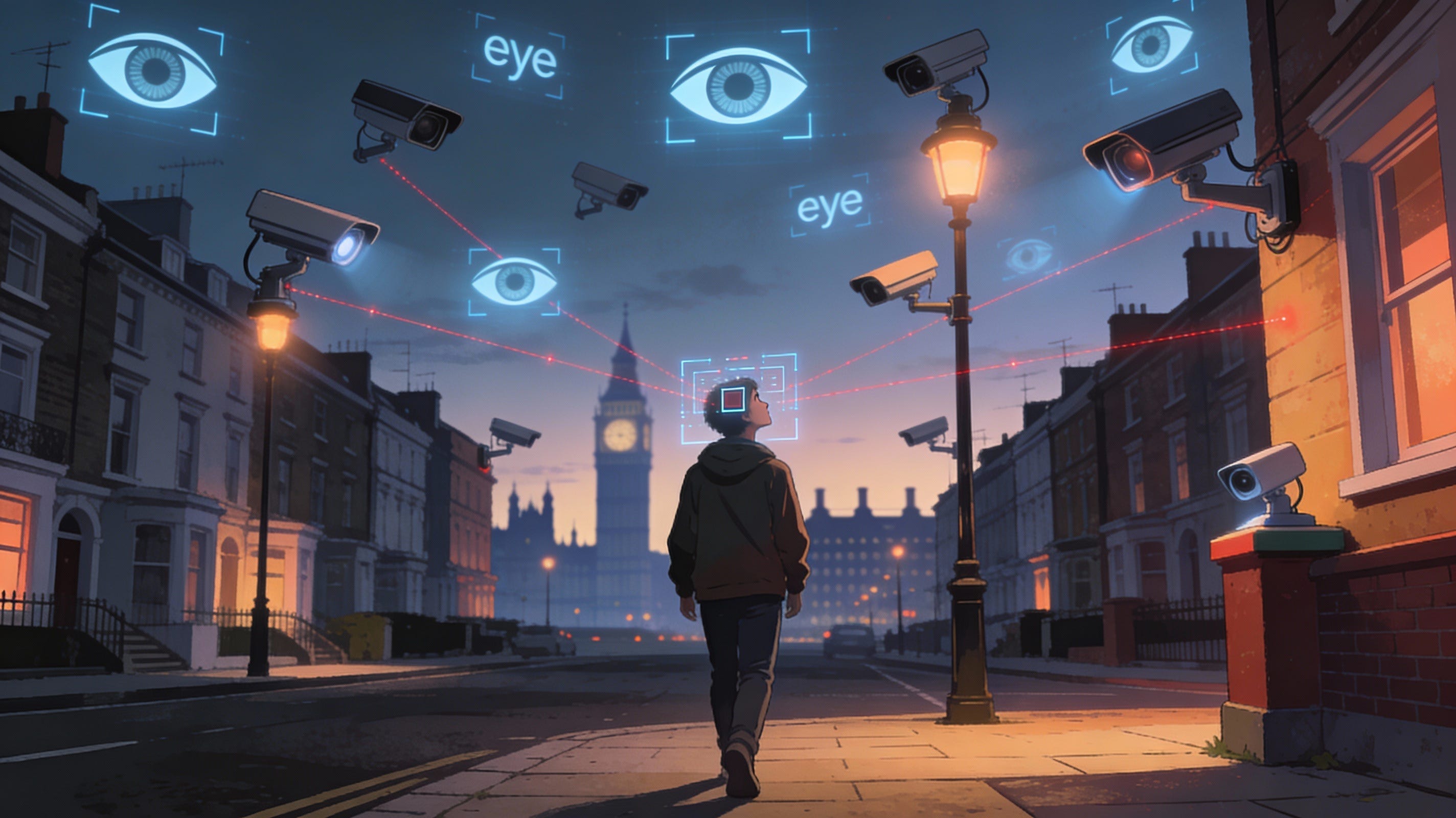
She did, however, go on to say that tech and AI, such as facial recognition, have the power to unlock effective punishment and transform the role of policing. More on that soon, apparently.
Few would dispute that the criminal justice system is under serious pressure. Many voters support tougher sentencing and credible punishment. But the question is not whether authority is needed; it is how it is exercised, and against whom.
What strikes me is how readily technological surveillance is now treated as the default solution, and enforced indiscriminately. Monitoring, data collection and real-time analysis are framed as efficiency gains rather than expansions of power. We are repeatedly reassured that this is not about surveillance - even as the outcome is precisely the continuous observation, recording and assessment of citizens’ behaviour.
Britain already possesses extensive legal and policing powers. The problem is not the absence of authority, but the failure to enforce existing rules consistently and effectively. Yet rather than fixing borders, courts or prisons, the state appears increasingly tempted to compensate by watching more people more closely.
Surveillance states don’t drop from the sky. They emerge alongside seemingly reasonable excuses that do not ring alarm bells for the ordinary citizen, piggybacking on genuine issues that are of concern to the public. In this case, with breathtaking cynicism, labour are using people’s justified concerns about immigration and the rise in crime to impose what Mahmood unironically describes as a panopticon state upon law-abiding citizens, whilst - typically for this government - doing nothing to address the root cause.
And it is worth asking who bears the cost. The surveillance state is born out of laziness at best, a desire to control at worst. It is difficult to fight crime, and it is difficult to address illegal immigration. Far easier to snoop upon those who are not breaking the law in the first place. Illegal immigration is not solved by monitoring the law-abiding citizens. Policing failure is not corrected by treating the public as data points. Yet it is the compliant majority who are asked to accept digital identification, facial recognition, and constant oversight, often with little clarity about where these powers stop, how long they last, or how misuse will be prevented.
Ministers will point to safeguards such as Part 3 of the Data Protection Act 2018, which places obligations on law enforcement to ensure data processing is necessary, proportionate, for a specific purpose and not excessive. But anyone familiar with how these regimes operate knows that broad definitions and operational discretion create ample room for mission creep, especially once expansive systems are already in place.
Which begs the question - Quis custodiet, ipsos custodes?
It is often said that those who are willing to give up a little freedom for a little safety will end up neither free nor safe. Under Shabana Mahmood’s system, the citizen is not safe from crime, and they are not free from the state. This is the definition of totalitarianism.
Eve Lugg is a Voice for Freedom with Fighting for a Free Future. Eve Lugg served as Special Adviser (SpAd) in the Cabinet Office and brings with her experience in policy and comms, as well as knowledge of how Whitehall really operates.

As you've identified, there is a compliant public allowing all this to progress.
I think it's accurate to say that both the Labour government and Conservative party are keen on Digital ID. The former using the excuse of immigration control and employment checks and the latter in their quest to ban social media for under 16's. So neither believes in liberty.