


With the state evermore keen to wrap its oily tentacles around every component of our lives, there is much to cause freedom-loving people to recoil. Yet perhaps one of the most disgraceful overreaches is so habitually shoved in our faces that its sheer volume has immunised us all to the outrage of it.
We are talking, of course, about those threatening TV licensing letters.
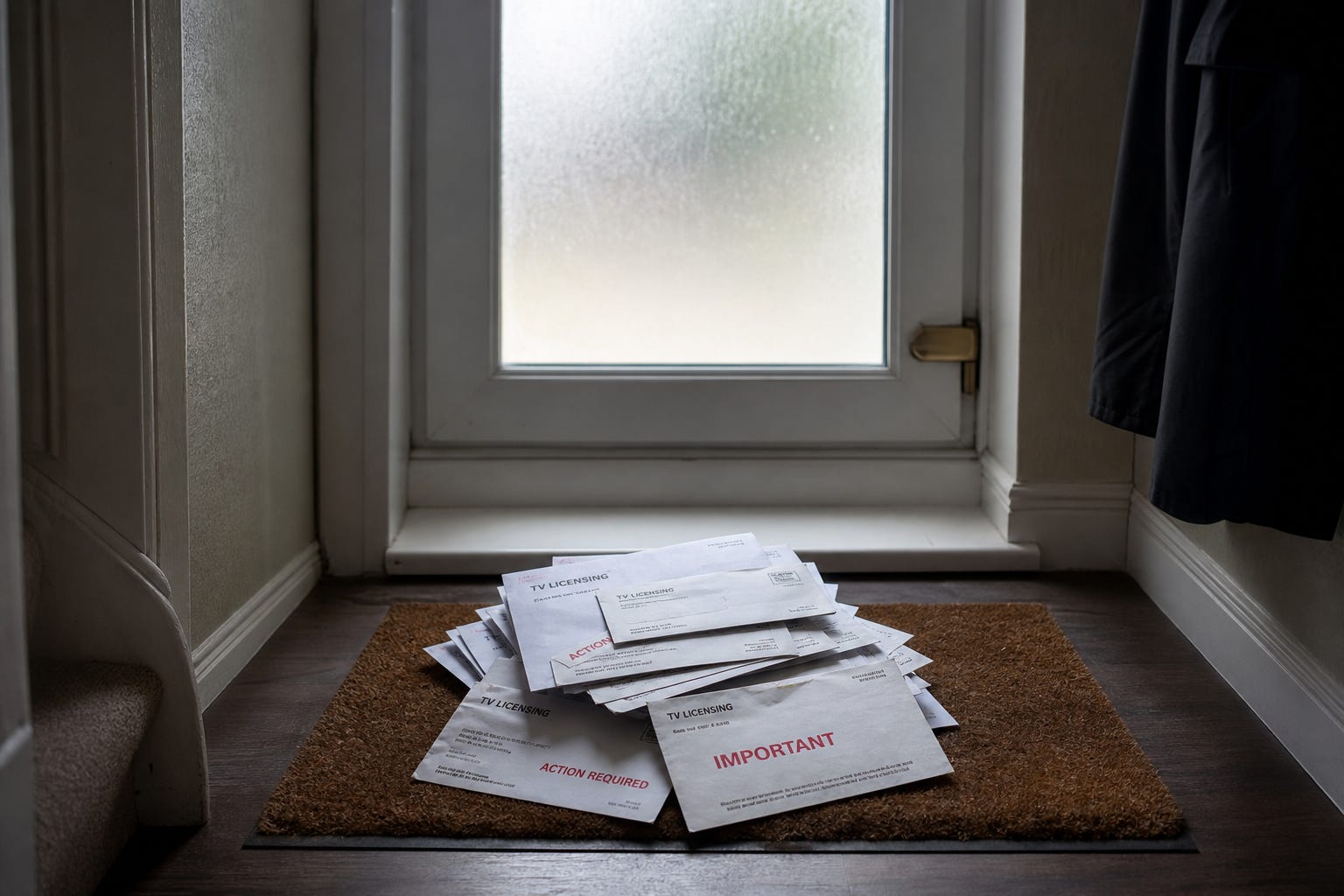
The issue is not that the TV licence isn’t really a proper licence at all. It is, at its core, a hypothecated tax: £180 per year, compelled by law, administered by a corporation with a Royal Charter, and enforced through the criminal courts. But we should not get too exercised about that in itself. We have an awful lot of “fees” and “charges” which exist precisely so that the state can extract more money from us without having the honesty to call it a tax. Stealth is, after all, the state’s preferred fiscal aesthetic.
No: what makes TV licence enforcement most morally affronting is not that it is a tax in disguise. It is the manner of its enforcement - a sustained campaign of postal intimidation so thorough, so relentless, and so magnificently baroque in its menace that it would make even HMRC blush.
The Letters
TV Licensing is administered through Capita, a private contractor, commissioned by the BBC, doing the state’s dirty work at arm’s length. This arrangement is worth pausing on. Parliament created the criminal offence, under Section 363 of the Communications Act 2003. That is where the legal menace behind every letter originates, and it belongs to the state. In 2015, the government struck a deal with the BBC, quietly offloading the cost of free licences for the over-75s onto the Corporation rather than funding it from general taxation - a decision whose downstream consequences now land, in the form of threatening letters sent to some of the most vulnerable people in the country. The BBC then contracted Capita to maximise compliance. Capita writes the letters. Each party in the chain can, when challenged, point to someone else. It is outsourced unpleasantness, structured for deniability.
Capita’s strategy is, in a bleak and purely technical sense, quite effective. Any address without a registered licence receives a seemingly endless barrage of correspondence. That is, on its face, a perfectly reasonable first step. If it were a gentle inquiry - have you, perchance, been watching live television without a licence? - it would be fine. Helpful, even.
But that is not quite how it works.
I am afraid to report that the letters have a tone. One missive in late 2024, “mistakenly” delivered around Christmastime to pensioners up and down the country, contained the following seasonal greeting:
“Will you be in on December 25? As there’s no record of a TV licence at your address, you should expect a visit from an enforcement officer. It may be on December 25 or another day.”
TV Licensing later apologised and confirmed there would, of course, be no visits on Christmas Day - which rather raises the question of what the non-mistaken letters are for.
Dennis Reed of Silver Voices described the campaign as “thuggish” behaviour: “an underhanded, desperate attempt to pressure older and vulnerable people into paying.” He is right. Though perhaps he undersells it. It would be bad enough were it merely thuggery, but it is Christmas thuggery. Santa Claus brings gifts. The enforcement officer brings the full cold anxiety of implied prosecution, even if you have done absolutely nothing wrong.
What makes the whole operation especially impressive, in a depressing sort of way, is that these letters are almost entirely a bluff. The wording is carefully crafted to intimidate through vagueness: “legal investigation,” “final warning,” “a visit has been scheduled.” In reality, these are mass-produced, automated communications dispatched to thousands of addresses regardless of guilt, yet designed to suggest specific wrongdoing. The visiting officers, if they do actually turn up, have no more legal authority than an ordinary member of the public. They cannot enter your home without your permission or a court warrant. Most people I know have received at least one of these letters; I can’t think of one who has ever had to answer the door to an investigator. If one did arrive on Christmas Day, you would be more likely to invite them in for a festive glass out of sympathy than to let them inspect your living room.
Who is Actually Being Targeted?
Here is where the joke, which already wasn’t very funny, stops being a joke at all.
A modern household can sustain an entirely full and frankly rather luxurious entertainment diet - Netflix, Disney+, Amazon Prime, Apple TV+, on-demand YouTube, a games console - without a single penny of it being any of the BBC’s business. A licence is legally required only if you watch live broadcast television on any platform, or use BBC iPlayer. Given that live TV viewership has declined sharply for years, the blanket presumption of guilt baked into these letters is not merely morally lazy. A significant proportion of recipients may be doing nothing wrong at all. They are being treated as suspected criminals for the crime of not having a licence - whether they need one or not.
And the people most effectively frightened by letters invoking criminal prosecution, enforcement officers, and the spectre of a Christmas Day visit are not, as a general rule, those with the most to fear from prosecution. They are not the savvy thirty‑year‑olds who know they should be paying and choose not to. Those people may well be breaking the law and should be made to pay, but they are also the least likely to lose sleep over an intimidating letter.
Those who are left to suffer are the 84-year-old woman who told GB News she received many “nasty letters” warning her to pay or face enforcement officers, and who - confronted with the full typographic menace of red capitals and legal language - genuinely did not know what her rights were. They are the 89-year-old widower who received fifty-three such letters. One begins to feel sorry for the postman.
The television licence is not like income tax, deducted at source and invisible in the mechanics of daily life. It is not like council tax, which at least theoretically funds something in the street where you live. It is an opt-in tax in all but name - legally mandatory only when you consume a specific category of content - administered by a private contractor incentivised to maximise compliance, enforced through the criminal courts, and operated on the assumption that the most efficient way to collect money is to frighten people into paying.
The law is the law. Those who genuinely owe the licence fee should pay it. The argument is not about who owes what. It is about how a state that considers itself civilised chooses to collect it.
We have constructed a method of collection that deliberately exploits the credulity, anxiety, and lack of technical sophistication of the most vulnerable members of our society to achieve compliance levels that the honest administration of the law would not achieve on its own.
The letters are not truthful about the legal powers of enforcement officers. They are not calibrated to distinguish between genuine evaders and people with a Netflix subscription and no aerial. They are not designed with the welfare of a dementia patient, a blind centenarian, or a recently bereaved widower in mind.
They are designed to frighten people into paying for something they don’t need to pay for. And that - whatever one thinks of the BBC, the merits of public broadcasting, or the appropriate level of the licence fee - is a shameful component of our tax settlement.
Hi Liam. I didn't realise the extent to which this harassment was taking place. Especially as you point out, there are many households nowadays who quite legitimately do not require a licence.
It's an absolute disgrace & awful to think of the elderly and vulnerable being targeted in this way.
Thank you for highlighting the issue.